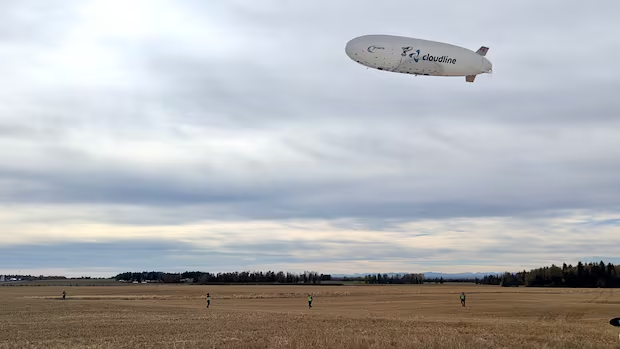
A rare sight in the sky over central Alberta last week turned heads and had people asking: Was that really a 20-metre blimp?
While some may have seen a Goodyear Blimp at a sporting event, it’s not every day you see such a site in rural Alberta.
In this case, it was a solar-powered airship, roughly the size of a school bus, testing a new way to collect aerial survey data near Rocky Mountain House, about 200 kilometres southwest of Edmonton.
A joint crew from Cloudline, a South African aerospace firm that manufactured the airship, and its Canadian operational partner, 3 Points in Space Media, ran flight tests with the airship out of the Rocky Mountain House Airport last week.
“It’s essentially the same as a helium party balloon,” said Sean Adams, founder and CEO of 3 Points in Space Media, as the crew conducted a trial with TC Energy to inspect pipeline corridors in the region.
He noted airship technology actually goes back many years, though they are doing something a little different from the blimps of the past.
“This particular technology, as far as I know, is very new… the application of combining the control systems autonomously with the airship.”

Pre-flight preparation begins as flight crews fill the airship’s white envelope with helium. (Nadeer Hashmi/CBC)
Pre-flight preparation starts with crews filling the envelope with helium and running diagnostic checks while the airship remains tethered. Once cleared, Adams said operators release the aircraft for calibration runs before launching long-distance survey flights.
“We’ve actually just finished flying a 100-kilometre run,” Adams said, noting the airship is classified as a remotely piloted aircraft system with automated flight controls.
He said it’s useful for collecting data in remote areas, such as monitoring pipelines, power lines, and infrastructure. Traditionally, energy companies rely on conventional aircraft or smaller survey drones for this work.

Members of the flight crew work at the Rocky Mountain House Airport, getting the airship ready for takeoff. (Submitted by 3 Points in Space Media)
However, Cloudline’s CEO and founder Spencer Horne, said the airship’s 40-kilogram payload capacity allows it to carry heavier camera and LiDAR sensors over much greater distances than standard drones.
“There are now heavier lift drones that are getting into 10, 20, even 30-kilogram payloads,” he said. “But a very important distinction to make is that…on those aircraft, your maximum payload is happening at your minimum range.”

Once untethered, the airship undergoes short calibration runs over the Rocky Mountain House Airport before heading out on long-distance flights. (Submitted by 3 Points in Space Media)
Still, Adams acknowledged that crewed aircraft could handle a lot more than airships when dealing with severe cold and unpredictable weather.
“Which is one of the prime use cases we’re trying to develop here is to harden it so that we can use it for that,” he said.
In an emailed statement to CBC News, Joe Zhou, vice-president of pipeline integrity at TC Energy, said the research initiative creates the potential to gather multiple types of data in a single flight, adding that the approach is quieter than conventional aircraft.
A modern revival of historic aviation
For Michael Adams, vice-president of research and development at 3 Points in Space Media, operating the airship is an exciting opportunity to modernize an aviation technology that lost momentum in the 1930s following the high-profile disaster of the Hindenburg.
“Airships were designed to carry people across the oceans faster than an ocean liner long before commercial travel in aircraft,” he said.
“It’s unfortunate that 100 years ago it had so much momentum that really got dropped fast because of how technology has developed over the decades.”
To bridge the gap between past and present, Adams attached a small swatch of fabric cut from the envelope of the Graf Zeppelin, a famous airship that completed the first commercial passenger flight across the Atlantic in 1928.

Michael Adams of 3 Points in Space Media holds a swatch of fabric cut from the historical airship Graf Zeppelin’s envelope, sourced from an aviation enthusiast’s collection. (Nadeer Hashmi/CBC)
“I thought it was a good idea to bring this sample and attach it to our payload … just as a celebration of the airship and how amazing the future looks with this new technology married with the old sense of where airships came from,” he said, as he showed the sourced swatch from an aviation enthusiast’s collection.
Local curiosity
For those in the Rocky Mountain House area, seeing an airship created plenty of buzz.
“We’ve never seen that. Actually, I’ve never seen that in my lifetime. And I’m 65,” said Rocky Mountain House Mayor Shane Boniface with a chuckle.
Boniface also got an interesting insight from the town’s communications officer, who said, “we got more hits on Facebook for the pictures she posted of the airship than we did about the tornado that we had.”

Crews completed a 100-kilometre flight run with its airship near Rocky Mountain House and Sundre, Alta. (Submitted by 3 Points in Space Media)
While Cloudline said they operate airships internationally in countries including South Africa, Namibia, and Kenya, such autonomous airships still remain a rare sight in Canadian airspace.
Next up for the flight team is cold-weather testing in Northern Ontario to prepare the aircraft for sub-zero operations and Arctic conditions.