
Open this photo in gallery:
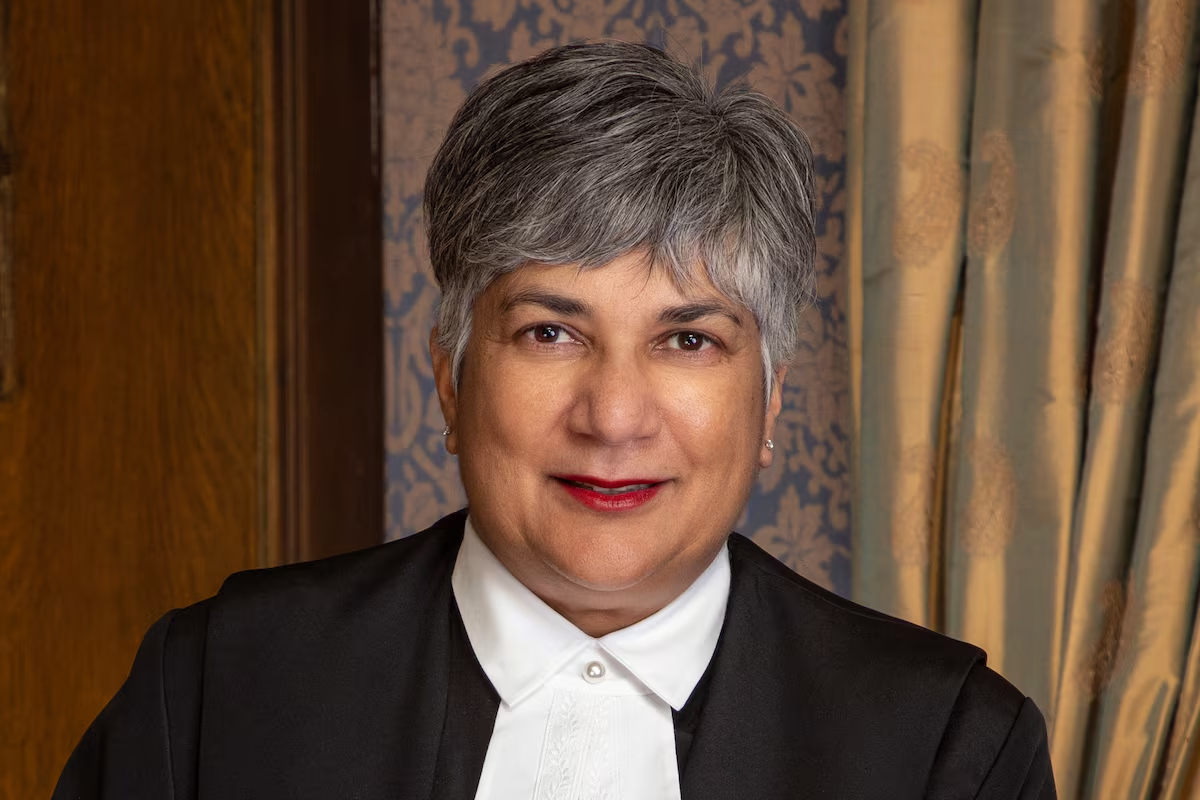
Alberta Chief Justice Ritu Khullar died on Sept. 3 at the age of 62.BRUCE ZINGER/Supplied
One day, after watching The Incredibles, an animated Pixar film about a family of superheroes, Ritu Khullar told her son Samir Reynolds that everyone has a superpower and the trick is deciding what to do with it.
“You can choose to help others, or you can choose to help yourself,” she said.
For her, it was a simple choice. The daughter of immigrants to this country who always identified herself as a proud Canadian first and foremost, she spent her life advocating for others, as a wife and mother, as a lawyer who specialized in areas such as labour and human rights, and as Chief Justice of Alberta and the courts of Appeal of Alberta, the Northwest Territories and Nunavut.
Former Montreal synagogue lead rabbi Leigh Lerner advocated for ‘radical inclusivity’
Chief Justice Khullar, who was appointed to the Alberta Court of Queen’s Bench in March, 2017, promoted to the province’s Court of Appeal the following year and named Chief Justice in November, 2022, died on Sept. 3 after being diagnosed with cancer this year. She was 62 years old.
“She was the rare person who was able to make a massive impact on the lives of many,” her son said at the provincial memorial held for her at the Northern Alberta Jubilee Auditorium in Edmonton. “She always used her superpowers to help others.”
With a moral imperative, Chief Justice Khullar saw the Constitution as a living tree that was constantly growing and changing, and justice itself as the application of law to life.
As a lawyer, this led her to represent clients such as Linda McKay-Panos in a case against Air Canada that revolved around the rights of those who are disabled. Ms. McKay-Panos was morbidly obese and made to pay for a second seat on a flight because her weight was not considered a disability.
Open this photo in gallery:
Complainant Linda McKay-Panos, left, at a Canadian Transportation Agency hearing into whether obesity is a disability and should be accommodated by the transportation industry, with her lawyer Ritu Khullar in Calgary in September, 2001.Larry McDougall/The Canadian Press
In 2008, the Supreme Court rejected an application for permission to appeal a Canadian Transportation Agency ruling that airlines must offer a “one person, one fare” policy to disabled people who require room for an attendant or a wheelchair, or take up more than one seat because of their disability, including some individuals whose obesity was determined to be disabling.
“Ritu was skeptical that disability could be understood in the abstract because it was about individuals,” said Paula Simons, a senator who knew Chief Justice Khullar through their children and interviewed her while a columnist at the Edmonton Journal. “She had a razor-sharp intellect grounded in common sense that helped guide her way.”
She was unafraid of making decisions that went against public opinion, such as one in which she and two colleagues ruled that two accused men’s Charter rights were violated when Canadian border officials searched their cellphones and laptop computers for no specific reason other than a suspicion that something was off; this, even though the officials found pornographic images of children.
In September of last year, she took the entire Alberta Appeal Court bench and northern judges to Nunavut, so they could participate in cultural activities, visit correctional institutions and speak with representatives from local community organizations about their experiences with the justice system. The idea was to sensitize judges to the ways of life and challenges faced by the people affected by the decisions made in courtrooms 2,400 kilometres due south.
In a statement, Alberta Justice Minister Mickey Amery lauded the intellectual rigour and compassionate leadership she brought to her role as Chief Justice. “She worked tirelessly to strengthen the justice system and to advance meaningful access to justice while preserving the independence and integrity of the courts.”
Peter Sankoff, a criminal defence lawyer in Edmonton and law professor at the University of Alberta, called Chief Justice Khullar one of the best listeners he has ever encountered.
“You could feel the sea change with her appointment. She brought a freshness to the court,” he said. “I always had a feeling of real confidence when she was appointed to a hearing. She was genuinely interested the issues, always having done her research beforehand. Whether … I won or lost, I always felt I had a fair hearing before her.”
Lawyer Rory Nott skillfully navigated work and life as a man with quadriplegia
Ritu Khullar was born on May 7, 1964, in Fort Vermilion, Alta., about 660 km north of Edmonton. She was the youngest of Jitendra and Pritam Khullar’s three daughters. Her father was Hindu and her mother, Sikh, both immigrants from India who arrived in the early 1960s to build a new life in a frigid climate.
Her parents were teachers, working first in a Mennonite community southeast of Fort Vermilion called La Crête, then in Jamaica and finally in Morinville, a suburb just north of Edmonton, and they instilled in young Ritu and her sisters the importance of curiosity, reading and recognizing that there was always more to learn. They also made sure their children understood the importance of community and contributing to the country that had given them a home.
Much of Ritu’s childhood was spent in Morinville, at the time a rural community with a large francophone population. While living there, she made friends who would last her lifetime and developed a love of places such as Jasper National Park, to which she would return again and again throughout her life.
In 1981, she graduated from Old Scona Academic, a public college-preparatory school in Edmonton’s Old Strathcona neighbourhood, then went on to do a bachelor’s in political science at the University of Alberta. Upon graduation, she worked in the province’s department of federal and intergovernmental relations, where she met Robert Reynolds, whom she refused to go out with until one of them quit to study or work somewhere else.
The couple had their first date when Mr. Reynolds decided in 1987 to go to law school. A little over a year later, when she was back in Edmonton for Thanksgiving after having moved east to study law at the University of Toronto, he proposed marriage.
“Ritu said she would consider it. Finally, in February, she got back to me and said ‘yes,’” Mr. Reynolds recalled. “I was admitted to the [Alberta] bar on a Thursday, and we got married two days later, on the Saturday.”
After getting her law degree from U of T in 1991, she was admitted to the Alberta Bar in 1992 and practised in the fields of constitutional, labour and human-rights law while raising two sons, teaching as a sessional instructor at the University of Alberta’s law school and serving on the boards of the Alberta Law Reform Institute and the Centre for Constitutional Studies.
In 2014, she was named a Queen’s Counsel in recognition of her exemplary service to Canada’s justice system.
She was focused, with a ferocious work ethic and an ability to organize and compartmentalize. When she was with her family, they had her attention. Ditto with Bentley, the family’s labradoodle, whom she would walk every morning, no matter the weather.
2024: A new generation of judges is redefining what Canada’s top courts look like
Each Saturday, she had her walking club, and as the boys became more involved in sports such as hockey, she became an avid Edmonton Oilers fan.
In November, 2022, she ignored a call from then-federal-justice-minister David Lametti, who wanted to tell her she had been selected to become Alberta’s chief judge, because she was invested in watching Jeopardy on TV.
“Ritu was my soulmate,” Mr. Reynolds said. “When you have spent a lifetime together – we were married for 35 years – every day there is something that strikes home what a good person she was.
“She worked hard as a judge to do what she thought was right and I think she had a real gift for making people feel comfortable. She showed. She listened. She cared.”
Chief Justice Khullar leaves her husband and her sons, Samir and Nikhil Reynolds.
You can find more obituaries from The Globe and Mail here.
To submit a memory about someone we have recently profiled on the Obituaries page, e-mail us at obit@globeandmail.com.