
Open this photo in gallery:
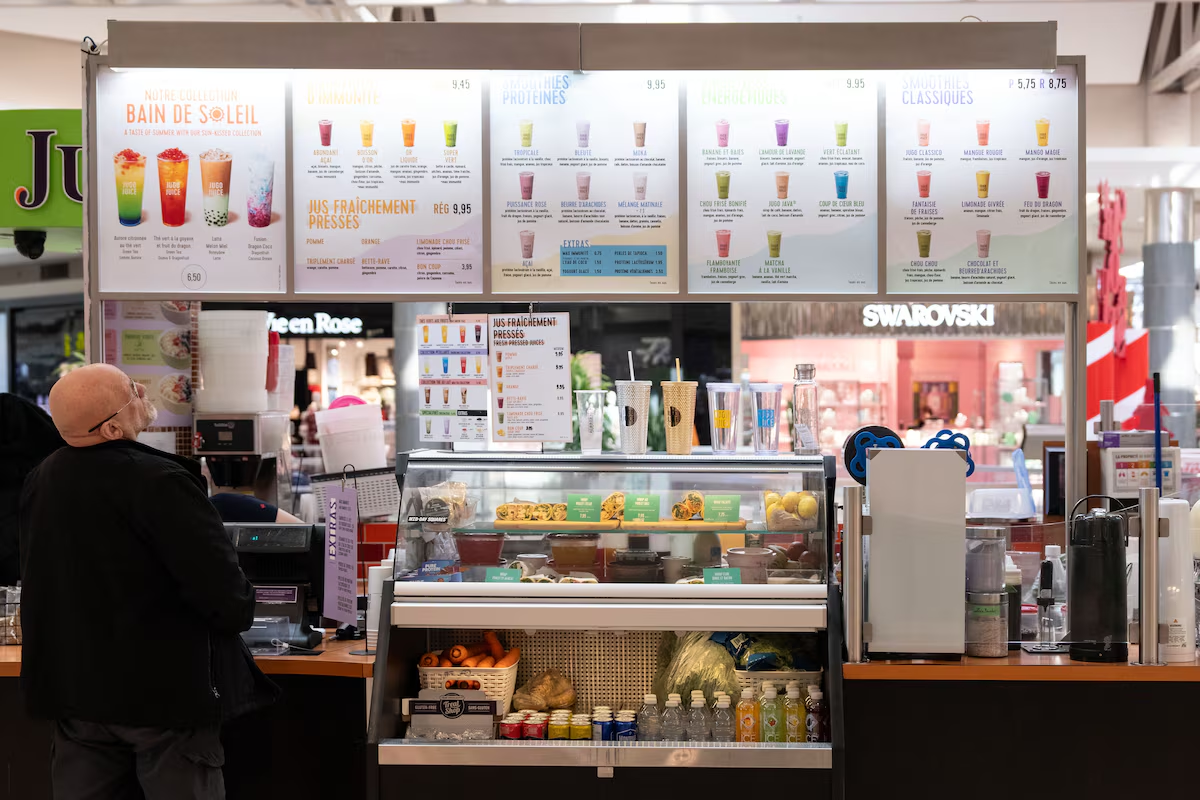
A man looks to order from Jugo Juice in a Montreal in 2024. MTY Food Group, the chain’s parent company, ended a strategic review after failing to find a suitable buyer.Christinne Muschi/The Canadian Press
MTY Food Group Inc. MTY-T has ended a strategic review without finding a buyer for the restaurant franchisor but says it’s on a new path to reshape the business and perhaps shed some of its 80 brands.
The Montreal-based company behind chains including Thai Express, Manchu Wok and Mr. Sub announced Friday the conclusion of a review it started in November, when its stock was under pressure amid rising prices, industry competition and general economic volatility.
Though the company was open to selling itself as part of the process aimed at boosting shareholder value, chief executive Eric Lefebvre said the board ultimately decided not to take on a buyer.
He offered few details about how the board arrived at its decision but said the group found few suitors would “offer the value and quality that MTY does.”
“So for the moment, the company will focus on returning capital directly to shareholders by buying back MTY’s own shares for cancellation and paying an increased dividend,” he told analysts on a call Friday.
The increased quarterly dividend will jump to 50 cents per share from 37 cents per share as the company will shift away from owning so many stores and move back to its old model, where all but 1 per cent were franchised.
MTY’s slate of restaurant banners may be too diverse for some buyers, analysts say
MTY has 6,966 locations across its network. Corporate-owned locations represent 2.6 per cent of the stores compared with 3.6 per cent last year.
In the process of moving almost completely to franchising, some MTY brands could depart the conglomerate.
“If we see that some brands would be better in someone else’s hands, then maybe we’ll need to take action on that,” Lefebvre said.
He didn’t name any chains that could be on the chopping block but said “the goal here is not to sell the crown jewels.”
“Everything is for sale, if the price is right, I would say that, but there’s no strong desire to divest of good brands,” he said.
“The brands we might decide are no longer relevant might not necessarily be the underperforming brands, but it might be brands for which we don’t have plans or we can’t come up with value creation.”
Lefebvre framed the attrition of brands as natural, though the company seldom publicizes it widely. He said it’s common for some chains to disappear or get converted to other stronger ones.
MTY, however, has been doing a lot of cutting lately. In July, it announced a plan to close 68 underperforming corporate-owned locations over the next nine months.
There were 74 store net store closures in its latest quarter, including 50 from the previously announced cull.
In the third quarter, MTY’s net income attributable to owners was $24.8-million, or $1.08 per diluted share, compared with $27.9 million, or $1.22 per diluted share, a year earlier.
On an adjusted basis, MTY says it earned $1.26 per diluted share during the period ended Aug. 30 compared with an adjusted profit of $1.19 per diluted share a year prior.
Revenue for the quarter totalled $277.7-million, down 7.1 per cent from the year before.
Because Labour Day fell later in September this year, the quarter did not include the boost MTY usually gets when customers dine out during the long weekend.
The quarter and franchise profitability was also hampered by “volatile” consumer behaviour and increasing protein costs, Lefebvre said.
But he explained, “It’s normal for our industry to go through these cycles and we’re prepared for that.”