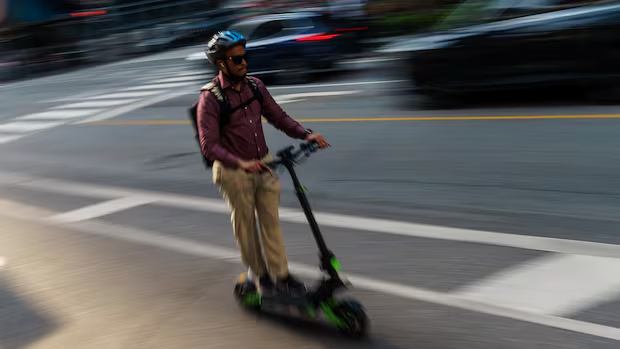
People who ride personal electric vehicles, like e-scooters and electric skateboards, will soon have to abide by new age and speed limits for the devices, as new rules are expected to hit roads across the province next year.
Those vehicles, along with e-unicycles, hoverboards and self balancing scooters, will be subject to new regulations under Manitoba’s Highway Traffic Act starting in 2027, according to the province’s website.
Riders must be at least 16 years old and anyone using the devices, including passengers, are required to wear properly fitting helmets, the province says.
Personal electric vehicles can’t go faster than 25 km/h under the incoming speed limit.
They won’t be allowed on sidewalks and can only be used on pathways, bicycle lanes and roads with posted speed limits of 50 km/h or lower, the province said. Depending on local rules, they may be allowed at some cycling facilities.
However, e-bikes — which are not affected by the new rules — are allowed to ride on roads with speed limits higher than 50 km/h, a provincial frequently-asked questions document says.

Personal electric vehicles, including e-skateboards, will have to follow new rules under Manitoba’s Highway Traffic Act starting in 2027. (Kate McKenna/CBC)
The government says personal electric vehicle users should adhere to the same basic rules as other road users, including following traffic signs and signals, not riding while impaired by alcohol or drugs, and using required lights and reflectors when riding at night.
Police and other peace officers can stop riders who aren’t following the new rules, the province said.
CBC News has reached out to the Winnipeg Police Service for comment.
Transportation Minister Lisa Naylor said in a statement on Saturday that more Manitobans are using personal electric vehicles and the government is “bringing in clearer rules to help protect kids and everyone sharing our roads.”
The minister said the province is particularly concerned about the number of young people that have been injured while using these devices. For example, a teenaged e-scooter rider was critically injured in a collision on Waverley Street in Winnipeg last month.
“This legislation is about preventing injuries, protecting kids and making our roads and communities safer for everyone,” Naylor said.
Earlier this year, the southern Manitoba city of Morden introduced its own personal electric vehicle bylaws, which require riders to wear helmets and stay off sidewalks, among other rules.
Mayor Nancy Penner says more people are wearing helmets and sticking to one rider per device. She said just a handful of tickets have been issued to riders since the bylaws — which are largely being used as an “educational tool” — came into effect in the spring.
Morden’s bylaws don’t include an age restriction or speed limit, but Penner says that will change once the provincial rules hit the road. She believes other communities will be supportive of the government’s move too.
“I think a lot of municipalities are finally saying thank you to the provincial government for finally stepping forward with some concrete guidelines,” Penner said.

Winnipeg e-scooter advocate Rob Kristjansson says he’s largely supportive of the province’s incoming rules for personal electric vehicles, but he questions some of the details. (Prabhjot Singh Lotey/CBC)
Winnipeg e-scooter advocate Rob Kristjansson says he has a “range of feelings” about Manitoba’s incoming rules. While he thinks the changes will be mostly good, he questions some of the details.
“We all have to share the roadway and that they’re now officially recognized as a legitimate thing on the road, that’s a great thing,” said Kristjansson, who moderates the E-Scooter Winnipeg Facebook group.
He says he’s not inherently against speed limits, but he’s not sure why 25 km/h was chosen as the maximum. He says he typically rides at 32 km/h, which is the speed limit for e-bikes. He also believes 16 years-old is an “arbitrary” age limit.
Kristjansson also says some e-scooter users are worried about being banned from using sidewalks, because Winnipeg’s infrastructure is “still quite patchy” and there may be few safe options for them to use in some parts of the city.
“It’s not so much rules, but infrastructure that I think will really save the day,” he said.
Winnipeg father Eric Wilson says he’s been riding an e-scooter for about three years. He mostly uses it for grocery runs and riding on trails alongside his 13-year-old son.
He believes the incoming rules are “overbearing” and worries they could push people off their vehicles altogether, turning them into e-waste and making them “practically useless.”
“I feel like everybody that’s riding an e-scooter is getting punished for the worst people that are out there,” Wilson said.
He said he doesn’t feel safe riding with his son on a 50 km/h road and they typically opt for the sidewalk. Sharing the sidewalk shouldn’t be an issue if riders are aware of their surroundings and respectful of other users.
“I teach my son when I ride that we slow down when we go close to people and let ourselves be known,” he said, adding he and his son both have bells on their e-scooters.
“Just like a bicycle would, you’re supposed to let people know that you’re around and that you’re not going to hurt them.”
Wilson said his son just got a new e-scooter in August. Now he’s not sure if he should hold on to the scooter or sell it, since his son will be under the age limit for a few more years.