
Open this photo in gallery:
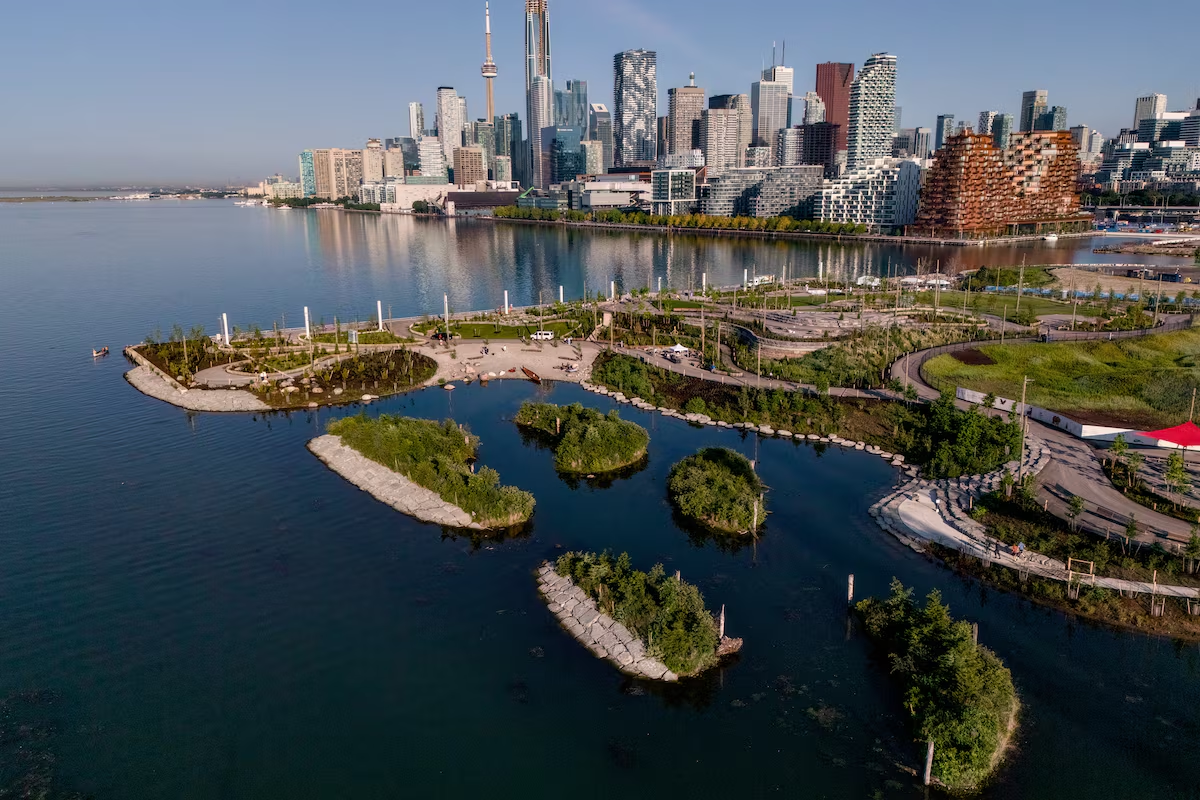
The opening day of the western section of Biidaasige Park in Toronto’s Port Lands on July 24. Biidaasige Park has instantly become one of Toronto’s most spectacular public places.Sammy Kogan/The Globe and Mail
Moving a river is a task for a giant or a God. Waterfront Toronto did it anyway. Since last year, visitors have been able to see the Don River transformed with a new mouth, new wetlands, and Biidaasige Park, which instantly became one of Toronto’s most spectacular public places. This didn’t just happen. It is the product of 25 years’ work at the waterfront organization, which has been building places – and a design culture – in a city that neglects both. Last week’s conference Leading With Landscape, and an accompanying exhibition at the University of Toronto’s Daniels Faculty of Architecture, Landscape and Design, carefully traced that history.
Open this photo in gallery:
Marc Halle of CCxA speaks at the Leading With Landscape conference on Oct. 2.Harry Choi Photography/Supplied
It also raised an awkward question. If Waterfront Toronto has figured out how to do this, why is no one following their example? The three-day event brought together local talent, such as urban designer Ken Greenberg, with a rogues’ gallery of the world’s great landscape architects, all of whom have put their marks on the Toronto waterfront since 2001.
There was much to do. In 1991, The Globe’s John Bentley Mays wrote about the city’s Port Lands as a “wilderness of trees and rust.” Then Waterfront Toronto emerged, jointly created by three levels of government to end a century of bickering and move ahead with the cleanup of the polluted Don River watershed.
They built a little utopia overlooking the ruins of the port, a fortress of solitude focused on landscape architecture and forward-thinking design. Public space was the first job. “Building parks first creates a there there,” Waterfront design czar Christopher Glaisek said last week. “And those parks in the middle of nowhere have got to be great.”
They were. Rotterdam’s West 8 created the Wavedecks and promenade that reframed the central waterfront. Montreal’s CCxA gave the city the singular Sugar Beach, Love Park and HTO Park. Michael Van Valkenburgh Associates built the fine Corktown Common and the grand Don River ensemble.
Open this photo in gallery:
The Spadina WaveDeck in September, 2008.J.P. MOCZULSKI/The Globe and Mail
Waterfront focused on landscape architecture, which in the 2000s was extending its reach as a discipline into shaping infrastructure, and they thought big. Having three bosses has somehow given the organization freedom. As the landscape architect and academic Charles Waldheim put it at the conference, it “acts as an agent of the state and also enjoys a kind of quasi-autonomy.”
But the organization has also built a culture. They took their mandate for “design excellence” seriously. To protect it, they created an arm’s-length design review panel to critique every park, street and building. Two key panel members were among the organizers of last week’s conference: landscape architect Fadi Masoud of Daniels and Nina-Marie Lister of Toronto Metropolitan University. Such independent experts raised questions and made trouble.
That helped when Waterfront, inevitably, made mistakes. Its dalliance with the Google sister company Sidewalk Labs received loud dissent within. When they delivered a subpar plan for the new island Ookwemin Minising, Prof. Lister and Prof. Masoud were among those who pushed for something better. And got it.
Open this photo in gallery:
People take in the morning on the opening day of the western section of Biidaasige Park in Toronto’s Port Lands.Sammy Kogan/The Globe and Mail
That is Waterfront’s crucial weapon: bringing in smart outsiders to challenge local ideas and norms. The design culture in Toronto suffers from a stultifying politeness. We’re not good at making public space, but one can’t say that out loud. Professionals see problems and hold their tongues. This is how we have made generational mistakes such as the Ontario Place spa and – almost – a monster-sized Billy Bishop Airport.
At the conference, Mr. Glaisek laid out the lessons: hire the best design talent. Use design competitions. Create formal policies on “design excellence.” Use peer review.
Good ideas. And none of them have travelled crosstown to City Hall, where the story has been one of endless plans and “strategies,” false economies in hiring, and poor results. Over the past 25 years, Toronto’s Parks department has spent billions building parks and facilities. How many are landmarks? How many good places have been built by any city agency? For great places, Toronto has had to turn to the waterfront. It’s time that other governments followed the leader.