
Listen to this article
Estimated 4 minutes
The audio version of this article is generated by AI-based technology. Mispronunciations can occur. We are working with our partners to continually review and improve the results.
The Northwest Territories is the first jurisdiction in Canada to contribute drill core samples to a cutting-edge digital library that aims to make the mineral information those samples contain publicly accessible.
Drill cores are long skinny cylinders of rock produced by miners and prospectors looking to prove mineral deposits. The cores are stored in boxes and are often held by mining and exploration companies on their properties or kept in storage across Canada, making them difficult for industry experts, researchers or the general public to examine.
The aim of the Canadian Digital Core Library is to change that, thanks to $40 million in funding from Natural Resources Canada. The library would make a wide array of samples freely available online and ready for artificial intelligence (AI) technology to be used for more sophisticated analysis.
Creative Destruction Lab is developing the platform in collaboration with the provinces, territories, industry and academia. The core samples will be subject to an array of scans, providing high-resolution images and data beyond what’s visible in a simple photograph.
The scanning of samples began in September in Calgary and, according to Creative Destruction Lab, at least 250,000 metres of scanned drill core will be uploaded to the library by March 2028.
Kumari Karunaratne, director of the Northwest Territories Geological Survey, said that she sees the digital core library laying the basis for more efficient exploration and supporting sustainable development of the territory’s rich mineral deposits.

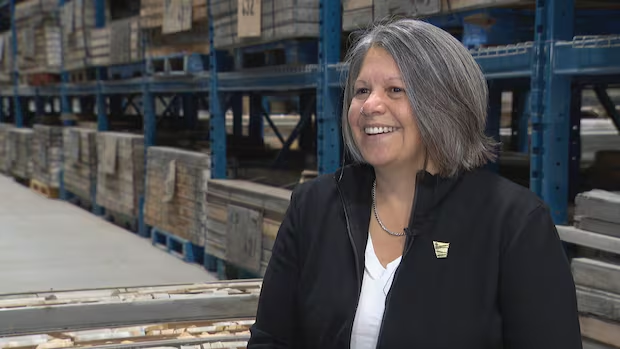
Kumari Karunaratne, director of the N.W.T. Geological Survey, says preserving information collected from core samples ‘allows people to not go and re-drill in areas where it’s already been drilled.’ (Allister Mccreadie/CBC)
“Whether you’re trapping or you’re harvesting timber or you’re doing an exploration project or some of these big projects that we’re looking at, they have an impact on the land,” Karunaratne noted.
“And these projects that have collected the drill core have also impacted land. So this drill core allows people to not go and re-drill in areas where it’s already been drilled. We already have that information. So it preserves that.”
She also says the cores can contain useful information about the rock where they were drilled.
“If a project is developed, we will be able to understand the risks associated with that development a lot better,” she said.
Karunaratne said that the N.W.T. was able to be at the forefront of the project thanks to the initiative of Industry, Tourism and Investment Minister Caitlin Cleveland, and donations of high quality drill cores from Valor Gold and Rackla Metals, two companies with active projects in the territory.
Tyler Acorn, a data geoscientist with the N.W.T. Geological Survey, explained the benefits of the technology being used to digitize a large array of core samples.

Tyler Acorn, a data geoscientist for the Northwest Territories Geological Survey, says sending every core sample to an assay lab for analysis is ‘a very involved process.’ (Allister Mccreadie/CBC)
He says typically, core samples are sent to an assay lab for analysis.
“That’s all really expensive, and you’re taking just a small portion of the rock. Every metre you’ll take a portion of the rock, send it off to assay. So it’s a very involved process,” Acorn said.
“With core scanning, what we’ll be doing is we’re actually digitizing, scanning it with different sensors, and we’ll be getting like a micrometre resolution across the entire drill hole. So that gives you a lot more information and a lot of complementary information to the assay data.”
Acorn said that the large data set being created from the core samples will make it possible for AI models to draw out patterns that point to signatures of geological features that wouldn’t be immediately apparent.
Rackla Metals’ vice president of exploration Scott Casselman said that the company was eager to contribute to the Canadian Digital Core Library and sees it as a valuable tool for mineral exploration and resource extraction across the country.
“From the perspective of an exploration company, having access to core in a core library, and all of the data that’s collected on that core, is very useful in identifying additional targets to go explore,” Casselman said.
“Or using it to compare what you might know about your own project and seeing if there is a possibility to look for elements that you might typically not analyze for.”
Rackla’s operations manager, Michael Shultz, said that he is encouraging other companies with projects in Canada to make their core samples available for digitization and inclusion in the library.