
Open this photo in gallery:
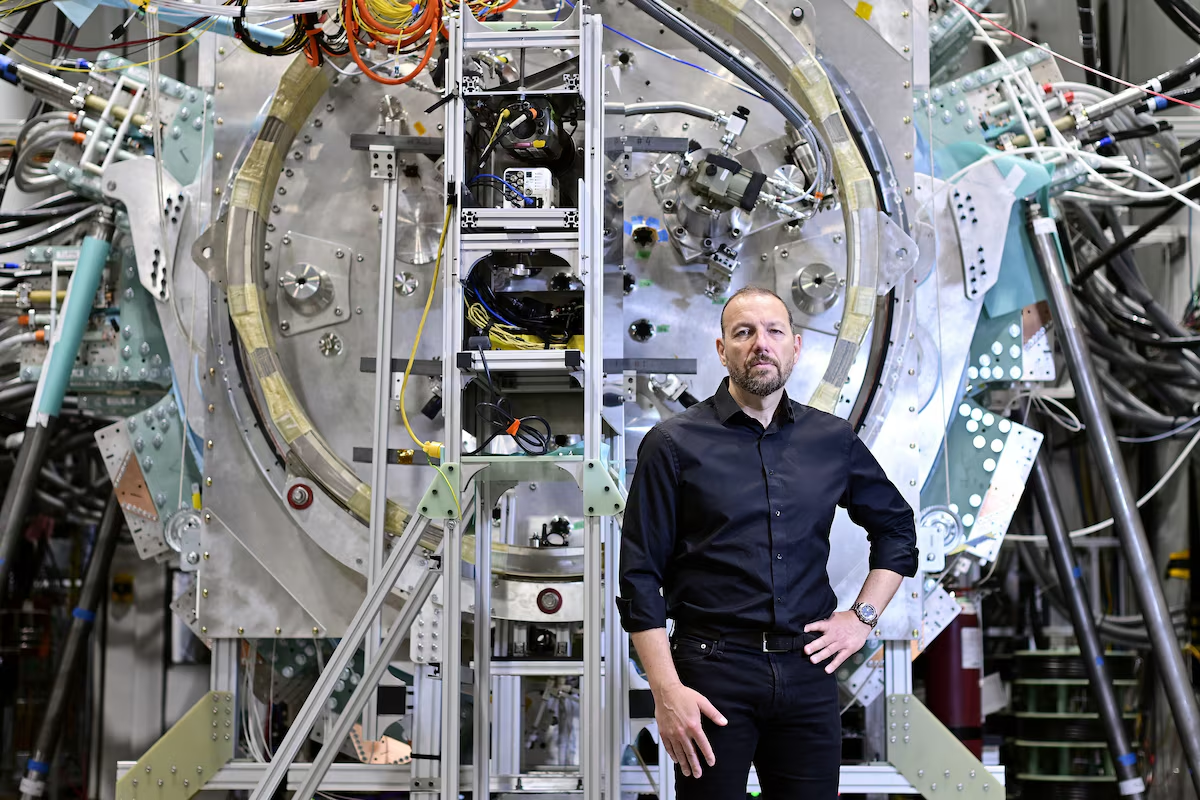
General Fusion CEO Greg Twinney stands with the LM26, which the company uses to test its fusion method, in Richmond, B.C., last year.Jennifer Gauthier/The Globe and Mail
General Fusion GFUZ-Q, Canada’s main contender in the emerging fusion energy sector, has claimed a new milestone on its path to building a commercial-scale reactor.
On Thursday, the Richmond, B.C., company announced it had successfully compressed a hydrogen plasma to the point where the energy of electrons in the plasma surpassed one kiloelectron volt (1 keV) – a threshold roughly equivalent to a temperature of slightly more than 12 million degrees Celsius.
The result demonstrates an ability to maintain the stability of a plasma while compressing it to the extraordinarily high pressures and temperatures required for fusion reactions to occur. It represents the first in a series of goals the company said it would try to achieve as it explores its unique approach known as magnetized target fusion.
“This is a step forward towards commercialization, delivering reliable commercial clean power from fusion energy,” said Greg Twinney, the company’s chief executive officer.
He added that the achievement moves the company toward its next goal of reaching an energy 10 times higher and, ultimately, toward operating a demonstration power plant by 2035.
Founded in 2002, General Fusion became a public company in July when it merged with a special-purpose acquisition company, becoming General Fusion Group Ltd., with a current market value around US$500-million.
Mr. Twinney said the capital it raised in the process “funds us through the next couple of milestones.”
Fusion is a type of nuclear reaction that scientists have long hoped to harness for power generation. It releases energy by combining the nuclei of lightweight elements, typically different forms of hydrogen.
In contrast, fission – the process that operates inside conventional nuclear reactors – involves breaking up heavy atomic nuclei like uranium.
If fusion can be made to work, it promises several advantages, including the fact that it delivers far more energy per quantity of fuel used.
The key challenge is that the fuel must be extremely hot before it reaches a point where it produces more energy than is needed to keep the process going. The point of net energy gain is referred to as Q greater than 1.
Open this photo in gallery:
A plasma injector feeds into the LM26, which General Fusion has used to stage successively more powerful compressions.Jennifer Gauthier/The Globe and Mail
General Fusion is one of several companies worldwide that are testing ways to commercialize fusion. It’s approach involves compressing a lithium metal shell with hydrogen inside to drive the hydrogen to fusion conditions.
Since 2023, the company has been developing LM26, a machine designed to test the method, which it has used to stage successively more powerful compressions.
Mr. Twinney said General Fusion achieved the 1 keV milestone during the past three months. It has released its results together with a pair of technical papers that have been submitted for peer review.
To have independent confirmation of its 1 keV measurement, the company partnered with the UK Atomic Energy Authority. The authority has expertise in measuring plasmas developed over decades of operations with the Joint European Torus, a fusion experiment in Oxfordshire that ran until 2023.
The authority and General Fusion together built a laser-based system to measure the energy of electrons in the plasma through an effect known as Thomson scattering, a gold standard in the industry.
While the measurement relates to the electrons in the plasma, not the hydrogen nuclei involved in the fusion, Megan Wilson, General Fusion’s chief strategy officer, said those nuclei also showed “meaningful heating” based on measurements of neutrons released by the plasma along with other indicators.
The company still has many hurdles to overcome to get to commercial energy production. Once the desired plasma energy is reached using LM26, it intends to switch from a solid to a liquid metal liner around the plasma, which can then be deployed inside a reactor that compresses plasma in a repeating cycle, rather than a single shot. The pulses of energy generated would be harnessed for a power plant.
The company’s approach compresses plasma in a matter of milliseconds rather than in time scales as short as nanoseconds required by some other methods. Ms. Wilson said it “means less power required for the process, less complexity, and ultimately less cost.”
In a joint statement with General Fusion, Dennis Whyte, a leading fusion expert and the U.K. authority’s newly appointed CEO, said the 1 keV milestone “reflects the tangible progress being made by General Fusion and others across a diverse set of fusion approaches in the private sector.”
The U.S.-based Fusion Industry Association lists 56 fusion companies around the world in its latest survey of the sector, with a total funding estimated at US$14.2-billion.