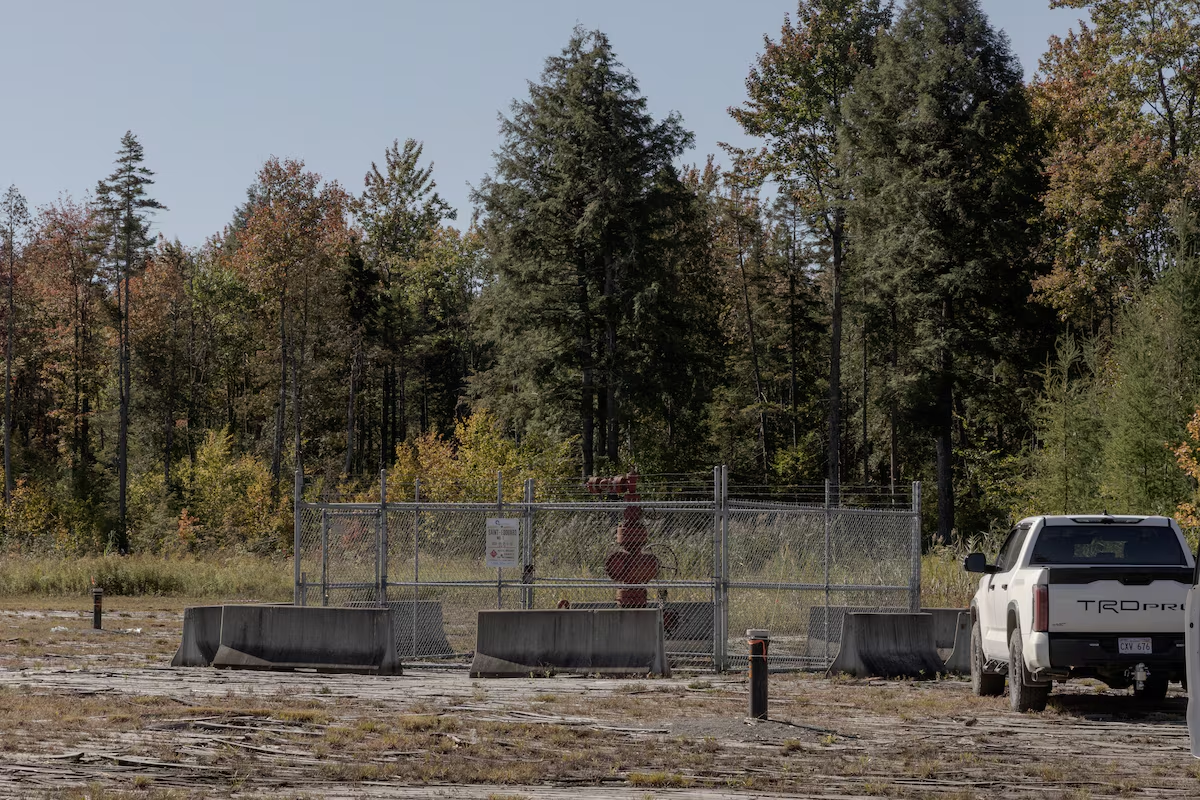

Open this photo in gallery:
The shale gas production well in Saint-Édouard-de-Lotbinière, Que. Roughly two dozen companies were holders or co-holders of licences for oil and gas exploration in Quebec when the province’s ban went into effect.Charles-Frederick Ouellet/The Globe and Mail
Quebec was among the first governments in the world to put a halt on oil and gas development on its territory when it introduced a ban four years ago, triggering lawsuits from energy companies with exploration licences that claimed billions of dollars in damages. Now, it might be steering toward a rethink.
After a decades-long flirtation with the industry that saw it support the hunt for hydrocarbons before beating a retreat, the province passed a law in April, 2022, that closed the books on new fossil fuel exploration and production. François Legault, premier the time, said Quebec’s energy future lay elsewhere.
The corporate backlash was swift. Companies that held permits sued, denouncing the law as “a disguised expropriation” that makes a mockery of investor rights. Industry opponents, meanwhile, hailed the decision, calling it a courageous move that paves the way for other jurisdictions around the world to do the same.
Four years later, a divisive subject many thought was dead and buried is once again bubbling to the surface. Conflicts in Ukraine and the Middle East are feeding a new drive for energy security in many parts of the world while in Canada, fraying ties with the United States have exposed our own weaknesses.
In hydropower-rich Quebec, the question is whether it needs its own oil and gas to add to the mix. Through the course of an election campaign that will yield a new provincial government Monday night, two party leaders showed an openness to revisit the issue – at least as it relates to shale gas development.
Quebec has lost its economic ambition, high-profile business leaders say
National Bank CEO urges Quebec to tap reserves of energy and natural resources
Éric Duhaime of the Parti conservateur du Québec is pushing for it as a way to create wealth. “We must consume our own gas in Quebec, we have it under our feet,” he said recently. Christine Fréchette of the Coalition Avenir Québec, whose party brought in the ban, said Quebeckers’ perspective has changed. “I believe there’s greater openness to these possibilities,” she said.
Parti Québécois leader Paul St-Pierre Plamondon, whose party looks set to win power Monday after months of positive polling numbers, has said “the debate is over” on developing shale gas in Quebec as far as he’s concerned. But he said he wouldn’t necessarily shut the door on all fossil fuel projects outright.
There’s no denying the landscape has shifted across the province. A recent survey of 1,000 people published in La Presse found Quebeckers are divided on whether to produce shale gas but that they’re more supportive if it’s used as a tool to gain energy autonomy from the United States. The U.S. and Western Canada are the main sources of Quebec’s gas supply.
It’s no surprise that Quebeckers are weighing the ramifications of that U.S. dependence, federal Minister of Energy and Natural Resources Tim Hodgson told The Globe and Mail.
“I suspect many people in Quebec think about whether that’s in the best interests of Quebec when their dairy farms are being challenged, their aluminum smelters are being tariffed, their steel processing and finished products coming out of smelters are being tariffed, their forest products are being tariffed,” Mr. Hodgson said.
Open this photo in gallery:
The heart of the village of Saint-Édouard-de-Lotbinière. Local activists who fought the industry in regions like this one are steeling for another battle.Charles-Frederick Ouellet/The Globe and Mail
Observers will be watching to what extent the idea of hydrocarbon development has legs in Quebec City with a new government and whether companies will want to jump back into the fray if the ban is lifted. Calgary-based Questerre Energy Corp., which holds the largest acreage position in the Saint Lawrence Lowlands, says it won’t push to drill for gas anywhere it’s not wanted.
Some oil and gas juniors previously active in Quebec have moved on to other places or other things, such as critical minerals. One resource executive said it will take more than words by campaigning politicians to revive his interest. As for the local activists who fought the industry in regions like Lotbinière, they’re steeling for another battle they’re convinced they can win.
The CAQ government in June released a management plan for its energy resources covering the next 25 years. It states that while demand for natural gas in the province will fall to 9 per cent by 2050 as renewable energy sources make up an increasingly bigger piece of the pie, maintaining supply of that fuel “appears essential in the short and medium term.”
Questerre chief executive officer Michael Binnion points to the government document as an acknowledgement that natural gas will have a role to play for the foreseeable future. As Hydro-Québec faces increasing demand for its clean power, he says locally produced gas can help avert shortages.
“I don’t think that the province of Quebec is backing away from its view that climate policy is important, that emissions reduction is still important. But we are seeing a clear, unequivocal change that any transition is going to take a lot longer,” the Questerre CEO said during a recent presentation to investors. “Should they decide that they want a strategic solution to the energy crisis in Quebec, we’d like to be there to help provide that.”
Quebec on the cusp of electing separatist government promising referendum
Roughly two dozen companies were holders or co-holders of licences for oil and gas exploration in Quebec when the province’s ban went into effect, according to information provided by the Ministry of Economy, Innovation and Energy. They include companies controlled by Utica Resources, as well as Ressource & Énergie Squatex Inc., and Pieridae Quebec Inc. How many of them would be interested in restarting operations is an open question.
Executives with Utica and Squatex declined to comment for this story.
Peter Dorrins, an industry consultant who formerly led junior exploration company Junex Inc., said he’s spoken with dozens of executives over the years who’ve concluded the political risk is too high in Quebec for them to pursue oil and gas development, even before the ban was imposed. He said Quebec would need to provide significant guarantees to the private sector if ever it were to greenlight the industry now.
“It’s going to be challenging for people to come back in,” he said, but “not impossible.”
One curious development pointing to an evolving relationship between Quebec and oil and gas players is that Quebec’s attorney-general and economy ministry have entered into confidential mediation talks with Questerre and Utica in an apparent effort to resolve outstanding legal action resulting from the 2022 prohibition. The process is voluntary and non-binding.
In an interview, Questerre’s Mr. Binnion would not comment on what led to the mediation or how it could affect his company’s aim of developing natural gas in the province. But he noted the company also won approval from the Quebec government in August for a five-year pilot project on carbon storage, which involves “the drilling of injection and observational wells,” including one of Questerre’s existing wells.
Open this photo in gallery:
Serge Fortier thought the battle to ban shale gas development in the province was won, now, he’s preparing for the possibly that the government reverses course.Charles-Frederick Ouellet/The Globe and Mail
In Saint-Édouard-de-Lotbinière, Serge Fortier and Pierre Bluteau are tracking the shale gas situation like sentries for the status quo. The two men were among the founders of a grassroots citizens movement in the region that succeeded in helping convince the government to halt shale gas development.
They thought that multiyear battle was won, even marking the ban with a celebratory supper back in 2022. Now, they’re dusting off their contact lists in the event Quebec reverses course. Development carries too much risk for too little payoff, they argue, especially for the potential contamination of groundwater and the use of agricultural land for industrial purposes.
“I couldn’t care less if it’s made-in-Quebec natural gas with a fleur-de-lis on it,” Mr. Bluteau said. “It’s still a hydrocarbon that’s 80 per cent more damaging than carbon dioxide. We have to get through the energy transition. That’s all.”
Drilling technology and techniques have evolved over the past decade so that companies can produce natural gas from shale with lower emissions and significantly fewer wells than before, Mr. Binnion said. Opponents remain unconvinced.
“The only thing that’s changed is the pressure on Canada that’s coming from south of us,” said Benoît Lemay, mayor of nearby Leclercville.
Open this photo in gallery:
Pierre Bluteau is one of the founders of a movement that succeeded in helping convince the government to halt shale gas development.Charles-Frederick Ouellet/The Globe and Mail
Oil and gas is back in the spotlight because people are alarmed by the rhetoric coming from the White House and feel a pull towards national sovereignty, including the idea of strengthening our pool of natural resources, Mr. Lemay said. But they’ve forgotten all the environmental problems that come with that.
“I’m telling people here: Be conscious of the fact that we’re panicking,” Mr. Lemay said. “Are we really going to start investing in fossil fuels here today when even oil-producing countries are already looking past that, to renewables? It makes no sense.”
If fossil-fuel production on Quebec soil looks unlikely under a future PQ government, the industry may still have other opportunities. Party Leader Mr. St-Pierre Plamondon has said he met with the promoters of one proposal – the $23-billion Kino Aski LNG project that would export Western Canadian natural gas to Europe from the port of Baie-Comeau, Que. – but emerged unconvinced that it provided enough benefit for the province.
“We’re not going to close the door on meeting people who say their project is good for Quebec,” he told reporters this past spring. “But we are hard to fool.”
Regardless of who forms the next government, the oil and gas debate will stay alive in the Quebec legislature because Éric Duhaime’s Parti conservateur will champion it, said Marc André Bodet, professor of political science at Laval University. Support for shale gas development is much higher in certain regions than others, notably where that party is stronger, he said.
“The discussion is now turning into a debate about local acceptability rather than national consensus,” Mr. Bodet said.
With a report from Emma Graney