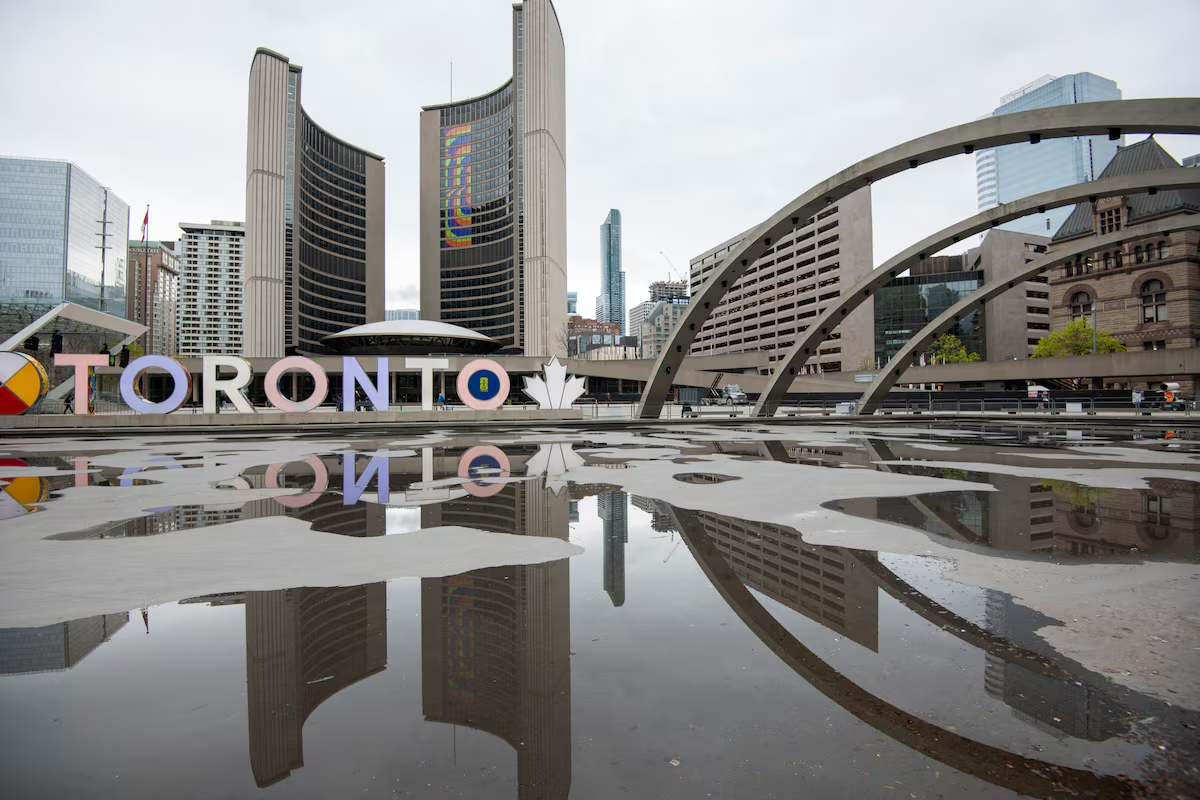

Open this photo in gallery:
The annual bill to run Toronto has now hit $18.9-billion – more than several provinces spend.Fred Lum/The Globe and Mail
Every year, the City of Toronto faces a fresh $1-billion-plus shortfall in its operating budget, an issue its main mayoral contenders have all vowed to fix. But experts say the city and other municipalities across Canada will be left perennially begging for cash without major changes to the way they are funded.
Toronto’s budget hole – city bureaucrats prefer the term “opening pressure,” pegging this year’s at $1.3-billion – must be filled each year, as municipalities in Ontario cannot borrow to cover operating deficits. The annual scramble usually ends with the use of tax hikes, reserve funds, spending reductions and varying amounts of financial support from Queen’s Park.
Mayor Olivia Chow – who took office in 2023, with a $1.8-billion gap looming for the following year – imposed two large property-tax hikes in a row, outpacing any others in recent memory. However, she was also able to win a “new deal” with Premier Doug Ford that provided important financial relief. Whoever assumes the mayor’s chair after the Oct. 26 municipal election will inevitably be seeking a New Deal 2.0 to shore up the city’s books.
Cities, as creatures of provincial legislation, have been set up across Canada with similar financial structural problems. In Ontario, municipalities are in worse shape because they’re required to cover more of the costs of social programs that are delivered by the province in other jurisdictions. And Toronto, with the country’s largest public transit system and busiest network of homeless shelters, is in a class by itself. In all, the annual bill to run Toronto has now hit $18.9-billion – more than several provinces spend.
“This is not a case of extravagant Toronto crying poor,” said Myer Siemiatycki, professor emeritus in the department of politics and public administration at Toronto Metropolitan University. “There is a systemic underfunding of municipalities right across this country.”
The problem, many experts and municipal leaders have argued over the years, is that municipalities largely rely on property taxes, which do not grow with the economy and inflation the way taxes on income do. (They also don’t sag the same way in a recession.)
Meanwhile, costs for Toronto and other municipalities – transit, homeless shelters, road repairs – often rise faster than the general rate of inflation, requiring hotly debated, highly visible property-tax rate hikes to keep up.
In years past, the annual budget process has seen Toronto council twist itself in knots. It has passed budgets that were only balanced with money still to come from other governments. It has resorted to arcane accounting tricks, such as selling all of its lamp posts to its own hydro utility in 2005 to raise $60-million. In 2017, then-mayor John Tory had to renege on a social media pledge to Olympic swimming gold-medalist Penny Oleksiak to keep city-funded lessons at her childhood pool, an $85,000 line item.
The deal that Ms. Chow struck with Mr. Ford provided a total of $1.2-billion over three years for operating costs, money that runs out this year and was enough to shrink, but not eliminate, the city’s annual budget shortfall. The province also agreed to take over two major expressways, the Gardiner Expressway and the Don Valley Parkway, taking billions of dollars of capital spending off the city’s books.
While they do not dispute the need for some sort of renewed deal with the province, Ms. Chow’s leading challengers in the upcoming election, city councillor Brad Bradford and former federal Conservative cabinet minister Chris Alexander, also accuse the sitting mayor, a former councillor and NDP MP, of not doing enough to contain spending.
Opinion: Why is Chris Alexander running for mayor of Toronto?
They have taken aim at her first two years, when, despite pledging “modest” hikes, she oversaw residential tax-rate increases of 9.5 and 6.9 per cent. That was just after her predecessor Mr. Tory had raised taxes by 7 per cent in 2023, as the city faced a pandemic-induced financial crisis amid high inflation. (For decades, property-tax hikes in Toronto were usually around or below the rate of inflation.)
But property-tax hikes cannot solve the problem. Every percentage point that Toronto increases property taxes means it takes in an added $49-million. Filling a billion-dollar hole with just property taxes would mean a pitchfork-prompting rate hike of more than 20 per cent.
Ms. Chow has said future hikes, if she is re-elected, would look more like this year’s hike of 2.2 per cent, and would be at or near inflation. Even with the increases, Torontonians’ property-tax burden remains lower than in several surrounding municipalities.
On average, according to 2025 figures compiled by the city that account for Toronto’s user-fee system for waste collection, Toronto households paid less property tax than those in Hamilton, Markham, Mississauga, Vaughan and Brampton. (Most municipalities fund their garbage collection through property taxes, but not Toronto.) Part of the reason for discrepancy in tax bills is Toronto’s large commercial and industrial tax base, which has historically allowed it to keep residential taxes lower.
Ford’s praise of Chow was not an endorsement, his office says
Both of her challengers have pledged to freeze property taxes in their first year in office, a move that might be popular but would add to – not reduce – the annual budget shortfall. (In decades past, mayors Mel Lastman and Rob Ford made similar moves, but returned to increasing taxes as cost pressures mounted.)
Mr. Bradford also says he would eliminate the city’s land-transfer tax on the first $1.1-million of a principal residence’s cost. He says doing so would cost the city $300-million a year, potentially making that gap wider once again.
But he also has promised to launch an external “line-by-line” review of city spending to find savings, while borrowing more money to cover infrastructure costs. Mr. Bradford accuses Ms. Chow of taking a record amount of money from other governments and still failing to deal with the city’s financial woes – while its transit system, parks and roads languish.
In an interview, Mr. Alexander said he would push city staff to find the $130-million needed to cover the cost of his tax freeze. He argued he would be a better negotiator in seeking a more comprehensive, permanent arrangement involving both Queen’s Park and Ottawa. He said that could perhaps involve some sort of constitutional change to give the city more power, an idea others have suggested but that has gone nowhere in the past.
“You want a super new deal,” Mr. Alexander said. “I think it should be a bridge to something that is institutionalized.”
Dynamic race underway to see who will be Ottawa’s next mayor
Ms. Chow has pointed out that her recent budgets have already relied on hundreds of millions of dollars in belt-tightening and other adjustments, found through “line-by-line” scrutiny of the city’s books by its own staff. She also routinely mentions the 2024 upgrade that the city won from credit rating agency S&P Global Ratings, which boosted Toronto to a AA-plus rating – the first such upgrade for the city in more than 20 years.
Governments often bring in outside experts for a second look at their finances. But previous external audits – including one from 2011, when the now-Premier was on council and his late brother Rob was mayor – found too little in pain-free savings to solve Toronto’s budget problems without requiring large service cuts.
Under former mayor David Miller, who launched an unsuccessful campaign for a share of sales-tax revenue, the city managed to convince then-premier Dalton McGuinty to give Toronto its own menu of potential “revenue tools” in 2007. Most were politically hard to swallow, such as a sales taxes on booze, or the vehicle-registration tax that Mr. Miller imposed, but that his successor Mr. Ford had council agree to scrap.
The city’s land-transfer tax on property sales, piggybacking on the province’s similar levy, survived, generating about $800-million this year. It has served as a lifeline that allowed subsequent mayors to avoid much larger property-tax hikes. But it also rendered Toronto’s budget vulnerable to swings in the real estate market. (Ms. Chow recently brought in a steeper rate for homes worth more than $3-million.)
Riley Brockington, president of the Association of Municipalities of Ontario and an Ottawa city councillor, said local governments across the province face a similar mismatch between their revenues and their responsibilities, along with a wave of aging infrastructure – everything from roads to hockey arenas – they cannot afford to fix.
“There just aren’t the revenues, Mr. Brockington said. “There’s a massive deficit in this province that we need addressed.”