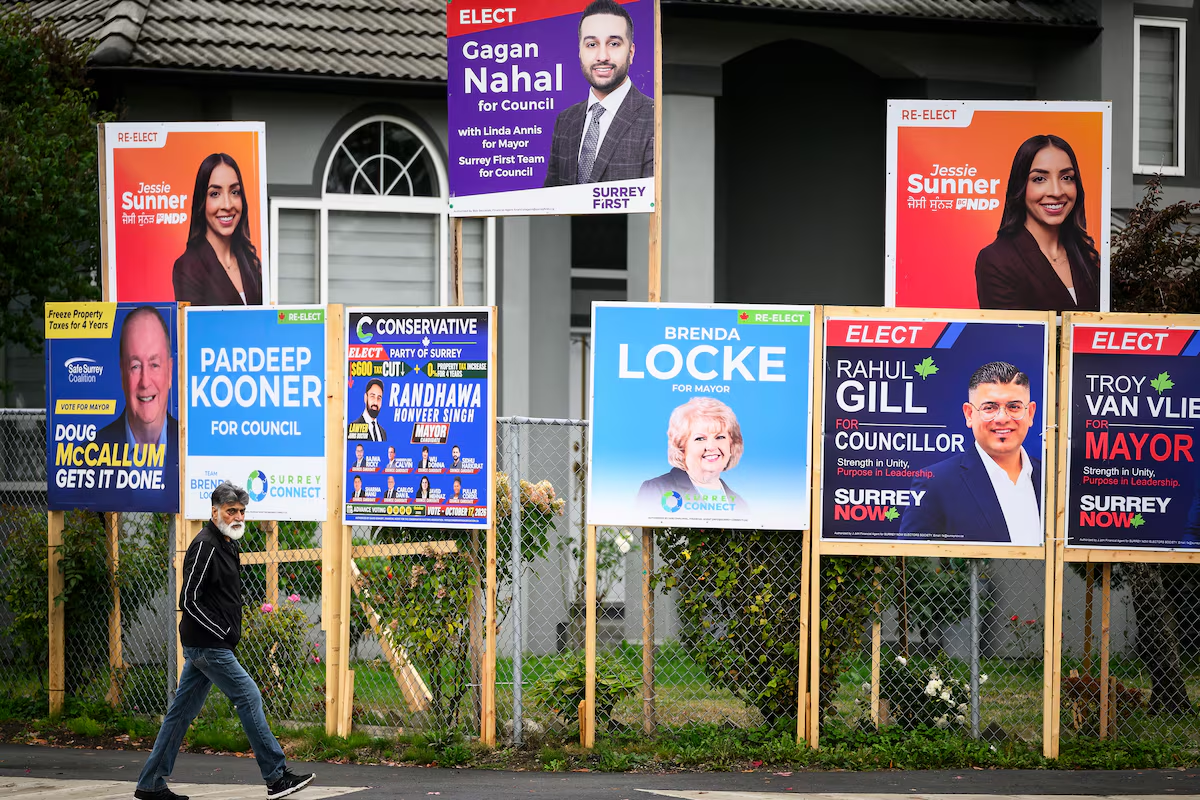

Open this photo in gallery:
Elections signs for the upcoming municipal and provincial election are seen in Surrey, B.C., Oct. 1.Jennifer Gauthier/The Globe and Mail
The mess of 14 large election signs featuring the faces of dozens of municipal and provincial politicians that sat along one of Surrey’s major thoroughfares became a symbol this week of the confusion permeating many parts of B.C.
The tangle of typography at the intersection – with five massive signs inside the yard of the corner house towering over the others zap-strapped onto the family’s fence – illustrated the difficult duty confronting British Columbians in the coming weeks. A handful of school trustee candidates’ signs had been shunted to the edge of the property, laying in a tidy sidewalk pile.
This month will see the first overlap of municipal and provincial elections since British Columbia’s Election Act was passed in 1995.
The homeowners didn’t want to speak on the record Thursday, but told The Globe and Mail the signs would soon be gone after learning their house had gained infamy online.
In Surrey alone, more than 380,000 eligible voters will be asked to cast a ballot for a mayor, eight councillors and six school trustees on Oct. 17 before returning the next weekend to select their preferred MLA. In total, voters in the Vancouver suburb and B.C.’s second biggest city will have to sift through nearly 100 candidates for the municipal elections. On Oct. 24, there’s expected to be a total of at least 20 candidates, likely more, running across Surrey’s 10 provincial ridings.
Opinion: Wingnuts could undo the BC Conservatives
Many in B.C. say they are burdened by the mental math needed to identify and choose their preferred candidates in the concurrent contests. The splintering and subsequent partial reunification of the provincial Conservatives has created a more crowded political landscape, which now includes two upstart rightwing parties promising they will compete in the majority of the 93 ridings.
Experts warn voter turnout could suffer, especially in municipal races planned years before Premier David Eby called a snap election on Sept. 22.
On Vancouver Island, Saanich resident Robert Randall, who himself ran unsuccessfully for Victoria council in 2008, said he finds the overlapping elections especially confusing because many of voters’ biggest concerns – such as affordability, homelessness and housing development – are being discussed at both levels, with both sets of politicians giving many of the same answers.
“I feel annoyed because researching a new mayor and a full slate of council candidates is a hard enough job without having an unscheduled provincial election dropped in the middle of it,” Mr. Randall said.
“I won’t take it out on the party in charge as I’m still a likely NDP voter, but I won’t be going to the polling booth with a skip in my step.”
Open this photo in gallery:
An Elections BC sign at a bus stop in Surrey, Oct. 1.Jennifer Gauthier/The Globe and Mail
Two weeks ago, at the weeklong Union of B.C. Municipalities convention in Vancouver, mayors and councillors from cities and towns across B.C. pleaded for things to be different. The group united to pass an emergency resolution urging Mr. Eby to hold off on calling a provincial election until after municipal voting on Oct. 17, to avoid interfering with local campaigns.
Cori Ramsay, an incumbent Prince George council candidate who just finished her term as UBCM president, said she is worried that too many of the temporary workers needed to pull off the local election in her northern city will chase the slightly-higher wages offered by the provincial election agency.
“If we don’t get the required [staffing] turnout then it’s going to be really long lines, it’s going to run the risk of people not wanting to go line up for the provincial poll and then come over to the municipal polls – because we got the advanced poll day for the province the exact same day as the municipal election,” she told The Globe.
The twin elections have also created the unusual situation of candidates running in both contests.
Kevin Acton has been the mayor of the Village of Lumby in the north Okanagan since 2009. He is simultaneously seeking re-election and running as the Conservative candidate in Vernon-Lumby. Should he win both races, B.C. law would automatically deem him to have resigned as mayor once the writ confirming his provincial election is returned, triggering a mayoral by-election.
Opinion: Brave David Eby will challenge anyone (with a leg injury) to a wrestling match
Mr. Acton said the early election call created “a lot of confusion and angst” among community members, including some concerned that he would abandon his mayoral bid and hand challenger Bradley Weston a “free seat.”
If, instead, he wins both elections, the resulting mayoral by-election – which he has pledged to pay for personally – could draw new candidates, including long-time councillor Randal Ostafichuk, who declared his interest on Tuesday.
Keeping his two candidacies straight has required some careful choreography. Mr. Acton said his coffee-shop campaign stops in Lumby remain focused on village issues, provincial events are clearly identified, and he will wait until after the municipal election to expand his door-knocking beyond Lumby.
“I can tell you, for the first few days, my head was spinning,” Mr. Acton said.
Others – including Courtenay councillor Will Cole-Hamilton, Terrace councillor Sarah Zimmerman and Central Saanich Mayor Ryan Windsor – withdrew from their local contests before running provincially.
Less than two weeks ago, Andrew Weaver, the climate scientist and former leader of the BC Green Party, was serving as campaign manager for his wife, Jordan Weaver, who is running for a seat on Saanich council.
Mr. Weaver felt compelled to return to provincial politics when nearly all the group of Conservative defectors who had joined the upstart CentreBC party returned to their old party. That left behind new CentreBC leader Elenore Sturko, whom he felt needed his support.
“I have no financial agent. I haven’t raised a penny. I have no rack cards. I have no signs,” Mr. Weaver told The Globe on Sept. 23, his first day as a CentreBC candidate in his old riding of Oak Bay-Gordon Head.
Stewart Prest, a political science lecturer at the University of B.C., said he expects the advantage incumbent candidates often enjoy in municipal elections to be heightened in this chaotic atmosphere because it will be harder for aspiring first-time politicians to “break through” and ingratiate themselves to enough voters.
Darin Nesbitt, a political science instructor at Douglas College, said voters are being asked to navigate two sets of candidates, ballots, polling places and voting dates, potentially compounding existing uncertainty about which level of government does what. And, he said, with bigger budgets, higher profile leaders and more media coverage, provincial campaigns risk drowning out municipal issues such as housing approvals, transit and police.
“When voting starts to feel like homework, some people simply opt out,” Prof. Nesbitt said.