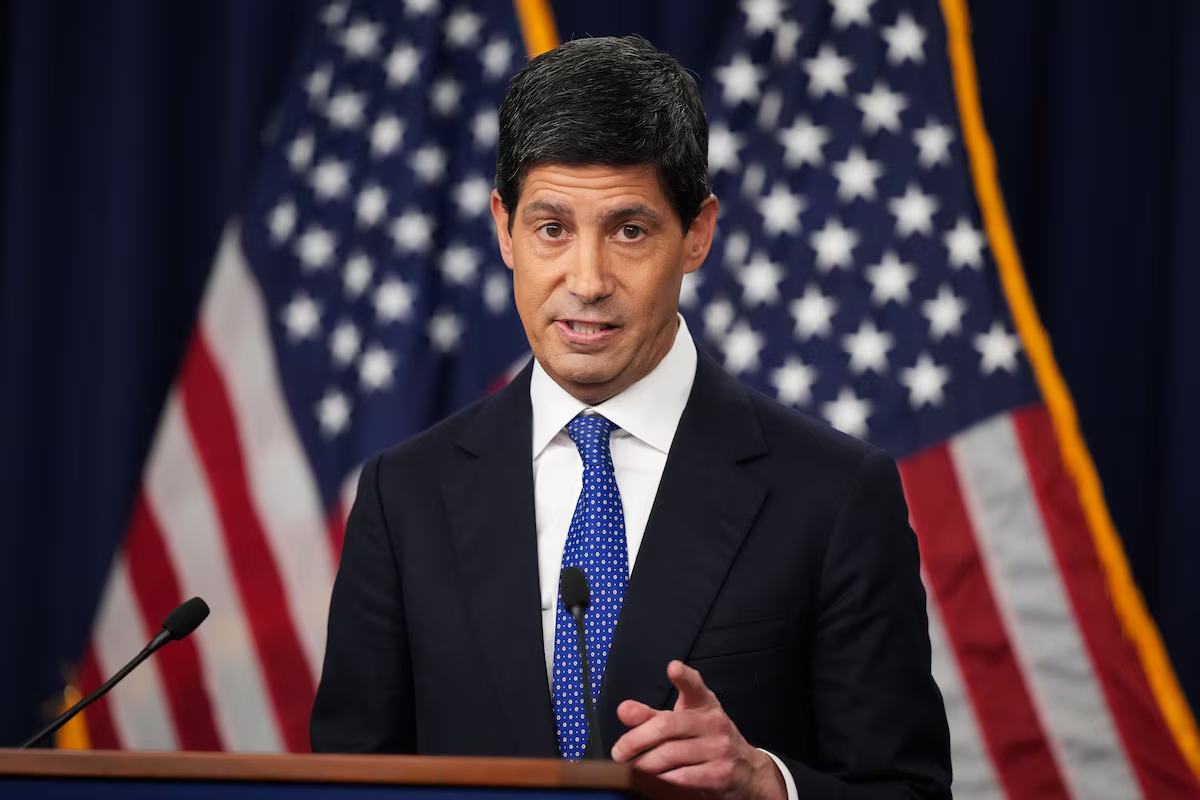

Open this photo in gallery:
U.S. Federal Reserve Chair Kevin Warsh speaks during a news conference at Federal Reserve Headquarters on Wednesday in Washington, D.C.Andrew Harnik/Getty Images
The Federal Reserve raised interest rates on Wednesday for the first time since 2023 in a bid to tamp down inflation, a move that drew criticism from U.S. President Donald Trump, who has implored the central bank to slash borrowing costs.
The policy-setting Federal Open Market Committee decided unanimously to raise its benchmark interest rate by a quarter of a percentage point to a range of 3.75 to 4 per cent. In a statement, it said the move would support a “timelier return” to the Fed’s 2-per-cent inflation target.
Since starting his term as chair of the central bank in May, Kevin Warsh has been closely watched by investors for signs of how he would handle the competing demands of reining in cost pressures exacerbated by the U.S.-Iran war, and the President’s wish for exceptionally low borrowing costs.
U.S. Federal Reserve Chair Kevin Warsh says the central bank raised interest rates by a quarter of a percentage point to address inflation, which remains above its 2 per cent target, and flagged further increases in borrowing costs in coming months.
Reuters
In his third decision as Fed chair, Mr. Warsh showed his commitment to the central bank’s inflation mandate, and his communications were generally viewed by investors as hawkish.
Mr. Trump criticized the move to raise rates, but stopped short of admonishing Mr. Warsh – unlike his frequent jabs at previous Fed chair Jerome Powell.
“Interest Rates in the United States should be 1%, or less, because we are the Best Credit in the World – BY FAR,” he wrote in a social-media post. S&P Global Ratings maintains a AA+ long-term sovereign credit rating for the United States, one notch below Canada’s top-tier AAA rating.
“LOWER THE INTEREST RATES FOR THE UNITED STATES OF AMERICA, AND FAST,” he added.
In a press conference on Wednesday, Mr. Warsh characterized the rate rise as removing “a dose of accommodation” from a strong economy.
“I would be hard-pressed to describe broad financial conditions as restrictive,” he said.
What the Street is saying after the Fed’s rate hike
Traders had priced in near-certain odds of a hike. But a jump in short-term U.S. Treasury yields after the decision suggested that they saw the materials accompanying Wednesday’s statement, and Mr. Warsh’s press conference, as more hawkish than anticipated.
“No one was surprised at the Fed hike today. What mattered was whether the Federal Reserve was going to indicate a lot more hikes or just one or two more,” Frances Donald, chief economist at Royal Bank of Canada, said in an interview.
“The culmination of their comments today tells us this is a baby toe stepping into a hiking cycle.”
The two-year yield, which is sensitive to market expectations of Fed interest-rate decisions, jumped more than a tenth of a percentage point to above 4.74 per cent after the Fed’s decision.
Fed policy projections showed that 16 of 18 policymakers anticipate at least one more quarter-percentage-point hike by the end of this year. Only two indicated expectations of rates remaining stable. Mr. Warsh, who has made limiting forward guidance a central theme of his leadership, did not submit a rate projection.
“I don’t think there was a single, especially hawkish element. Rather, it was the combination of several smaller signals,” Tiago Figueiredo, macro strategist at Desjardins, said in an e-mailed response to questions.
Open this photo in gallery:
A NYSE trader looks on near a screen after the U.S. Federal Reserve raised interest rates on Wednesday on the floor of the New York Stock Exchange (NYSE).Jeenah Moon/Reuters
He highlighted the lack of dissenters to a rate rise, the removal of an easing bias next year from policy projections and the slight increase in projected policy rate, as well as a higher inflation forecast.
Wednesday’s announcement followed U.S. inflation data released last week that was widely viewed as hotter than anticipated.
In the press conference, Mr. Warsh said that the strength of the U.S. economy and resilient labour market, inflation trends and geopolitical concerns – though he did not mention war in the Middle East specifically – had supported the decision to raise rates. Mr. Figueiredo said uncertainty around energy prices complicated the Fed’s outlook.
“Oil will remain the key wild card for monetary policy. If prices normalize relatively quickly, the committee may not need to raise rates much further,” he said.
“But the longer they remain elevated, the greater the risk that higher energy costs spill over into other goods and services, forcing the Fed to tighten policy again. I am not yet convinced that another increase will be necessary later this year, but the risks are clearly tilted toward a higher policy rate by year end.”
The benchmark U.S. 10-year Treasury yield, which had retreated on Wednesday morning, ended the day up 1 basis point to 5.02 per cent. One basis point is one one-hundredth of a percentage point.
Canadian government bond yields reacted little to the Fed decision. The five-year yield was unchanged at 3.659 per cent and the 10-year yield edged down one basis point to 3.941 per cent.
Canadian dollar hits 12-day low as inflation data meets expectations
“You’d be hard-pressed to say there was a dramatic readjustment in Canadian rates,” said Jim Gilliland, chief executive officer and head of fixed income at Leith Wheeler Investment Counsel Ltd. in Vancouver.
“The Canadian curve had already priced in a pretty significant amount of tightening and maintained that through the decision by the Fed,” he said in an interview.
Swaps markets pricing on Wednesday indicated expectations for between four and five interest rate hikes by the Bank of Canada by next June, which Mr. Gilliland said is “aggressive.”
“We think that’s probably overly discounted.”
Ms. Donald said that while many Canadians are focused on domestic interest rates, the five-year yield, which is dominated by moves in global bond markets, is more relevant to Canadians with mortgages.
“As goes the U.S. five-year, it will drag up or pull down the Canadian five-year as well,” she said.
“So, Canadians should spend just as much time thinking about the U.S. bond market as they do the Bank of Canada’s next move.”
With reports from Matt Lundy and Reuters