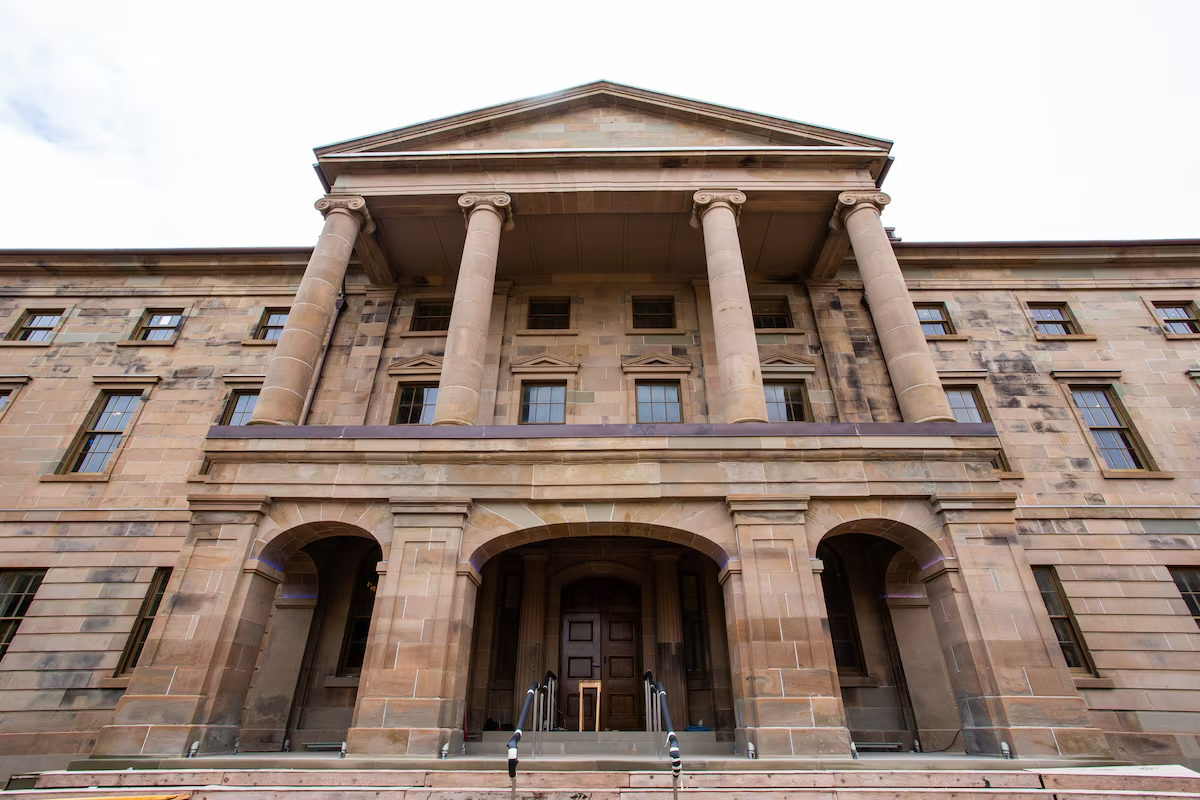
The stately sandstone building in Charlottetown where the idea of Canada was born has been fenced off from the public eye for more than a decade.
Province House National Historic Site, home to Prince Edward Island’s legislative assembly, had been at risk of crumbling to the ground.
The story of the building’s restoration and conservation should perhaps go down in the history books itself – for the near 12 years it took to complete, its giant, taxpayer-funded, $138-million price tag and the secrets that were unearthed inside its stone walls. The finishing touches are now under way and provincial politicians, some of whom have never walked its halls as lawmakers, will soon move in for the fall sitting of the legislature.
The newly restored building where a united Canadian state was first imagined is returning to the public sphere at an inflection point, when the foundations of that idea are being tested by separatist sentiments and an economic assault by the United States.
It was around midday on Aug. 31, 1864, when the S.S. Queen Victoria dropped anchor in Charlottetown Harbour, with $13,000 of champagne in its hold. PEI’s colonial secretary William Henry Pope rowed out to meet the delegates.
They included Sir John A. Macdonald, the man who would soon become Canada’s first prime minister; his nemesis George Brown, publisher of the Toronto Globe, an early incarnation of this newspaper before it merged with the Mail and Empire; and Sir George-Étienne Cartier, who would lead Quebec and eventually the Northwest Territories, British Columbia and Manitoba into Confederation.

Delegates from across British North America met in Charlottetown in 1864 to discuss a federal union. Province House was the main venue for their talks, but this photo, with John A. Macdonald seated at middle, was taken at the lieutenant-governor’s residence.
G.P. Roberts/Library and Archives Canada
Mr. Pope brought the group to the seat of PEI’s legislative assembly, the Colonial Building, as it was called at the time.
It was here, on the second storey of the right wing, between the faux marble pillars and around a long mahogany table, that 36 leaders from the colonies of Nova Scotia, New Brunswick and PEI, along with the Province of Canada (Ontario and Quebec) laid the groundwork for Confederation.
Within these walls, now freshly painted in Benjamin Moore Bryant Gold, the leaders forged an agreement in principle for a federal union. Their discussions – lubricated by boozy seafood banquets and balls held over a week – later became known as the Charlottetown Conference.
It led to the Quebec Conference that October, where 72 resolutions were drafted to form the foundation of the British North America Act, now referred to as the Constitution Act. That was signed into law in London by Queen Victoria on July 1, 1867.
The bronze plaque of the Fathers of Confederation dates back to 1914, the 50th anniversary of their meeting. The Confederation Chamber’s paint job, Benjamin Moore Bryant Gold, is a fresh addition.
While many different peoples form the fabric of the Canadian state, including Indigenous nations whose voices were not included or considered at the time, Confederation is still the template within which those relationships are negotiated, said Edward MacDonald, a professor emeritus of history at the University of Prince Edward Island.
More than any other building in Canada, he said, Province House is a symbol of that foundational pact. “It’s a physical emblem of the relationship that defines us as a nation, and all of the complexities, all of the challenges, and all of the accomplishments of Canada,” Prof. MacDonald said.
Designed by Isaac Smith and built between 1843 and 1847, Province House is Canada’s second-oldest legislature after Nova Scotia’s. Like many state buildings of the day, the design is neoclassical, influenced by Roman and Greek architecture with massive columns, symmetrical fronts and smooth stone walls.
When the restoration project began in January, 2015, the building smelled musty. Soot from decades of coal-burning heating systems and grit from disintegrating sandstone and plaster collected in every crevice. More than a tonne of dust was carted out before work even started.
Engineers discovered the mortar that held the walls together had disintegrated over the decades due to moisture. The walls had essentially become blocks of dry stone stacked one on top of one another.
Without the use of modern reinforcements such as steel beams or columns, workers meticulously rebuilt the walls from the top down, stone by stone, using red sandstone from PEI. They replaced 124 cubic metres in total using hammers and chisels – the same tools as the masons who helped build Province House. They spread 11 kilometres worth of mortar by hand and trowel.
Open this photo in gallery:
This sandstone, part of the original exterior, was kept exposed inside the building. Workers found many carved signatures and drawings left in the stone over generations.
True to how it was in the 1800s, there is no drywall to be seen – just plaster. It was made out of 78 tonnes of sand, carried inside in five-gallon buckets, along with lime and goat hair shipped from Wisconsin, which came packaged like sheaves of wheat.
Heritage plaster experts used a centuries-old technique to recreate walls and ceilings, and more than 600 metres of cornices, the decorative moulding located along the top of interior walls. They also recast hundreds of plaster embellishments for the ceiling’s medallions, which form ornate bases around light fixtures.
To restore the massive medallion on the Legislative Chamber ceiling, four heritage plasterers each hand-sculpted replicas of the flower, shell and acanthus-leaf embellishments out of clay. These were used to create silicone moulds to recast the embellishments in plaster. In an effort to preserve a historic look and to avoid a cookie-cutter appearance, the replicas were interspersed around the medallion at random.
Lead plasterer Kieran Reid of the architectural restoration firm Heritage Grade said the project was the biggest full historic plaster restoration project in history in Canada, even bigger than the work required for West Block on Parliament Hill in Ottawa, which he is about to start working on.
The most difficult room was also the most decorative and perhaps the most famous – the Confederation Chamber where the idea of Canada was hammered out, with its curved ceiling, arches and three large medallions. Mr. Reid said he spent a lot of late nights and early mornings over the two-and-a-half years he worked on the building to figure out how to “respect what happened in that room before.”
“There’s a lot of history in the building, but in that one room in particular, you can almost feel it when you walk in,” Mr. Reid said in an interview from his home in Ottawa.
Open this photo in gallery:
The view of St. Dunstan’s Basilica would be unfamiliar to the Fathers of Confederation: The stone cathedral, also a National Historic Site, was built later.
The builder likely felt it would become an important place, too.
One of the most treasured finds during the project was Isaac Smith’s signature, found scrawled in chalk on a structural beam along the underside of the southwest balcony in the Confederation Chamber. While there was some doubt at first about whether it was authentic, his descendants helped verify it with a copy of his personal Bible. The signature inside the Bible matched the one on the beam.
Open this photo in gallery:
One of the architect’s descendants helped confirm that this ‘Mr. I. Smith’ inscription was genuinely his.
The exterior of the building was also in rough shape. Much of it was rebuilt using sandstone from Wallace, N.S., from the same vein of stone that was originally used to build Province House.
Stonemason Robert Morrison of RJW Stonemasons spent 250 hours to rebuild one of the building’s eight Ionic capitals – massive decorative scrolls at the top of the columns in the façade.
Mr. Morrison, who previously worked on the Palace of Westminster and Buckingham Palace, has said it was one of the most technically challenging projects of his 41 years as a stonemason.
Open this photo in gallery:
Getting the stonework right has been a challenge: Workers had to hand-carve a new capital on the left column to match the original one on the right.
There has been much criticism about the length and cost of the project, which ballooned from an initial five-year timeline and $20-million budget to a near 12-year renovation that cost the federal government $138-million.
Parks Canada, which operates the site jointly with the province, oversaw the restoration. It said the delays were mainly due to the extent of the building’s deterioration, some of which remained hidden until work began. As a result, design plans had to be continuously adapted. The intricacy of the masonry and sourcing stones also caused delays.
In addition, the timeline was set back because two firms involved in the project went into receivership, requiring new tendering processes. On top of that, the COVID-19 pandemic slowed work and interrupted supply chains.
“You can pinpoint small little things as you go along that always delay,” said Ryan McGuire, senior project manager for Public Services and Procurement Canada, which is managing the project for Parks Canada. “But globally, the project itself has been a 10-plus-year project, and it’s those reasons that just accumulate and accumulate.”
Open this photo in gallery:
This basement corridor was part of the housekeeper’s quarters. The restored version has washrooms for the public and service rooms for water and power utilities.
Parks Canada acting project manager Chantelle MacDonald said the project came in on budget, despite the expanding cost. “It was just that it was allotted incrementally as the project evolved,” she said.
One aspect of the project that isn’t complete for the reopening is an interpretive exhibit meant to include perspectives of Black and Indigenous people, whose voices were not represented at the Charlottetown Conference. Black people lived in a historic neighbourhood in Charlottetown known as The Bog starting in the 1780s. Mi’kmaq have lived on the island for more than 12,000 years.
Ms. MacDonald said in a statement that the exhibit is on pause for now.
“To prioritize the reopening of the building for legislative use following the unforeseen challenges encountered late in the conservation project, Parks Canada put a hold on the interpretive exhibit for Province House National Historic Site to ensure full focus on the building’s completion,” she said.
Though the legislature will use the building beginning Nov. 3, there is still no official opening date for the public to visit the site. Ms. MacDonald said it’s difficult to identify a precise reopening date with a project of this complexity, though she added, “we expect the building to reopen to the public this fall.”
Open this photo in gallery:
Chantelle MacDonald from Parks Canada, right, says a public reopening is expected this fall, but pinning down an exact date is complex.
Despite the delays and setbacks, Prof. MacDonald, from the University of PEI, said the timing of the reopening is poignant.
Reflecting on pre-Confederation times, he said one of the factors driving the union of the colonies was fear of American invasion or annexation – a threat that’s dominating Canadian headlines thanks to U.S. President Donald Trump’s trade war.
“For the first time in generations, we have to think about the future of our nation-state with America, the neighbour and friend who suddenly appears to be a bully, talking about annexation, talking about the 51st state,” he said.
Even as a strong vein of nationalism presents itself in the wake of President Trump’s threats and punitive economic measures, those in some parts of the Confederation are voicing displeasure to the extent that they might consider leaving, Prof. MacDonald added.
In Alberta, a segment of the population is dissatisfied enough about their relationship with Ottawa to contemplate separation, with a referendum scheduled for the fall on whether a binding vote should be held.
And Quebec, which has held two such referendums and whose relationship with the rest of Canada remains at times tenuous, could put the sovereigntist Parti Québécois in power after an October election.
“It’s an important moment in Canada and, again, a building is a building, but a building is also a symbol,” said Prof. MacDonald.
“This building is a symbol of all those things, and for it to reopen at a time when reopening some of those debates is happening is a coincidence, but a significant coincidence.”
Open this photo in gallery:
Constructing Canada: More from The Globe and Mail
City Space podcast
Heritage conservation is a hot topic in Canada as cities, racing to build new homes, reassess what older buildings are worth. Two years ago, City Space took a deeper look at one famous case – Montreal’s Van Horne mansion – and how its demolition in 1973 still shapes our debates about preserving the past.
Ottawa’s political architecture
The history of 24 Sussex, the residence that’s been vacant for a decade
John A. Macdonald’s Ottawa home gets a British makeover
Opposition leader’s residence needs upgrades, but no workplan is in place