
Open this photo in gallery:
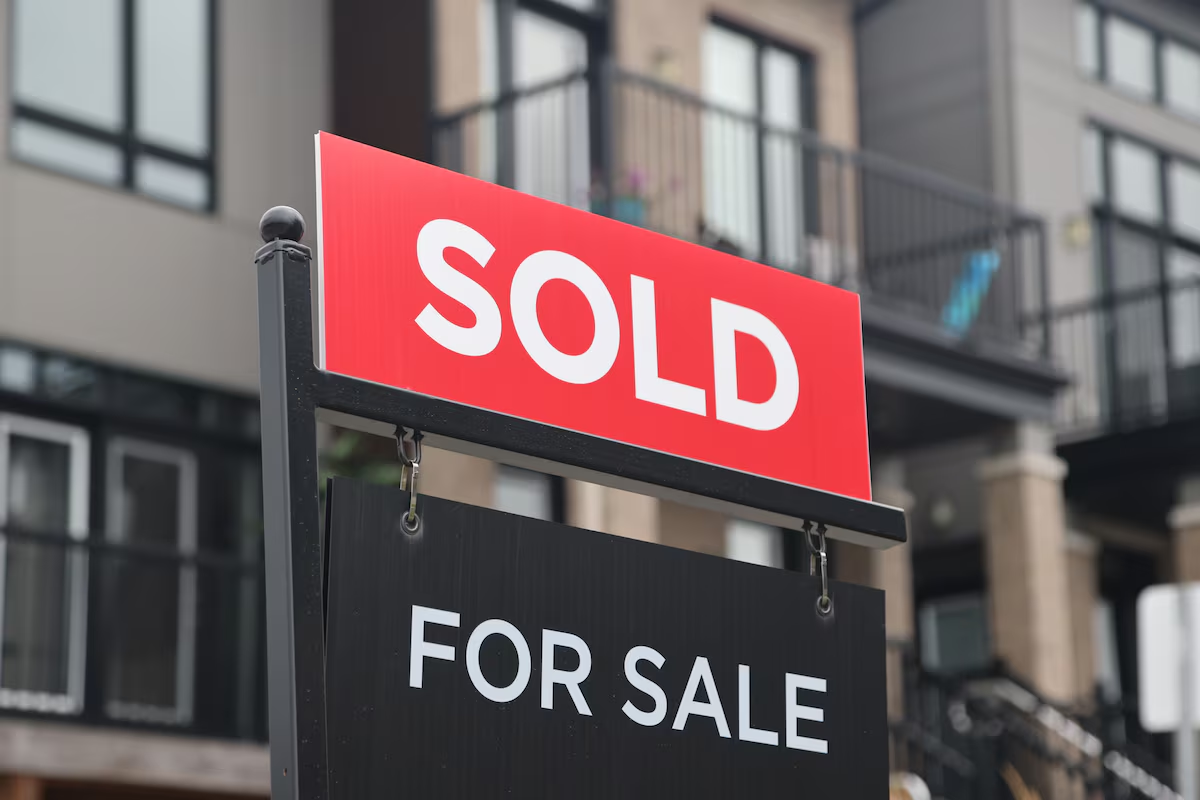
A for sale/sold sign stands in front of residential homes in the Riverside South neighbourhood of Ottawa, in 2024.PATRICK DOYLE/The Canadian Press
The bond market has gained increased attention in recent weeks as fluctuations and record highs affect consumers and investors alike, influencing inflation, mortgages and car loans, GICs, long-term bonds and more.
But what is a bond yield, how does the bond market work, why is it so critical to the global financial system and how does it touch Canada specifically?
Scott Barlow, a market strategist for The Globe and a 20-year veteran of Canadian investment banks recently joined The Decibel podcast and spoke with host Sherrill Sutherland to break it all down.
(Listen to the episode below, or find it on the podcast player of your choice.)
What is a bond?
It’s basically a contract where an entity borrows money and agrees to pay interest to the people who have lent it that money.
For instance, a government might say “I need money to pay my giant bureaucracy, so I’m going to give you a piece of paper and you’re going to give me $100. And I will give you interest payments twice a year of 5 per cent on that amount until the period of the bond is over.” It could be five or 10 years, which are common.
Governments and big institutional investors buy and issue bonds, right?
Yes. And consumers can buy them for their portfolios, too.
How do you make money from a bond?
If you buy a bond for $100 when it’s issued, for example, and there’s a 5-per-cent yield on it, you get $5 per year on the $100, and then you get the principle back at the end of the five-year period. That’s if you hold it, and it’s the simplest way of making money from a bond.
Or you can buy and sell bonds at different prices as the market changes. Say interest rates went up to 6 per cent from 5 per cent. The new bond will yield 6 per cent, but yours – the one you held – will only yield five. So, the value of the bond decreases.
U.S. Treasury or government bonds are considered one of the safest bond investments, and they influence the global economy, including Canada’s. Why?
Part of it is because the U.S. dollar is the global reserve currency. Also, the U.S. economy is so dominant. When their interest rates move, either everyone else’s rates move, or the value of their currency fluctuates quickly.
Bond yields have increased recently. How does this compare with where they’ve been previously?
Right now, yields are kind of where they were in 2023. But the concern is that they’re on a steady upward trajectory, and people are extrapolating that to mean significantly higher bond yields, a slower economy and weaker stock prices. And they may be correct.
The U.S. 10-year bond yield is trading around 5 per cent, which is an important philosophical number for U.S. investors. That kind of woke people up to that fact that we might be in a different environment with bond yields and interest rates. Longer-term bond yields are definitely a source of volatility in equity markets.
One thing to discuss are discounted cash-flow calculations. If someone said they’d give you $95 now or $100 18 months from now, there is an actual calculation that reveals the smarter way to do it. In other words, $100 18 months from now holds an actual value now. Interest rates are a big determinant of the present value of future money. The higher the interest rate, the more you want your money now. This is key because the higher the interest rate, or the higher the bond yields, the less future profits of stocks are worth.
Why are bond yields going up right now? What has been driving them?
Oil prices and tariffs, from a North American perspective. The central bank is concerned about something called contagion, which looks at the way higher oil prices trickle through the economy, creating higher gas prices at the pump, for example. If prices start increasing by 3 or 4 per cent, people start asking for raises because of affordability issues. This can lead to what’s called a wage-price spiral, which drives up interest rates.
With tariffs, U.S. goods we used to import at cheaper prices are now more expensive. Companies try passing the tariff cost to the consumer, which causes goods to increase in price, creating inflation. As a result, the central bank will raise interest rates in an effort to lower demand and slow the economy so that prices don’t spiral out of control.
Bond yields price off of the central bank’s policy rate, so if the Bank of Canada raises interest rates 25 basis points, for example, all things being equal, bond yields go up the same amount. That increases borrowing costs, which can slow the economy and ease demand so that prices don’t skyrocket.
Do bond yields reflect how investors view the state of the future economy?
The differential between short-term and long-term bonds can give a sense of where markets believe growth is going. The most common measure is the steepness of the yield curve, comparing two-year versus 10-year yields. In normal conditions, the 10-year bond yield is considerably higher than the two-year yield, and that indicates optimism that growth will improve.
It’s a bad sign for the market when the 10-year bond yield goes below the two-year. That happens very rarely, and it’s called an inverted bond yield. That’s when everyone really panics.
U.S. debt recently surpassed the $40-trillion mark. Why does that matter to the bond market?
A Treasury bond was generally viewed as 100-per-cent risk free and the most dependable asset you could buy. But the sheer scale of the debt is causing investors to question that dependability, and they may want a slight premium in terms of yield to mitigate risk. Maybe one basis point, or a half.
Are bonds now facing more investor competition from other sectors, like the AI industry?
Bond prices, the reverse of yield, are moving in the same direction as equities. So, bond prices are going up and down when equity prices do, which is unusual. Because of that, they’re not offering much in the way of diversification.
Under normal circumstances, if you hold an equity portfolio, you’ll add an allocation of bonds, and that will reduce the volatility of your overall portfolio. But that’s not the case now. So given that your return potential is higher in equities, and you’re not getting any diversification benefit from bonds, you’re going to buy more equities. And that’s not just with the AI industry but throughout the economy.
High bond yields make debt more expensive. Explain how that affects the consumer.
Take a mortgage or car payment. The lower the rate you finance, the lower your payments. So, the lower interest rates are, the lower your monthly payments are. Those rates are driven off of bond yields, and that’s how higher rates slow the economy.
What’s the significance to the Canadian economy specifically?
Canadians are facing inflation pressure at a time of sluggish growth, which is kind of a double whammy. It’s important that some of the tariff issues get resolved so the economy can start to grow and compensate for the downward pressure on growth that’s caused by higher rates.
Bond yields are currently high, but this isn’t the highest they’ve been, right?
1982 was the peak, and that was bad for the economy. They called it stagflation with ultra-slow growth and prices going up frequently. People were really suffering.
For context, then, where is the bond market at today?
There are two ways of looking at this. Looking at the short-term view, things are relatively orderly. But longer term, we’ve entered a new era where we can’t rely on ultra-low interest rates. Investors are used to an environment where interest rates always go lower, because that’s been happening since 1982 when they peaked.
During the pandemic and the financial crisis, we got used to near-zero rates, but they can’t go much lower. The trend over time may lead to steadily higher rates, say decades into the future. Hopefully, they level off and stay stable, but people are going to have to start thinking about a different investing environment, both consumers in terms of mortgages and also for investors who are valuing stocks.