Maritime first responders are advising against using AI chatbots for weather reports following a close call for a paddler on B.C.’s South Coast.
Jonathan Levine considers himself lucky to be alive after his kayak capsized in the ocean during what he thought would be a leisurely paddle in Howe Sound.
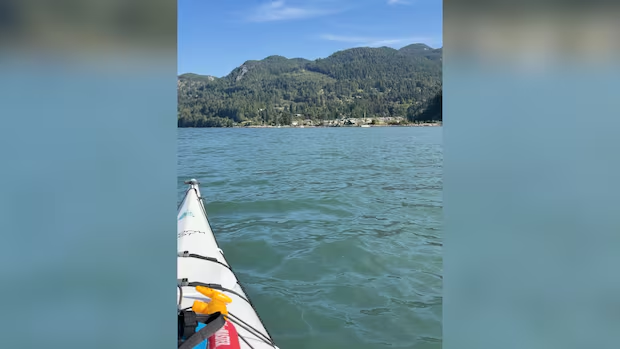
Levine and his wife Jane were eager to go for a morning kayak paddle on Sunday, as they’ve done many times, from their home in Furry Creek, about 35 kilometres north of Vancouver.
They tried to use an AI chatbot to determine the safest time to paddle after finding it difficult to get concise information online.
“We proceeded in the direction of Britannia Beach, as ChatGPT had suggested to my wife,” Levine said.
 Jonathan Levine was wearing a life-jacket when his kayak tipped over. (Jane Levine)
At first, it was sunny and seemingly calm, so the couple decided to stay out longer than planned.
That’s when they got into trouble.
“I hit these massive waves that came from nowhere. They were at least about five, six feet in height, and my kayak was rocking and rolling all over the place,” Levine said.
The Howe Sound commonly experiences strong winds in the afternoon on warm days due to the coastal fjords along and temperature differences. There can also be fairly strong currents due to the strong river outflow.
WATCH | B.C. man pulled from ocean by boaters after kayak capsizes:
B.C. man pulled from ocean by boaters after kayak capsizes
A B.C. man is lucky to be alive after strangers rescued him from the ocean. He and his wife went for a morning paddle from their home like they’ve done many times before. But as Alanna Kelly reports, conditions quickly changed.
As the couple rounded the corner at Minaty Bay, Levine’s kayak flipped, sending him plunging into the waves.
“The life-jacket was almost like trying to be wrenched off my body, basically because of the actual wave movement,” Levine said.
He tried over and over again to swim to the shore.
“Every time I kept swimming in one direction, [the waves] kept pushing me back,” Levine said.
 The couple was headed home and after passing Minaty Bay when tall waves caused Levine’s kayak to capsize. (Mike Zimmer/CBC)
Levine tried to stay calm while getting battered by waves for 15 minutes.
“I think as a human being aged 71, part of the advantages of being an old man is that you are probably quite clever in dangerous situations,” Levine said.
His wife, who was in another kayak, shouted to nearby boats and used her cellphone to call for help.
Strangers spot capsized kayak
Long-time sailor Adrian Ward and his friend, local firefighter Travis Welsh, were out for a boat ride near Minaty Bay when Ward noticed the bottom of the kayak floating amid the waves.
“As we approach, we’re starting to see waves crashing over his head,” Ward said.
The conditions caught Ward and Welsh off guard.
“We were just getting lifted up and down, six feet at a time, and it came on really quickly,” Ward said.
 Adrian Ward and his friend were on the water in a boat and rescued the kayaker. (Alanna Kelly/CBC)
Ward and his friend pulled Levine out of the water and onto their boat.
“He was really tired and a bit cold, not too cold, luckily,” Ward said. “Just really happy that it had a good outcome for the guy and that he got to go home.”
Levine was not injured and said the two strangers managed to get his kayak out safely, too.
“The two men were incredible, they calmed me down, they knew exactly what to do, they were so helpful,” Levine said.
His wife paddled safely to shore.
“She was a superwoman,” Levine said. “Without Jane, I wouldn’t be alive.”
 Jonathan Levine thanks his wife and two strangers for him being rescued on Sept. 13, 2026. (Alanna Kelly/CBC)
Staying safe on the water
Experts suggest checking multiple reports from verified sources for wind, tides and currents, rather than relying on artificial intelligence.
“Checking Environment Canada is important because they still have actual human eyes on those forecasts that understand thermal inflows and outflows,” said Scott Shaw-MacLaren, the coxswain with Squamish’s Royal Canadian Marine Search and Rescue.
“If you do, like, anything with AI, verify sources and read it for yourself.”
Shaw-MacLaren also suggests always having a marine VHF radio, as it’s the fastest way to alert other boaters if in trouble.
Brehnen Rowell, Officer in Charge at the Victoria Lifeboat Station with the Canadian Coast Guard, also recommends using multiple different sources and, in particular, the Government of Canada website.
“That’s really key for making sure you’re staying safe out there, is making sure that you’re aware of the currents and tides,” Rowell said.
Rowell said making a plan before heading out on the water and sticking to it is also important