Manitoba recorded the highest number of people signing up to be organ donors since its online registry was launched over a decade ago, but the vast majority of eligible adults still aren’t in the system.
With only six per cent of Manitobans enrolled, organ recipients and transplant advocates say the province needs to find alternatives to grow registration with the intention of saving more lives.
“The need is now. There is urgency to everything that we do … and the more donors we register, the more donors that consent, it benefits everybody,” Dr. Owen Mooney, medical director with Transplant Manitoba, said.
“I am much more likely to require an organ as are you than to ever be an organ donor yourself.”
Paul Meilleur was diagnosed with pulmonary fibrosis, a chronic condition that scarred his lung tissue, making it hard to breathe on his own and turning his active lifestyle into a daily challenge.
“I was basically laying on a couch, unable to move like 24/7 hooked up to oxygen,” Paul said.
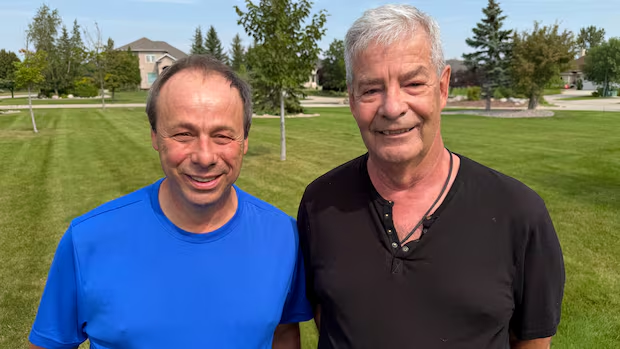
 Siblings Paul Meilleur, left, and Adrian Meilleur, right, said organ transplants saved their lives. They want more people to register as donors so that more lives can be changed. (Rudi Pawlychyn/CBC)
“Anything was a task … there’s really just very little that person can do, you’re just waiting for that phone to ring,” for a double-lung transplant, he said.
After months on the waitlist, Paul received the new organs in early 2025.
Paul’s brother, Adrian Meilleur, almost died from complications related to pulmonary fibrosis in 2015 before a lung donation saved his life.
The siblings say their story shows the importance of organ donations, and they want to see more people registering in Manitoba.
“We think we’re invincible. But, you know, just this one little thing … changes our lives just like that,” Paul said.
Around 75,000 Manitobans signed up to be an organ donor by the end of August, according to Transplant Manitoba.
The current number of registered donors has almost doubled since 2018, growing by about 23,000 in the last five years alone. But Dr. Mooney said the province still has “a long way to go.”
While public support for organ donation is “overwhelming,” he says that’s not being reflected in the number of people who’ve actually recorded their wish, and the need for organs is a constant in the health-care system.
Last year six people died on standby for a new organ in Manitoba, while 243 patients ended 2025 on the transplant list, according to an annual report from the Canadian Institute for Health Information.
Addressing the gap
At six per cent, the rate for organ donor registration in Manitoba is nowhere near enough, said Greg Unger, executive director with the province’s branch at the Kidney Foundation of Canada.
The majority of organ recipients in Manitoba have received a kidney transplant. Last year there were 20 living kidney donors, but Unger said the system is still heavily reliant on deceased candidates.
“Every new registration brings us closer to giving more people the chance to receive,” Unger said.
Under believes educating Manitobans about how the process works will increase registration.
“There needs to be more information out there. There needs to be more conversation,” Unger said.
When a person is a registered donor, next-of-kin are far more likely to consent to surrendering their organs if they become a candidate, Mooney said.
Family approval is needed when a person can’t directly accept the donation, including at sudden death.
“They’re not making the decision on the member’s behalf. They are armed with that information … so it is a no brainer for most,” Mooney said.
Intensive care units in the province have adopted a mandatory notification process where staff contact Transplant Manitoba when a patient is put on a ventilator, or when end of life discussion is planned, so families can talk about organ donation.
“If we were armed with the information about every single one of those patients … that probably would translate into more donations,” said Mooney.
Mooney said Transplant Manitoba is “limited within our ability” to reach prospective donors, particularly those who are not tech savvy or lack access to the internet.
Adding more ways to register could help, he says. For example, giving donors the option to register at MPI when getting or renewing their drivers’ licence, or when signing up for a health card.
WATCH | Organ donor registration reaches new high in Manitoba:
Organ donor registration reaches new high in Manitoba, with room to grow
About 75,000 people are registered as organ donors in Manitoba, amounting to about six per cent of eligible residents in the province as of the end of August, according to Transplant Manitoba. Advocates and transplant recipients wants to see the number grow with the government raising more awareness about how to sign up for organ donation.
MPI told CBC that customers are not asked about organ donation when getting a driver’s licence or an ID card.
“Any interface between the government and the public is important,” Mooney said. “We’re trying to capture as many people as possible to register their intent.”
Ontario, Alberta, British Columbia and Nunavut give residents the option to get more information about organ donation by ticking a box on their tax form. A spokesperson for the Canadian Revenue Agency told CBC provinces can opt in, but Manitoba is not participating at this time.
Unger with the Kidney Foundation would also like to see Manitoba consider using existing routine processes to ask residents about registering for organ donation or getting more information about it.
“Whatever can be done to make that more visible, [it] helps the people in need,” he said.
A spokesperson for Manitoba’s health minister said the province continues to work with Transplant Manitoba to promote organ donation and to look for opportunities to increase registration.
‘A second chance at life’
Eleven years after his double-lung transplant, Adrian said he has largely recovered the “normalcy” his chronic lung disease took away from him.
“I went back to hunting, fishing, doing all kinds of things with the grandkids and the kids,” Adrian said.
He wants others in need of an organ to get that same gift, and would like Manitoba to bring up organ donation more often.
“Ten years ago you used to sign up on your driver’s licence,” he said. “That question should be out there — ‘Do you want to become a donor?'”
But he said the infrastructure to retrieve organs also needs to grow in rural and remote areas to be reached quicker.
“A transplant will give you an opportunity,” he said. “It’s a new life. You’re given a chance. A second chance at life.”