
Open this photo in gallery:
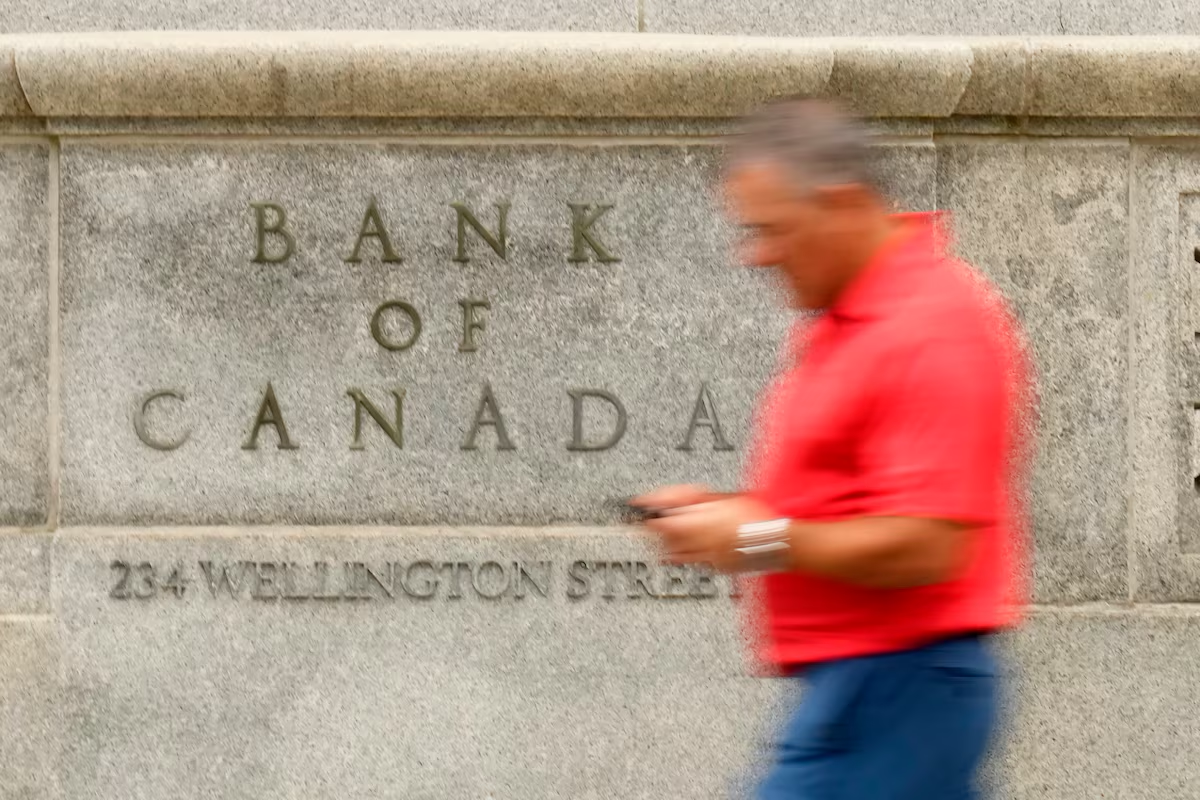
A man checks his phone as he walks past the Bank of Canada building in Ottawa. The BoC cut interest rates four times in 2025 and held it through 2026.Adrian Wyld/The Canadian Press
The Bank of Canada is expected to bide its time this week as it wrestles with an escalating trade war that risks pushing up consumer prices while hammering economic growth.
The odds of an interest-rate hike or cut were already low heading into the fall. Now, the breakdown of trade negotiations between Ottawa and Washington – followed by tit-for-tat tariff threats – makes it even more likely the bank will keep its benchmark interest rate steady at 2.25 per cent at Wednesday’s rate announcement, analysts say.
“The only option for the bank is to wait and see,” said Jeremy Kronick, CEO of the C.D. Howe Institute and chair of the organization’s monetary-policy council.
“We could go back to the negotiating table. I have a feeling the Prime Minister is going to want to have something positive when he hosts the investment summit on the 14th and 15th of September, so lots could change between now and then.”
In depth: From flower farmers to cheesemakers, meet the business owners and leaders affected by the trade war
On Aug. 22, U.S. President Donald Trump imposed new 50-per-cent tariffs on around $28-billion worth of Canadian exports after Mark Carney walked away from the negotiating table. Ottawa responded by outlining “dollar-for-dollar” countertariffs against U.S. products, which are scheduled to come into force on Sept. 8.
Ottawa’s retaliation will raise prices in Canada and add to headline inflation, which is already running hot because of the oil price shock tied to the war in the Middle East. Annual Consumer Price Index inflation hit 3 per cent in July – the top end of the central bank’s target range.
A Bank of Canada study of Canadian countertariffs imposed last year found that they raised the prices of targeted items by around 6 per cent and added 0.3 per cent to overall CPI inflation at the peak of the price shock.
At the same time, an escalation in the trade war could weigh on the Canadian economy more broadly if exports contract, businesses hold off hiring and investing amid the uncertainty and consumers get nervous.
“If the tariffs stick, they will have more of a growth impact than a lift to inflation,” said Avery Shenfeld, chief economist at Canadian Imperial Bank of Commerce.
“There is a modest one-time lift to the price level. Our estimate is on the order of 0.3 per cent, because many of the items that were chosen for tariffs in Canada are the very items where there are lots of substitutes. So, it’s not a big inflation impact, and if growth slows, you could easily put more downward pressure on inflation from increasing slack.”
Because the new U.S. tariffs only hit about 5 per cent of Canadian exports, Bay Street economists aren’t expecting them to have a large macroeconomic impact. CIBC pegs the hit to gross domestic product at about 0.5 per cent, while Royal Bank of Canada estimates the fallout at 0.4 per cent.
But the tariffs could have a major impact on the affected industries – including electrical equipment, plastics, clothing, paper and appliances – and hit Ontario, Quebec and British Columbia particularly hard. Canada’s retaliation, in turn, could disrupt supply chains, raise input costs and force Canadian companies to rethink their markets.
What trade war? Mortgage rates are in wait-and-see mode
Monetary policy, which adjusts financial conditions for the entire country, isn’t particularly well-suited for dealing with this kind of disparate shock. Targeted federal and provincial government relief for struggling businesses and workers tends to work better.
“Monetary policy … can’t target the hard-hit sectors: aluminum, steel and autos. It can’t help companies find new markets. It can’t help companies reconfigure their supply chains,” Governor Tiff Macklem said in October, 2025, the last time he cut interest rates.
“What it can do is it can try to mitigate the spillovers from the hard-hit sectors to the rest of the economy. And it can try and help the economy adjust to this structural change. But its role is limited because this is more than a cyclical downturn, it’s a structural change.”
Financial markets expect the central bank to remain on hold through the remainder of the year, before starting to increase interest rates in early 2027, according to Bloomberg data.
In some ways, this is a return to an earlier phase in the trade war, when Mr. Trump threatened wave after wave of tariffs, and Ottawa responded with three rounds of countertariffs on some $90-billion worth of U.S. imports – only to later walk back much of the retaliation last summer in the hopes of reaching a détente.
Throughout the opening months of the trade war, Mr. Macklem and his team decided not to rely on a central forecast, as is usually the case. Instead, they used a range of upside and downside scenarios that hinged on rapidly changing U.S. trade policy. The goal was to pick a path for interest rates that could work for a variety of possible tariff outcomes.
The Bank of Canada cut interest rates four times in 2025. It’s been on hold through 2026 as the key monetary-policy risk shifted from a tariff-induced recession to the oil price shock caused by the U.S. war with Iran.
If it wasn’t for the latest flare up on the trade front, the central bank was possibly inching toward an interest-rate hike. The oil-price shock owing to the closing of the Strait of Hormuz has lifted headline inflation; unemployment has been trending lower through the summer; and economic growth rebounded in the second quarter after essentially flatlining in the first.
Opinion: Can Canada afford the price of being ‘masters of our own destiny’?
The latest GDP numbers, published on Friday, showed that the Canadian economy grew at an impressive annualized rate of 3.3 per cent in the second quarter, ahead of the central bank’s forecast for 2.5-per-cent growth.
But ultimately, the argument for a rate hike in Canada has remained inconclusive, said Mr. Kronick of the C.D. Howe Institute. Core-inflation measures that strip out volatile energy prices remain close to the central bank’s 2-per-cent target. And financial markets are also doing some of the central bank’s work for it.
In recent months, Canadian bond yields – which underpin interest rates for mortgages and other types of loans – have risen alongside the sharp increase in U.S. bond yields.
“You’re getting a bit of that tightening, anyways, so I’m not sure you need to push that any further,” Mr. Kronick said. “I just don’t see evidence to move very much in either direction at this point, whether the trade situation was upon us or not.”