
Listen to this article
Estimated 5 minutes
The audio version of this article is generated by AI-based technology. Mispronunciations can occur. We are working with our partners to continually review and improve the results.
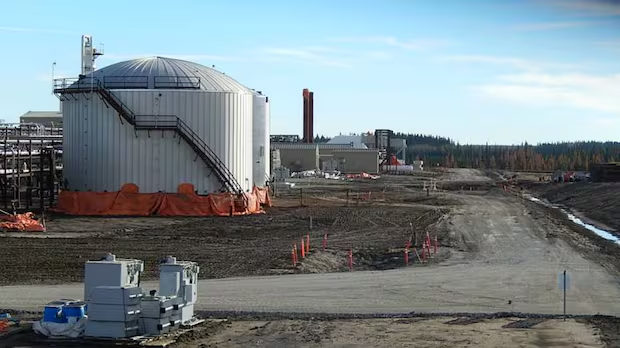
Warped boilers on the brink of failure, leaking steam valves, fractured gas lines and decaying unpurged pipelines with leaks that went undetected for months. These are the conditions that cost Sunshine Oilsands Limited control of its flagship thermal oilsands project in northern Alberta.
Sanctions ordering Calgary-based Sunshine Oilsands Ltd. to shut down and permanently decommission its West Ells project — located 115 kilometres north of Fort McMurray — have been upheld on appeal.
The operator had challenged a pair of orders issued by the Alberta Energy Regulator (AER) due to the company’s repeated failures to comply with its regulatory and environmental obligations. The AER ordered a suspension of operations two years ago.
But hearing commissioners said in their decision they did not believe Sunshine Oilsands is capable of bringing the project into compliance. Lifting the orders poses an unacceptable risk to the public and the environment, the panel wrote.
“We are not convinced that Sunshine will have the resources in the immediate future to execute any plan to restore reasonable care and measures or complete abandonment and reclamation,” the commissioners wrote.
“While the West Ells site may have future potential, Sunshine has not proven to be a responsible operator.”
Sunshine wants operations back
The regulatory battle began in November 2024 when the regulator ordered a suspension of operations. Sunshine Oilsands was also told to post a security deposit of more than $6.1 million to offset the anticipated costs of reclaiming its wells, pipelines and facilities.
A second order issued in May 2025 told Sunshine to decommission the site and abandon its assets. The AER cited a history of non-compliance and financial troubles.
Company officials urged regulators to rescind the sanctions, arguing that restarting production was the only way to resolve its severe cash-flow crisis and cover its debts.
 (Alberta Energy Regulator)
Sunshine claimed they could not make an immediate payment of the $6.1 million deposit after surrendering assets. They blamed regulatory failures on mistakes and a lack of money.
The panel dismissed Sunshine’s recovery plans as speculative and unrealistic, emphasizing that financial distress does not excuse an operator from environmental obligations.
“Sunshine attributed many of the major non-compliances to mistakes or lack of funding. Neither of these constitute a valid reason for not complying with AER requirements,” the panel ruled.
Company officials have not responded to requests for comment from CBC News. However, they told shareholders last week that they plan to fight the appeal decision by seeking a legal stay of the order in court.
History of regulatory violations
Hearing documents reveal a long history of safety and compliance failures of the now-shuttered West Ells project since it became operational in 2017.
Regulatory documents from the AER show the initial suspension followed 19 separate violations of environmental monitoring conditions. Inspectors later discovered monitoring stopped entirely because Sunshine stopped paying its workers and contractors, documents show.
A follow-up inspection revealed steam leaking from three locations along an active pipeline. Sunshine failed to report the leaks, investigate the causes or have a containment plan in effect on site.
By February 2025, the AER directed the Orphan Well Association (OWA) — the industry-funded agency tasked with cleaning up wells in Alberta that have been abandoned or no longer have a responsible owner — to take custody.
Regulatory documents detail how inspectors found unpurged and split gas lines, leaking steam valves, a sewage leak and faulty containment around storage tanks.
One steam-generation boiler was warped into an oblong shape, both on-site power turbines were dead and safety devices designed to detect explosive gases were bypassed.
Hearing documents state workers went unpaid for months — some for more than a year — and the only access to the camp was an unmaintained, 52-kilometre dirt road that was barely passable.
Mounting debts, contingencies
Sunshine officials told the appeal hearing that the company needs roughly $76 million to safely restart West Ells.
But the regulator calculated that simply regaining control and making necessary repairs would cost at least $37 million. That does not include $34 million in unpaid municipal back taxes, as well as unpaid wages and contingencies owed to the regulator.
AER’s compliance branch urged hearing commissioners to reject the appeal, arguing that the company has proven itself incapable of meeting its regulatory obligations.
“A promise that one will comply with a regulatory regime is not the same as compliance,” they said.
Sunshine’s assets will remain in the OWA’s custody. Its president, Lars De Pauw, said in an interview with CBC News that Sunshine’s assets are not considered orphaned.
While its assets were taken out of service, there is still a designated owner responsible for its eventual cleanup. De Pauw said it’s too early to say if the site will become part of the association’s inventory.
“The role of the association on the Sunshine oil sands assets at this time is just to provide reasonable care and measures,” he said.
“We’ve shut the facility in and we have site security in place. So in the scheme of our other operations, that order for that facility is quite minor relative to other work.”
The OWA’s latest annual report estimates total cleanup cost for all Alberta’s orphan sites reached a record $1.66 billion this July. De Pauw said the increase has been driven by a recent spike in insolvencies.