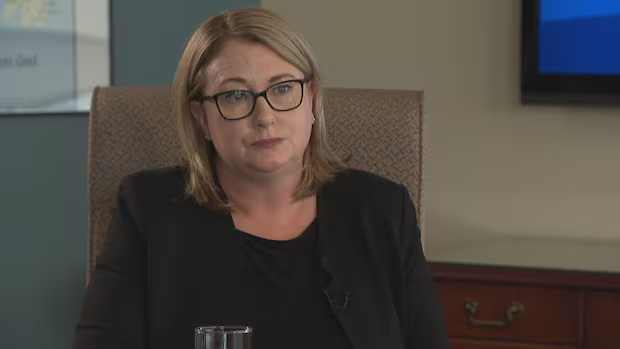
Newfoundland and Labrador Hydro president and CEO Jennifer Williams says the new memorandum of understanding on Churchill River power is “absolutely not” leading the way to contracts akin to the power purchase deal signed in 1969 by the Churchill Falls (Labrador) Corporation (CFLCo).
“What we have now is something I feel very good about,” she said, in an interview with CBC’s Carolyn Stokes.
The 1969 contract — which is still in effect — locked in low power rates for Hydro-Québec as a purchaser for decades, with comparatively little benefit for seller CFLCo when market prices for electricity shot up.
The new, three-way MOU between the province’s utilities and jointly-owned CFLCo was announced on Aug. 17, setting out the possible basis for a new sales contract, plus billions more in possible capital projects and power sales tied to the river.
Prime Minister Mark Carney was on the waterfront in St. John’s to trumpet the milestone agreement, joined by then-Quebec premier — now Coalition Avenir Québec candidate — Christine Fréchette and N.L. Premier Tony Wakeham.
What the text sets out, Carney said, is no less than “the biggest green energy initiative in North American history.”
 Newfoundland and Labrador Premier Tony Wakeham, then-Quebec Premier Christine Fréchette, and Prime Minister Mark Carney announced a new Churchill Falls deal in St. John’s on Aug. 17, 2026. (Ted Dillon/CBC)
From the point of the announcement, Williams has limited public comments. However, she sat for one-on-one interviews this week.
Responding to public commentary, she said the electricity being produced at the Churchill Falls power plant will not be sold at a flat rate, despite the phrase “fixed rate” sometimes used in public discussions.
“I want to be really clear that there’s significant escalation in this price,” she told CBC News, on how the proposed 50-year sales contract for Churchill Falls power differs from 1969.
WATCH | Jennifer Williams discusses new Churchill Falls deal:
In-depth interview with N.L. Hydro president Jennifer Williams
N.L. Hydro president Jennifer Williams explains to the CBC’s Carolyn Stokes why she believes the latest Churchill River power agreement with Quebec is the best deal for the province.
Under the arrangement, she said, with Newfoundland and Labrador selling the maximum amount of power to Quebec under a new premium, the price charged to Hydro-Québec to 2041 will reach 11.5 cents per kilowatt hour.
Williams and N.L. Hydro describes the initial period to 2041 as an average escalation of 14 per cent a year in price. It will continue to increase after that, at a slower rate, with an adjustment guided by the Consumer Price Index.
Without any agreement, Williams noted, the price until 2041 would continue under the existing contract, with Hydro-Québec paying just 0.2 cents per kilowatt hour.
The price, plus the extended length of the sales agreement, is in part a reflection of Hydro-Québec’s willingness to halt the existing contract 14 years early, she said.
Opening the deal up now, Williams added, offers the essential opportunity to deal on additional power generation on the river. She described that as necessary for N.L. Hydro to meet its mandate and feed industrial growth in Labrador.
2026: Higher stakes, N.L. choices
When the existing Churchill Falls power contract was signed, the undertaking was between Hydro-Québec and the private CFLCo.
Newfoundland and Labrador’s direct interest in Churchill Falls increased significantly in 1974, when the provincial government aggressively bought out private industry shares, ending up in a majority ownership of the power producing company, alongside Hydro-Québec’s minority holdings.
Regardless of the province’s new interest in the company producing power at Churchill Falls, the sales contract covering the bulk of power produced stood firm, and included only the slightest increases in what was charged over time. That’s even as energy prices rose to a far greater degree, more quickly.
 Government officials hope final terms of the new Churchill Falls MOU can be agreed upon by the end of the year. (CBC)
Beyond Churchill Falls power sales, including additions to the power plant’s capacity, the newly announced MOU sets the stage for contracts covering a separate development at Gull Island — a prospective dam site downstream on the Churchill River.
It would also support a new transmission line in Labrador, while making various organization and financial commitments for investigating potential, additional energy developments.
Changing goals: direct power sales
One of the main issues, and then-to-now comparisons, is the continued lack of ability for N.L. Hydro to directly sell to customers beyond Quebec.
The MOU instead lays out arrangements whereby additional electricity produced in Newfoundland and Labrador will be sold to Hydro-Québec for resale beyond, with formulated returns.
There will be payments back to N.L. Hydro, but it is not the same as the utility dealing directly with outside customers.
Williams made the point that the negotiators on the new arrangement have, “taken the reality of where the power is located” into account in putting the whole package together.
“We had to sit on somebody’s transmission lines or build new very, very expensive ones,” she said Wednesday.
She referred to the immense challenges in regulatory clearances and construction faced by Hydro-Québec in recent years when building transmission infrastructure into New England and New York State.
 The House of Assembly will reopen for a special debate on the MOU on Sept. 14. (John Gushue/CBC)
When it comes to specifically the idea of N.L. Hydro selling more Labrador power on spot market, she said, N.L. Hydro has returns designed to reflect Hydro-Québec’s contract pricing as the company sells South, suggesting it’s the better option for Newfoundland and Labrador.
“The price that you can get into New York — that we would get into New York — is around eight cents an hour, versus the spot market price may be five,” she said, talking about sales options and market risks.
It marks a fundamental shift in Newfoundland and Labrador’s power policy and aims, compared to the last Progressive Conservative government in particular.
It’s a shift Williams is standing behind.
A bigger pie
Overall, she described what’s on the table as an advancement from where things stood in 2024, when a different MOU was announced.
The last agreement, since expired, dealt with less power. It also didn’t have the same commitments from the federal government in the financing of the Gull Island development and new involvement of the Major Projects Office.
“I don’t know that we’ve necessarily had a lot of trade offs [compared to 2024]. What we’ve done is we’ve gone and said how can we make this better for everybody involved and bring the federal government in?” Williams said.
Politicians across the province will be part of a special debate on the MOU in the House of Assembly on Sept. 14.
The agreement speaks to trying to reach final terms by the end of the year.
Download our free CBC News app to sign up for push alerts for CBC Newfoundland and Labrador. Sign up for our daily headlines newsletter here. Click here to visit our landing page.