Deb Perelman has seen a lot of change online.
The food blogger’s popular site Smitten Kitchen turns 20 years old this summer.
“I’ve always had the philosophy that I would just meet people where they were,” Perelman said, which is why she established a presence on social media platforms from Twitter to Instagram to TikTok — but always took readers back to the recipes and stories on her website.
Now, she faces a new challenge: AI summaries.
 Deb Perelman, creator of the food blog Smitten Kitchen, has seen AI summaries eat into her website’s traffic. (Submitted by Deb Perelman)
Perelman said she’s seen “a summary or a chunk of my own recipe in the AI blurb that you have in the top of search results.”
“It’s honestly shocking to me that somebody can publish my work … without my permission,” said Perelman, who is now pursuing AI-limiting protections for her site.
Google recently reimagined the search box for the first time in 25 years, with “AI Mode,” a conversational back-and-forth that’s similar to using ChatGPT or other AI chatbots. This Google function has surpassed a billion monthly users.
 This screen grab shows the landing page for Google’s AI Mode. (Nora Young)
Beyond that, Google is also prioritizing extensive AI summaries over links to websites — the result being that people increasingly don’t need to leave Google’s main page to get an answer.
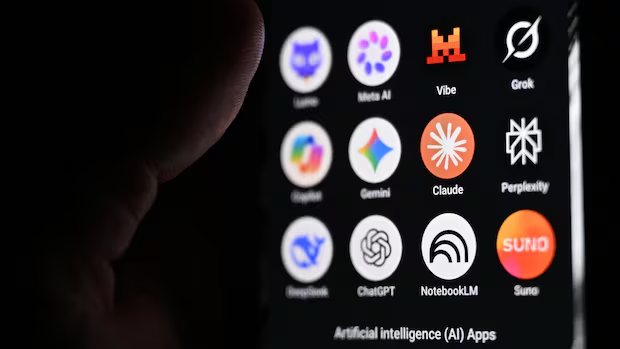
Similarly, you can rely on Claude, ChatGPT or other LLM chatbots to provide answers, recommend products or take on more complex tasks, like creating an itinerary for a trip.
It’s convenient, but it means big challenges for site creators who rely on human traffic. The web is being fundamentally reoriented to accommodate the bots that scrape websites for the information we seek.
Websites for machines as well as humans
Human web traffic is declining. Data from Cloudflare, a U.S. company that provides a range of internet services for websites and apps, found declines in human traffic across retail, software, IT and finance websites. Some hardest hit categories declined by up to 40 per cent between June 2025 and April 2026.
“The biggest impact is … machines going to read your content,” said Hamzah Khadim, co-founder of Toronto-based internet marketing service Logik Digital.
Khadim argues that as search has moved “from keywords to conversations,” the main goal for any website is not turning up in a list of links but being part of an AI’s answer.
Logik Digital has long specialized in SEO (search engine optimization), so that websites turn up in search results, but it’s now also focused on GEO (generative engine optimization). That means adding specific information that both indicates a site’s credibility and answers the questions a user is likely to ask AI.
Sometimes, that means adding a lot of text to a website — for example, in its “About Us” section.
“People aren’t gonna necessarily read all of that, but AI definitely will,” Khadim said. “And it’ll help establish trust.”
 The AI chatbot ChatGPT is shown on a smartphone in Mulhouse, eastern France. (Sebastien Bozon/AFP/Getty Images)
Getting paid for content and for the cost of scraping
While many independent content creators monetize their content on social media apps, through moves like brand partnerships, a lot of websites rely on selling ads or subscriptions to fund their content. So what happens if website visitors are AI bots and not humans?
Mark Surman, the president of Mozilla, best known for the Firefox browser, is concerned that “if those incentives to create original, creative, independent content disappear, does content just come from big and powerful companies, or from governments, or from AI itself?”
Even if a publisher is content to let AI have content for free and doesn’t rely on advertising, there are real costs associated with AI accessing web content.
Wikipedia is one of the most-visited websites in the world. Lane Becker is president of Wikimedia Enterprise, which makes Wikipedia content accessible to organizations at scale. From an access-to-information perspective, Becker is enthusiastic about AI spreading Wikipedia’s content.
Wikipedia articles are free for anyone to access, but the server infrastructure providing that content costs Wikipedia (or any website) a tiny bit of money. The sheer volume of requests from bots means that can really add up.
 Lane Becker, president of Wikimedia Enterprise, which operates Wikipedia, says just one bot can click on 50 articles in under a second. (Submitted by Wikimedia Foundation)
Becker says just one bot can click on 50 articles in under a second.
“It’s easy for one robot to show up and say, ‘Hey, I want to scoop every single page out of every single Wikipedia [edition] and every single language, and I’m going to do it in under half an hour.'”
So Wikimedia Enterprise has deals with a number of AI companies — including Google, Microsoft, Amazon and Meta — to pay for direct, bulk access to Wikipedia’s data.
A new deal for the AI-native web
Other media companies may start pushing back, too, if the decline in web traffic continues. According to reporting by the Wall Street Journal, Reddit and some other prominent publishers are considering cutting off or changing their relationship with Google.
USA Today’s CEO recently said the “traditional Google search business model is dead … that traffic is declining … so we are going to be in a position soon where we have to block Google.” He seemed to signal a willingness to forego showing up in Google search results at all.
But hope remains for a model that would preserve the open web and its diversity of voices.
For Deb Perelman, AI summaries miss something you can only get from the individual perspectives of creators.
“The context of a recipe is really important,” she said, arguing “you’re not going to get that from a blurb on top of a search result that has been extracted, perhaps correctly, perhaps incorrectly, from the actual recipe.”