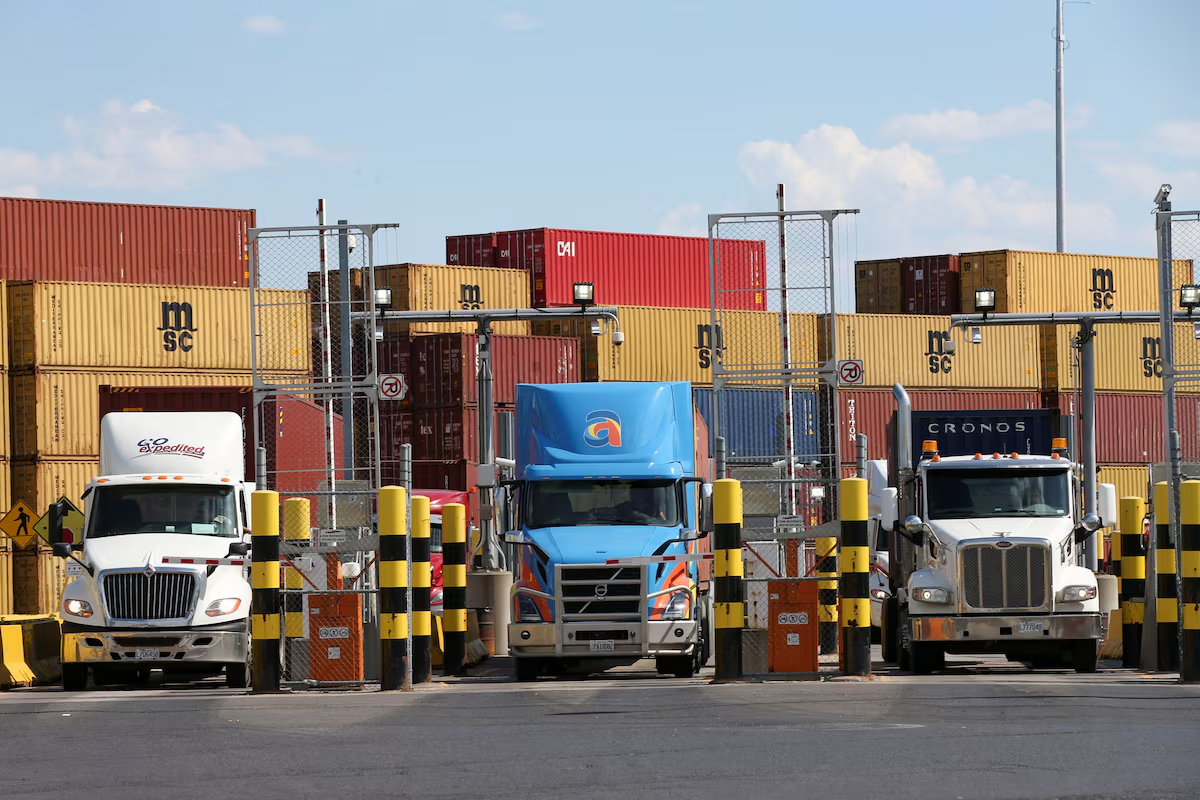

Open this photo in gallery:
Trucks loaded with shipping containers leave the Port of Montreal in Quebec in 2021.Christinne Muschi/Reuters
The Quebec government will require inexperienced truck drivers from Ontario to pass a practical exam to obtain a licence, after a provincial Auditor-General’s report this spring pointed to lax training in Ontario’s trucking sector.
Quebec has been grappling with an increase in the number of fatal collisions involving heavy vehicles in recent years.
According to the new temporary measure announced on Thursday, Ontario truck drivers with less than 24 months’ experience will have to pass a road test to obtain a Class 1 heavy vehicle licence from Quebec’s auto insurance board, the Société de l’assurance automobile du Québec. If they fail twice, they will have to undergo training.
The rule will not affect Ontario drivers who travel through Quebec roads, but only those who move to the province.
“Road safety is paramount,” Quebec Transport Minister Benoit Charette said in a statement on Thursday. “We want to ensure that the people on our roads are qualified.”
Open this photo in gallery:
Quebec Transport Minister Benoit Charette said ‘road safety is paramount,’ in a statement on Thursday.Jacques Boissinot/The Canadian Press
In May, the Ontario Auditor-General’s Office reported private career colleges in that province were accrediting aspiring commercial truck drivers who had not completed minimum training requirements, and in some cases were altering student records to falsify their qualifications.
In a news release on Thursday, Quebec’s auto insurance board said the report “highlights the need to strengthen oversight of training and licensing programs to ensure that drivers on the roads are adequately qualified.”
Mr. Charette told Montreal’s La Presse that the new rule will remain in place until Ontario can demonstrate that it has tightened its rules.
Marc-André Gauthier, director of communications with Teamsters Canada, said the trade union welcomes all measures that improve road safety, but added that Quebec’s new rule doesn’t tackle the root of the problem. He said the real culprits are not individual drivers, but predatory trucking companies that exploit them.
Regulators urged to step up inspections and enforcement in trucking sector
In May, a year-long Globe and Mail investigation documented the illegal misclassification of truck drivers as self-employed workers to evade payroll contributions and strip them of basic rights.
Mr. Gauthier said that practice leads to safety risks, because trucking companies have little incentive to ensure self-incorporated drivers are properly trained.
“They don’t have standards to uphold,” he said. “We really believe that it’s the companies that should be targeted, not the truck drivers themselves.”
This week, The Globe published a further investigation that found nearly 100 trucking companies with a history of safety infractions, labour violations and other regulatory failures have been granted approval by Ottawa to hire temporary foreign workers since 2019.
In its 2025 road-safety record, Quebec’s auto insurance board reported that 102 of 371 fatalities that year were the result of collisions involving heavy vehicles – the largest number since at least 2020. The increase is a “big concern,” Mr. Gauthier said.
The Ontario Auditor-General’s report found that while large trucks represent about 3 per cent of all vehicles on provincial roads, they accounted for 12 per cent of all fatal collisions between 2019 and 2023.
Long-haul truckers susceptible to wage theft, survey shows
Last fall, Quebec’s Public Security Minister ordered a public inquiry into fatalities involving heavy vehicles after a truck crashed into a car in August, 2025, killing a woman and her five-year-old son. The provincial government also imposed mandatory training for Class 1 licences last December.
Quebec’s trucking association says employers in the province have repeatedly raised concerns with the government about heavy-duty truck drivers from Ontario. “We know that many self-incorporated drivers and their employers are operating in the Ontario region; this measure is a first line of defence to protect our companies, their drivers, and all road users,” president and chief executive Marc Cadieux said in a statement.
The Quebec government has also announced a working group to look at road-safety requirements for temporary foreign workers. Mr. Charette told La Presse that someone arriving in Canada who has never driven in winter, for example, “may have a little trouble getting their bearings.”
With reports from Sara Mojtehedzadeh