
Open this photo in gallery:
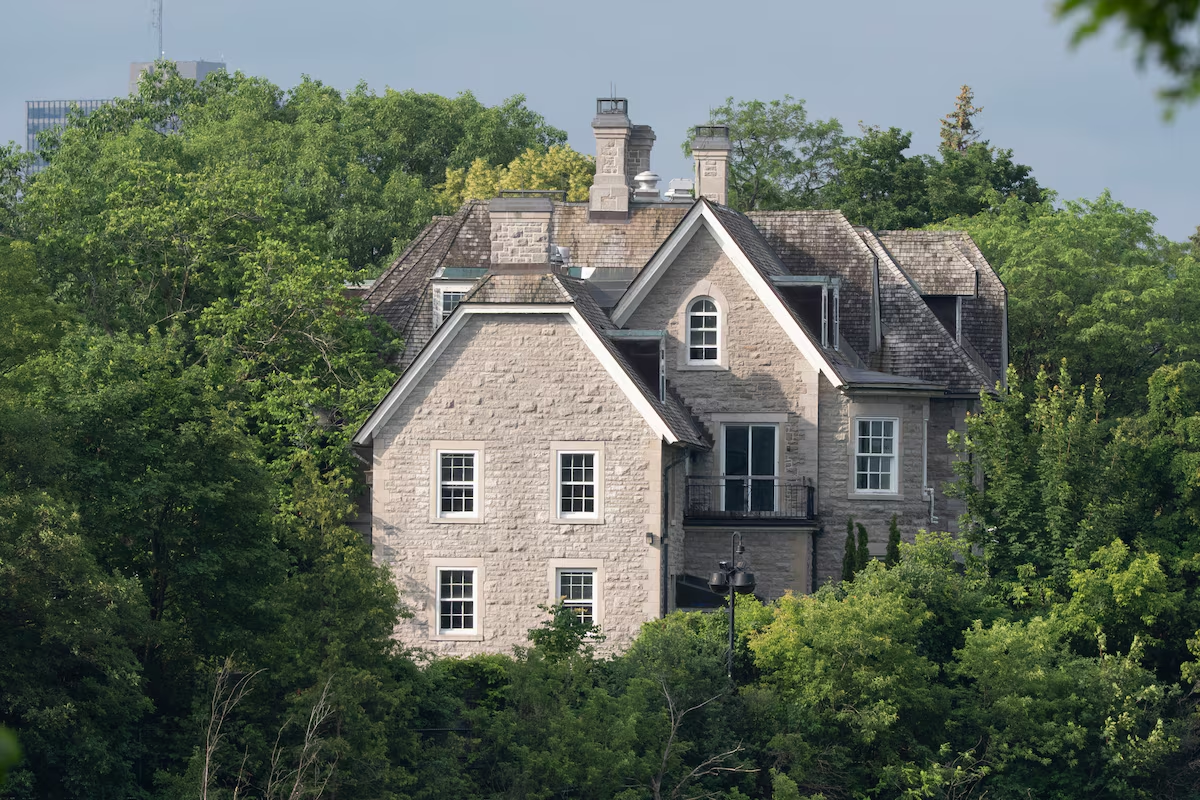
The federal government is holding a Canadian-only ‘design-build competition’ to renovate 24 Sussex Dr., the residence of the prime minister in Ottawa.Adrian Wyld/The Canadian Press
What is Canada all about? Is it a place where cultures flow together above a great river, a land of stone and mighty trees? Or is it a place of cozy oligopolies and timid bureaucrats?
The recent news about 24 Sussex Dr., the residence of the prime minister, suggests the latter. On June 26, Prime Minister Mark Carney announced a process to renovate and expand the house, which has been decrepit for years. That is overdue.
But the government is going about this work in the wrong way. This project should generate a flagship of Canadian architecture and a symbol of a country looking forward. Instead, it’s apt to serve up something bland.
For 24 Sussex, Mr. Carney has announced the government will hold a Canadian-only “design-build competition.” A jury of professionals led by architect Moshe Safdie will choose a design proposal, picking among teams that each include designers and builders.
Ottawa sets Aug. 15 deadline for companies to indicate interest in renovating 24 Sussex
That package deal is a serious problem. The government won’t be hiring the architects with the best ideas; it will hire the best architects who have business relationships with any of a half-dozen large construction companies. Already, no doubt, Canada’s design talent is being sorted by the business development team at EllisDon.
Mr. Carney has also called for private philanthropy to fund the rebuild. That is unfortunate – a signal that Ottawa is too timid to spend money on a place of symbolic value. Government should build well and unapologetically. If the opposition wants to score cheap points by complaining, let them so diminish themselves.
As it is, this design-build pass-the-hat will likely follow the lead of recent public buildings in Ottawa, including the temporary homes of the House of Commons and Senate. These are design-by-committee exercises in golf-club conservatism. That is not what Canada should be projecting to itself or the world.
There is another, better way. The term “design competition” implies that an independent jury will examine competing design proposals and choose on qualitative grounds. The design team with the best idea will get the job. Builders are hired separately. This is how excellent public buildings are produced in Quebec, and in much of Europe; it is also how Parliament Hill got built.
Open this photo in gallery:
The Canadian flag blows on the Peace Tower on Parliament Hill.Sean Kilpatrick/The Canadian Press
The best version of a competition would be anonymous and open, leaving the door ajar for ideas that could move the culture forward.
The building at 24 Sussex deserves just this kind of attention. After becoming the prime minister’s official residence in 1951, it had served increasingly as a venue for state events, until relatively recently. Canadians know the address, even if they know nothing about the house.
Perched above the Ottawa River, the building is a cipher. Completed in 1868 as a lumber baron’s mansion, it was altered by a later owner and then by the government in the late 1940s. A now-forgotten firm of Toronto establishment architects, Allward & Gouinlock, refaced it, fusing Château style and Georgian Revival. Architecturally, it is a dull Canadian compromise. Its interior, now gutted, was a forgettable mélange of mid-century décor. In 1970s photos, it looks like the house of a suburban podiatrist.
Open this photo in gallery:
Former prime minister Pierre Trudeau hosts a meeting at 24 Sussex with provincial premiers.POOL/The Canadian Press
In its next chapter, it must be fit for a head of government, and also a flagship of Canadian architecture. The house should be contemporary in spirit: open to the seasons and the changing light of the Ottawa River; built for a changing climate; ambitious in exploring colour, detail and form. The finishes, furnishings and art should come from leading Canadian artists and makers. (Not to mention the landscape, which is crucial and has so far been ignored.)
There is still time for Mr. Carney to alter the process and push for such a result.
In doing so, he should also reconsider the role of an outside group, the Royal Architectural Institute of Canada, which is “supporting“ the project.
RAIC is a century-old advocacy group for Canadian architects, but in the past decade it has become very close to the federal government. Between 2019 and 2025, it was involved in design procurement or review on four projects in Ottawa and was awarded contracts with an estimated total value of more than $5-million. It was also awarded a six-figure contract to administer the recent design competition for a Parks Canada visitors’ centre in Banff.
The institute’s presence in such matters seems redundant. For the Block 2 office building competition in Ottawa, the government also hired Phase Eins, consultants who specialize in running competitions. Why not just hire such professionals directly?
Most likely, Public Services and Procurement Canada lacks the confidence to do so. An outside voice insulates the civil service from political pushback if the project ends up being costly, as it will, or if the designers make choices that are politically unpopular.
Official Opposition leader’s residence needs upgrades, but no workplan is in place
Which can happen. In 2020, a competition for a monument to Canada’s Afghanistan mission was won by a team including architects Daoust Lestage. The Trudeau government faced pushback from veterans groups who disliked the design, and it appeared to cave, overruling the competition jury by relying on a dubious online poll. The winners had their project taken away and a more populist choice is now being built. Architecture advocates should have been up in arms. But RAIC said little.
Coziness engenders mediocrity. And that explains why Canada, a country of brilliant creative minds, has built badly over the past 40 years. The élan that characterized the work of Arthur Erickson, Cornelia Hahn Oberlander and Raymond Moriyama has faded. A small group of large design firms controls public projects, and the quality isn’t getting better.
None of this is inevitable. Designing and commissioning buildings is a core task of government. Mr. Carney would do well to remember that architecture is culture as well as business. Ottawa should have the judgment to commission great architecture, and the guts to do so.