
A Canadian accused of being the leader of one of three global drug trafficking rings targeted by U.S. law enforcement this week previously had only a faint brush with the law, keeping a much lower profile than the other two alleged gang leaders who are in prison in India.
Court records show Ravinder Dhanda, 57, of Surrey, B.C., spent the past 20 years running non-descript trucking companies and only appears in an unrelated court case as a one-time target of a police wiretap.
Lawrence Bishnoi, 33, and Jaggu Bhagwanpuria, 38, are both high-profile prisoners in India who were accused Tuesday of running separate transnational networks from behind bars.
The three men were among 37 suspects, 24 of whom were arrested, in connection with a multiyear investigation probing three separate organizations that allegedly engaged in a range of crimes such as racketeering, killings, shootings, extortion and drug trafficking across the globe.
At a news conference in Los Angeles, the U.S. Department of Justice, Federal Bureau of Investigations and head of the RCMP alleged Mr. Dhanda, also known by colleagues as “John Wick,” headed a sophisticated cocaine and methamphetamine smuggling network for traffickers in the U.S., Canada, and Mexico.
Bishnoi gang leader charged in connection with slaying of Nijjar
A grand jury indictment unsealed this week alleges Mr. Dhanda had help running his ring by corrupting a Canada Border Services Agency employee to get crucial information on when guards may be inspecting trucks coming back north over the border. The employee is not identified.
Two other Canadians that police said were tied to Mr. Dhanda were also among the people charged across three unsealed indictments targeting three separate transnational gangs. One of them had successfully avoided deportation following drug charges in 2008.
None of the allegations have been proven in court.
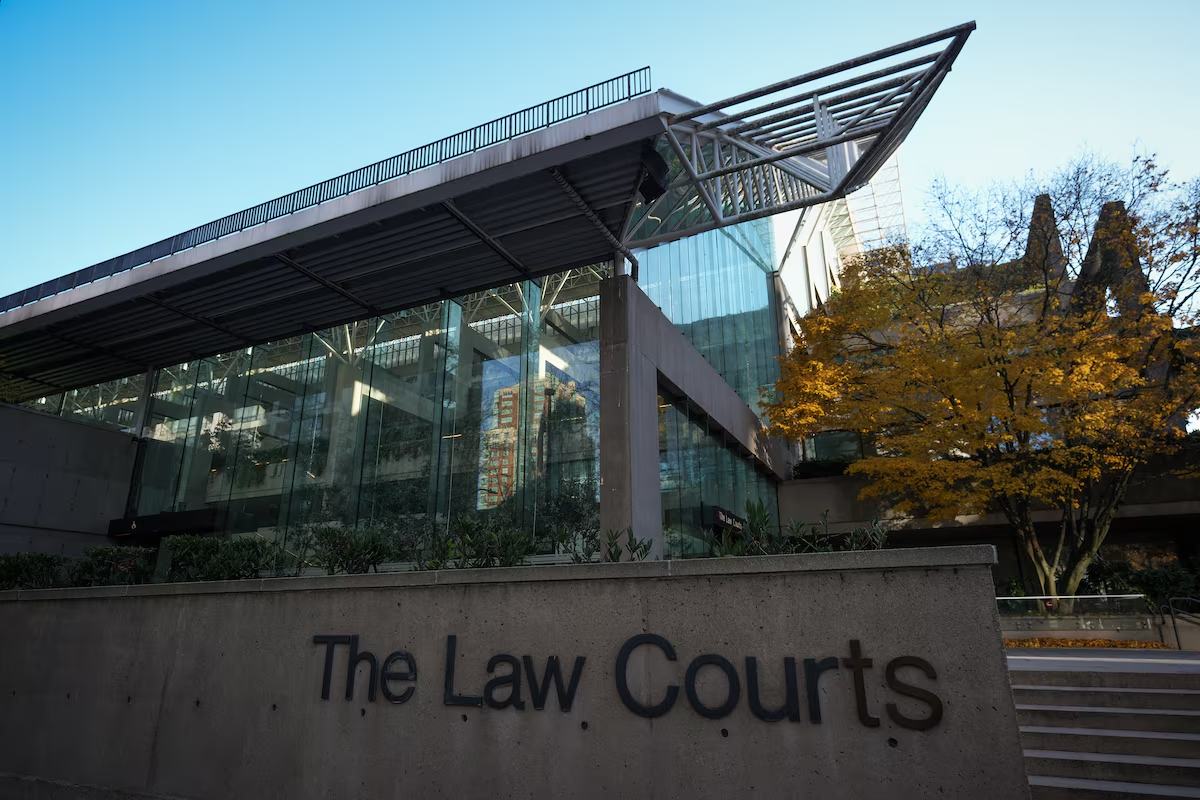
This week, extradition proceedings began in Vancouver’s B.C. Supreme Court for Mr. Dhanda and his co-accused, Jaskarn Baghri, 50, of Surrey, B.C., and Gurtej Singh Smagh, 43, of the Kootenays town of Creston. All were arrested in B.C.
An eight-count U.S. indictment alleges Mr. Dhanda’s organization transported, smuggled, and distributed hundreds of kilograms of cocaine and methamphetamine from the U.S. into Canada, by hiding the contraband inside long-haul trucks leaving the Los Angeles area each week.
Between the summer of 2023 and November, 2024, his group allegedly smuggled 430 kgs of cocaine, the indictment alleges.
Mr. Dhanda had designs on conquering more of the illicit market, according to the indictment, which states he allegedly told an informant at a meeting in South Surrey at the start of last year that he “intended to start a new ‘cartel.’”
Convicted drug smuggler allegedly flees Canada after court blocked attempt to revoke bail
Mr. Dhanda grabbed the attention of B.C.’s organized crime unit in 2007 after it targeted him for a wiretap over suspicions he was exporting mass amounts of cannabis to the United States and conspiring to import cocaine, according to a 2014 provincial Court of Appeal ruling on an unrelated matter.
But he was never charged, spending the ensuing two decades operating two different trucking companies licensed to haul goods across the U.S.
Former regional RCMP leader Brad Desmarais said there would have been dozens of similar wiretaps filed in and around Metro Vancouver each year during that era, with most resulting in charges. But, he said, there could be a number of reasons why a wiretap fizzles, including there not being enough evidence to merit a charge, the suspect is captured providing exculpatory evidence, they turn into a confidential informant themselves or laying charges would put another informant at risk.
The RCMP did not respond to questions about what happened to the 2007 investigation of Mr. Dhanda.
Mr. Desmarais said he is not surprised a border agency employee was allegedly targeted by organized crime groups, which, he noted, search for any way to maximize profits like their cutthroat counterparts in legitimate sectors.
The CBSA refused to comment this week on whether it was investigating the agent said to have been helping the Dhanda organization. A spokesperson for the border agency referred The Globe and Mail’s questions to the RCMP, which then referred them to its American counterparts – stating it does not comment on such allegations unless the work of the Mounties has resulted in criminal charges.
Ottawa declines to say if working theory in Nijjar killing investigation still faults Indian government
Court and immigration board records show that Mr. Dhanda’s co-accused Mr. Smagh was previously convicted of cross-border drug smuggling in the U.S. in 2008 but was allowed to stay in Canada after his release.
The Immigration and Refugee Board overturned an attempt to deport Mr. Smagh, who goes by Raj Smagh, from Canada as further punishment because an adjudicator found it was in the best interest of his family members and child if he stayed.
“I note that the appellant does not appear to have family left in India. He testified that his only paternal aunt will be immigrating to Canada shortly. I am satisfied that he would suffer some hardship by reason of his dislocation, given his family ties to Canada,” adjudicator Erwin Nest found.
Mr. Smagh, a cherry farmer from Creston, B.C., had been sentenced to nine months in jail in Washington state in 2007 for possession of marijuana with intent to distribute.
Court records show he was charged with assault with a weapon and uttering threats for alleged offences that occurred in November, 2016, but one of the charges was withdrawn and he was given a peace bond and $500 fine.
Mr. Smagh’s lawyers in the immigration case, the U.S. criminal case and the assault case in B.C. did not immediately respond to requests for comment.
Court filings show Mr. Baghri did not have a criminal record in B.C., and was a truck driver, according to a civil lawsuit after filed after he was injured in a crash.
With files from Steph Chambers and The Canadian Press