
Open this photo in gallery:
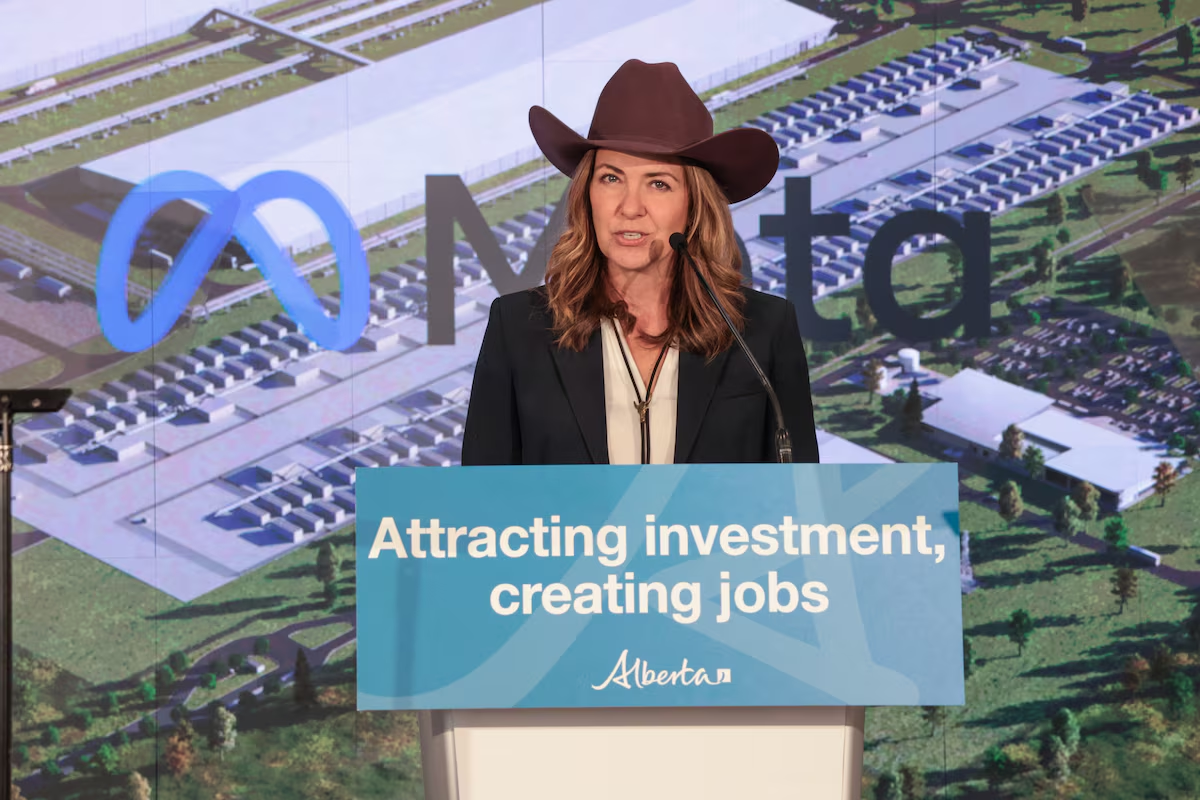
Alberta Premier Danielle Smith participates in the announcement of the major investment in the AI sector during a press conference in Calgary on Wednesday.AHMED ZAKOT/The Globe and Mail
Tech giant Meta Platforms Inc.’s META-Q decision to spend $13-billion on an Alberta artificial intelligence data centre is expected to boost the fortunes of the province’s utilities and natural gas power producers, while renewing environmentalists’ calls for increased investment in renewable energy.
On Wednesday, Facebook parent Meta confirmed it will be the latest hyperscaler to build big in Alberta, with plans for a 1-gigawatt facility in Sturgeon County, north of Edmonton.
The project, which will consume roughly three-quarters as much electricity as the entire city of Edmonton, will be powered by the nearby $4.6-billion Greenlight natural gas-fired plant, which was announced last year.
Meta to spend $13-billion to build AI data centre in Alberta
A consortium led by Calgary-based Pembina Pipeline Corp. is building the Greenlight facility. Edmonton-based Capital Power Corp. also announced a long-term, 250-megawatt power contract with Meta this week.
“The [Meta] investment demonstrates that global hyperscalers are willing to commit meaningful capital to Alberta, supporting the broader thesis that AI-driven demand growth can create incremental opportunities across the power and natural gas value chain,” said analyst Robert Hope at Bank of Nova Scotia in a report.
“The project also improves confidence that additional large-scale data centre developments could follow, supporting future demand for generation, transmission, natural gas supply and related infrastructure,” said Mr. Hope.
Five years ago, Meta rival Amazon.com Inc. launched a $4.3-billion data centre in the Calgary suburbs. Analysts say Pembina, Capital Power Corp. and other Alberta utilities are negotiating with additional data centre operators.
Alberta has rolled out the welcome mat for tech companies at a time when numerous North American jurisdictions, including Manitoba and Hamilton, Ont., and U.S. states such as Michigan and Georgia, have stopped or slowed data centre developments over concerns that fuelling the facilities will result in higher electricity prices for other consumers, including homeowners.
The Alberta government earned praise from analysts for landing Meta’s project without risking significant increases in electricity costs, and for ensuring projects use minimal amounts of water for cooling.
When the Greenlight plant comes online, the provincial government projects ratepayers will see a decrease of up to 6 per cent on their electrical bill’s transmission costs.
The Alberta government is only approving data centres that come with what it calls a “Bring Your Own Power” or BYOP agreement with a utility such as Pembina or Capital Power.
Meta will also use what it called a “closed loop” cooling system the company claimed will draw less water than a typical Alberta golf course.
“The announcement adheres to Alberta’s goals to keep electricity reliable and affordable, protect its water resources, and ensure that major projects pay their own way,” said analysts Maurice Choy and Robert Kwan at RBC Capital Markets in a report.
Alberta utilities will benefit from more stable cash flows as they lock in large long-term contracts with investment-graded companies like Meta and Amazon, according to the RBC analysts.
“We like that the provincial government’s BYOP framework may lead to a somewhat synchronized build-up of load and generation capacity,” said the RBC report. “These conditions can offer the generators better cash flow visibility and opportunities to grow through new asset developments.”
Alberta utilities that stand to profit from the AI build out include TransAlta Corp., Canadian Utilities Ltd. and TC Energy Corp., along with Pembina and Capital Power, said the RBC analysts.
Open this photo in gallery:
Meta’s planned AI data centre, its first in Canada, to be constructed in Sturgeon County, Alta., is seen in an artist’s rendering.Meta/Reuters
Alberta is landing data centre developments while the provincial government pumps the brakes on renewable power. In 2023, the government halted renewable project approvals for seven months. It then introduced a regulatory regime that has discouraged investment in alternatives to natural gas, such as wind farms and solar facilities.
Environmental groups such as the Calgary-based Pembina Institute said the Alberta government’s focus on fossil fuels, a major source of provincial revenue, means the province is missing out on potential private sector investment in renewable energy as a source of data centre electricity.
“The Alberta government could have announced cheaper, low-carbon solutions that wouldn’t expose consumers to higher and more volatile energy rates,” said David Pickup, director of electricity at the Pembina Institute, in a report.
Under the BYOP rules, “developers like Meta are effectively forced to choose gas-fired generation, rather than allowing them to choose a combination of technologies to power their operations,” said Mr. Pickup.
Even companies with a seemingly distant relationship to Alberta’s AI boom, such as construction equipment resellers Finning International Inc., are getting a lift from the data centre boom.
Vancouver-based Finning, which sells Caterpillar Inc. equipment, stocks a line of natural-gas powered engines that has begun to compete with power plant turbines made by companies such as Siemens Energy and Mitsubishi Power. In the past, Finning products were primarily used to supply back-up power, as turbines are cheaper to run.
Power producers are now waiting up to five years for natural gas turbines, owing to data centre demand, opening the door for Finning. In a report, analyst Jonathan Goldman at Bank of Nova Scotia said that for the foreseeable future, Finning will sell up to $300-million of engines each year to data centre power suppliers as its equipment “emerges as a viable alternative” to turbines.
Finning’s stock price is up 40 per cent over the past 12 months.