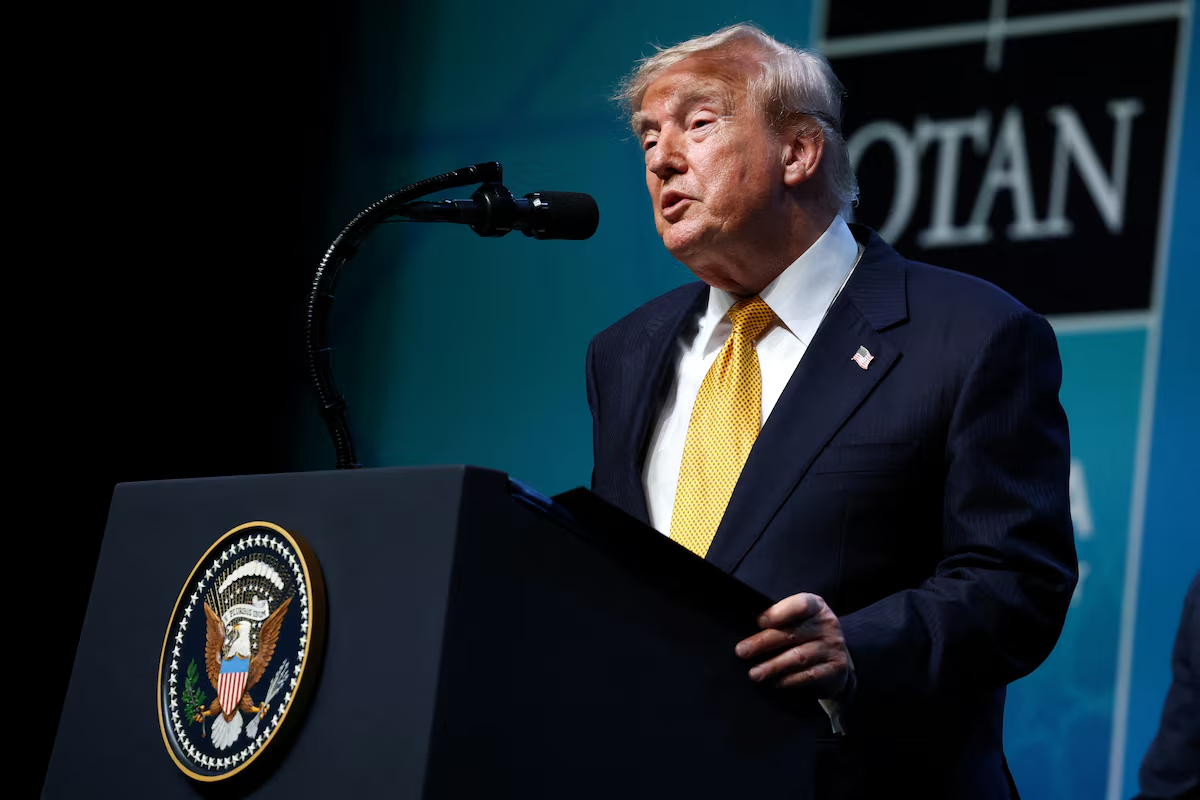

Open this photo in gallery:
U.S. President Donald Trump speaks during a press conference on the day of a NATO leaders’ summit in Ankara, Turkey, on Wednesday.Stoyan Nenov/Reuters
During its decade-long involvement in the Vietnam War, the United States military lost nearly 10,000 aircraft.
That nearly unfathomable figure reflects the awesome manufacturing capacity of mid-20th century America. It also illustrates the limits of American political will and power, even at the peak of that power.
Despite the expenditure of so much American treasure and blood in Vietnam, a smaller, weaker, poorer opponent forced the U.S. to yield.
Washington fought the war on a calendar measured in months, whereas North Vietnam’s timescale was decades. And while Hanoi suffered far more dead and wounded, the totalitarian regime could accept that.
The side willing to endure more punishment for longer, won. With a lower pain threshold than its adversary, and a shrinking domestic constituency for an endless war, U.S. political leaders from both parties eventually agreed that they had to find a way out.
U.S., Iran trade escalating attacks across the Mideast, threatening fragile ceasefire
Washington ultimately negotiated a face-saving exit from Vietnam, in which it agreed to leave while its adversary conceded essentially nothing. In the end, America stood aside as the governments it had backed in South Vietnam, Laos and Cambodia were crushed.
For Iran, that history is a vision of the future. It’s why the Strait of Hormuz is still mostly closed. It’s why the war in the Persian Gulf still isn’t over.
U.S. President Donald Trump badly wants the strait open and the war closed. That’s why he agreed to a memorandum of understanding last month that, in return for a promise to reopen a waterway that had been wide open before the war, lifted sanctions on Iranian oil for 60 days, dangled the prospect of far larger rewards, and effectively made Iran’s permission for shipping to resume in the Persian Gulf conditional on the U.S. restraining Israel in Lebanon for the benefit of Iranian-backed Hezbollah.
The MOU also contains a commitment to hold an umpteenth round of talks on limiting Iran’s nuclear program. It’s a transparent fig leaf, designed to cover Mr. Trump’s naked retreat.
However, the agreement to have the U.S. pay Iran a ransom started falling apart the minute it was signed.
The United States launched new air strikes against Iran early Thursday, and Tehran responded by targeting Bahrain, Kuwait and Qatar in crossfire that again threatened an interim deal intended to help end the war.
The Associated Press
The main reason – why Iran started taking shots this week at ships in and around the Strait of Hormuz – is because Tehran negotiates a bit like Mr. Trump. It wrested concessions in the MOU and now it wants more. It believes, not unreasonably, that it can once again force Mr. Trump’s hand by once again leveraging its power to raise oil prices through a squeeze on the strait.
If you spend your time reading the President’s Truth Social feed, none of this computes. Didn’t he annihilate Iran’s military? Isn’t Iran begging for a deal?
Nor does it make sense if you consume more left-leaning American media, where this is Mr. Trump’s war, it’s resumption must be his fault, and the answer is to just, um, you know, stop the war.
It is beyond dispute that Mr. Trump made a terrible mistake starting this war, but Tehran has been in the driver’s seat for some time. It appears to be counting on its ability to compel further Trump retreats, using the chokepoints of oil prices and American politics.
There is a strong anti-war sentiment among both Democrat and Republican voters. There’s also a strong bipartisan desire for low oil prices. It’s why Mr. Trump is in a hurry to be done with the war, whereas Tehran is not.
U.S. carries out more strikes on Iran after Trump says ceasefire is ‘over’
From the mid-1960s until America’s exit from Vietnam in 1973, U.S. troops suffered nearly 60,000 dead.
In the Iran war, in contrast, 13 American service personnel have died, while 42 U.S. aircraft have been reported destroyed or damaged. For most American voters, it’s already too much for too little. The Iranians know that.
The prize Iran is chasing is the ability to toll the Strait of Hormuz. It’s trying to force ships and the countries of the Persian Gulf – American allies all – to pay protection money to ensure the “safety” of their oil and gas shipments. (Safety from what? Safety from Iranian attack.) It’s a straight shakedown. It would remake the Middle East.
However, even though caving in to Iranian demands would be terrible for America’s regional allies and U.S. global standing, it would lower oil prices, at least in the short term. That’s what happened after Trump’s previous cave-in delivered the MOU.
Iran wants peace, but on its terms. Tehran understands that Mr. Trump’s political priority remains low prices at the pump. Iran can deliver – if he just makes a few more concessions.