
Listen to this article
Estimated 5 minutes
The audio version of this article is generated by AI-based technology. Mispronunciations can occur. We are working with our partners to continually review and improve the results.
The cost of the new Gordie Howe International Bridge connecting Windsor and Detroit is still $6.4 billion CAD despite multiple delays, according to the federal authority overseeing the project.
“The $6.4 billion is still the total contract value,” said Tara Carson, a spokesperson for the Windsor Detroit Bridge Authority (WDBA).
The Canadian government has footed the bill for the construction of the entire span and plans to recoup the costs through tolls over the next several decades. Once that’s done, Canada and the state of Michigan, which co-own the new crossing, will share the revenue.
The project’s price tag dates back to early 2024, when the WDBA announced that due to “unprecedented disruptions as a result of the COVID-19 global pandemic,” the bridge would open in 2025 instead of 2024, and that the cost had gone from $5.7 billion to $6.4 billion.
At the time, the WDBA said that its deal with Bridging North America — the consortium of private companies designing, building and maintaining the new crossing — “provides for the schedule and cost impacts of certain risks to be shared.” The parties had agreed to amend the contract, the statement said, to include “new measures to ensure” the project stayed on track.
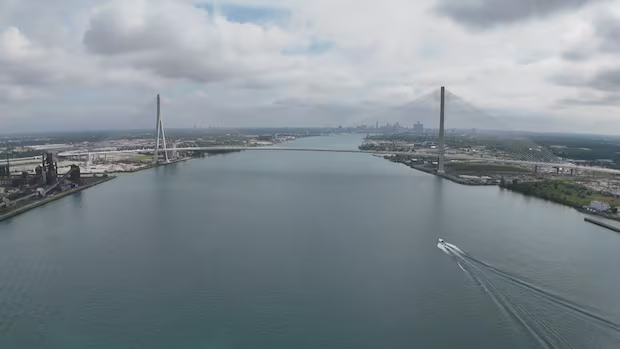
 The Canadian side of the Gordie Howe International Bridge seen in June 2026. (Jacob Barker/CBC)
More than two years later, the bridge is still not open. The WDBA had maintained up until last month that the crossing would open this spring. But on June 11, the authority announced that Canada and the U.S. had “agreed to delay the opening of the bridge, taking the necessary time to resolve any outstanding issues.”
The additional delay came a few months after U.S. President Donald Trump threatened to block the bridge’s opening unless Canada provided concessions. That threat followed a significant lobbying effort and political donations to Republicans from the Moroun family of Michigan, the owners of the existing Ambassador Bridge, which is expected to lose toll revenue once the new bridge down the river is open.
‘I don’t know what to believe’: MP
Asked about the cost to taxpayers remaining the same, the local MP said he doesn’t “know what to believe” from the bridge authority anymore.
“When you tell me that the price is still at $6.4 billion, even though this was supposed to open last year in September 2025 and we are well into now July of 2026, somebody’s paying for this bridge,” said Windsor West Conservative MP Harb Hill. “There are people working there; somebody’s absorbing that cost, so I would love to know exactly what’s going on.”
 Windsor West MP Harb Gill in the House of Commons in 2025. (ParlVU)
Carson, the WDBA spokesperson, suggested Friday that the private sector partners could be absorbing costs.
“The Gordie Howe International Bridge project is being delivered as a public-private partnership (P3), meaning it is a fixed price contract,” she said by email. “One of the benefits of a P3 is that risks are appropriately shared between WDBA and Bridging North America. For instance, cost overruns are shifted from the taxpayer to the private sector.”
Asked for an update on when the bridge will open, she pointed to the WDBA’s statement three weeks ago announcing the delay.
Gill expressed frustration over his inability to get details about the delays from the Liberal government — and said it points to a bigger issue.
“This has become now a test of Canada’s political and economic leadership,” he said. “For weeks we have heard the conflicting stories about when this bridge is going to open.”
Last month, Carney pointed to “a series of technical aspects” when asked about the delay, but he would not elaborate.
“If there is a technical issue, just tell us what it is,” Gill said. “If it’s a diplomatic issue, tell us that as well. Either way, people here deserve an honest answer, and they’re not getting that.”
Gill submitted several written questions in the House of Commons about the costs and delays the day after the most recent postponement was announced. He said he has not yet received a response. The government has until September to reply.
U.S. ambassador says higher cost factoring into delay
U.S. Ambassador to Canada Pete Hoekstra, speaking on a podcast this week, said the higher-than-expected project cost is a factor in discussions around opening the bridge.
“We have a bridge that has come in significantly over budget and has come in significantly later than original forecasts. That has changed the business model,” he told the Food Professor podcast.
WATCH | Hoekstra claims it’s ‘big myth’ that Canadian government is paying for bridge:
U.S. Ambassador to Canada joins food podcast to comment on Gordie Howe bridge
U.S. Ambassador to Canada Pete Hoekstra joined a Canadian podcast this week and was asked about the Gordie Howe International Bridge. He said the business model surrounding the multi-billion dollar bridge has changed, and argued that it’s a “big myth” that Canadian taxpayers paid for the new crossing. The CBC’s Emma Loop breaks it down.
“What both governments said when the bridge opening was delayed a couple of weeks ago is […] ‘Let’s get this all ironed out before we move forward in terms of how the business case has changed,’ because it’s very, very different than when the original agreement was signed, what, 12, 15 years ago?” Hoekstra said.
“Things have changed. That’s what we’re working on.”
Hoekstra also argued that border traffic in the Windsor-Detroit corridor isn’t increasing, so the Gordie Howe bridge will simply take away revenue from the other crossings.
“You’re going to actually pay for the bridge by moving revenue from either the tunnel or the [Ambassador] bridge and moving it to the Gordie Howe Bridge,” he said.
Commercial truck traffic at the Ambassador Bridge is down because of higher tolls.
Hoekstra’s office said he was not available for an interview with CBC Windsor.