
Open this photo in gallery:
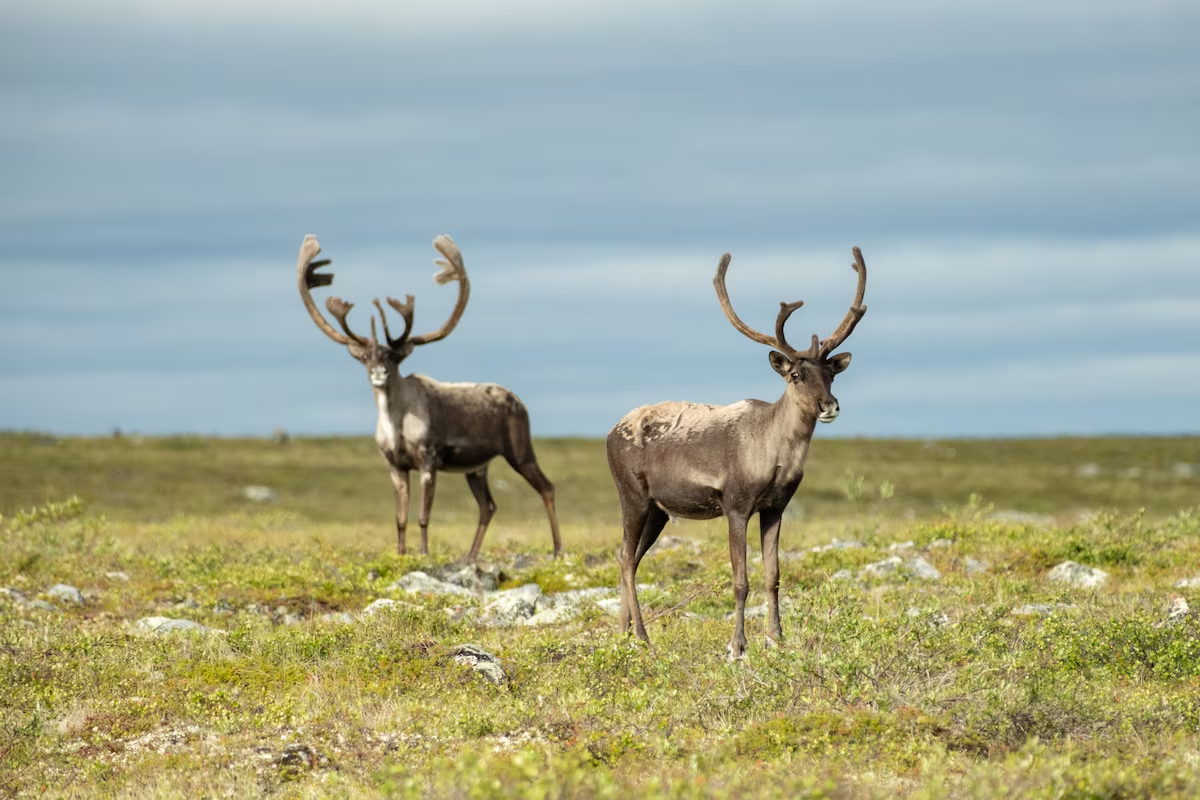
Barren-ground caribou roam the tundra near Contwoyto Lake, Northwest Territories. The federal government and the government of Quebec say they’re confident that a deal to protected endangered caribou populations in the province will be reached.PAT KANE/The Globe and Mail
Environmentalists are divided on whether a new funding deal reached between Quebec and the federal government is a meaningful first step to saving the province’s dwindling caribou herds or a smokescreen that does little to protect the threatened species.
The agreement announced Tuesday will see Ottawa send Quebec $25-million over five years to spend on caribou conservation initiatives, as well as another $15-million to Indigenous communities who are implementing their own programs.
The deal signals an end to the years-long federal-provincial battle over caribou that began in 2022, when then-federal environment minister Steven Guilbeault threatened to act unilaterally to protect the herds if the province failed to submit a concrete plan to save them.
Opinion: Steven Guilbeault is on a collision course with Quebec over caribou-protection measures. Will he blink?
Ottawa’s threat drew strong condemnation from Quebec’s political class, who accused the Liberal federal government of trying to interfere in provincial jurisdiction. While Guilbeault renewed the threat in 2024, the federal government never issued a federal decree to protect caribou territory.
Quebec, which has committed to $59.5-million between 2024-28, says it will use the new federal funding to continue initiatives such as boosting habitat conservation and restoration, as well as managing the wild herds it has been keeping in enclosures in recent years.
The executive director of environmental group SNAP Québec says the deal is “a step in the right direction.”
Alain Branchaud says it reflects an openness by the Quebec government to collaborate with Ottawa on caribou protection, which includes the province agreeing to publish reports on how it’s using the money.
“For the first time in a few years, there’s really an openness from the Quebec government to work with the federal government and to share information, to report on actions that will be taken with the transfer of money from the federal government,” he said.
A statement that accompanied Tuesday’s announcement says that the federal government “has chosen, at this time, to pursue a collaborative approach, with the government of Quebec and First Nations to support actions for the conservation and protection of boreal caribou in Quebec.”
Between 2023-24, the federal government conducted a threat assessment on the boreal caribou – Quebec has roughly 15 per cent of the population. Ottawa concluded that the local populations of the species, listed as threatened since 2003, “are declining across much of its Canadian distribution.”
“These declines are primarily a result of habitat loss and the resulting changes in predator-prey dynamics, which will require time frames of 50 to 100 years to reverse.”
While Branchaud believes the agreement could pave the way for more announcements, he says the $25 million – or $40 million, if the funding for Indigenous initiatives is included – falls far short of what is needed.
The funding agreement, he says, didn’t include compensation to help communities that depend on logging, whose activities would be disrupted by any meaningful measures to preserve the old-growth forests the caribou rely on.
“That’s the big gap, I would say, in this agreement,” Branchaud said, nothing that the province has still not released a comprehensive strategy to reverse caribou decline, and that there is still strong resistance among some ministers to any conservation measures that could impact logging jobs.
Rachel Plotkin, the boreal program manager for the David Suzuki Foundation, says she’s pleased to see any progress toward increased caribou protection.
“We are happy just that the stalemate has ended between Quebec and the federal government and that the province has agreed to move forward on caribou recovery,” she said, adding that she’s also heartened to see Quebec supporting the $15 million given to Indigenous communities.
However, she worries the province will increase its use of “superficial” conservation strategies, such as predator control or penning in herds, rather than protecting forests.
Plotkin says the true next step to helping caribou would be for Quebec to work with Indigenous leaders to identify priority areas to restore degraded habitat, and to preserve large swaths of forest that are at least 65 per cent undisturbed, to respect the threshold of what the herds need to survive.
Retired Université de Sherbrooke biology professor Marco Festa-Bianchet sees the announcement as a “smokescreen” that lacks specifics and gives the illusion of progress.
“The Quebec government looks like they’re just taking this $25 million to do whatever they want,” he said. Most distressing, in his view, is that the announcement touts the Quebec government’s decision to put three dwindling herds into enclosures as a conservation measure.
“Those caribou are going extinct, and they put the last few in a cage,” he said. “These are called woodland caribou for a reason: they need forest.”
Festa-Bianchet believes the federal government’s decision to back off its threat to protect the caribou by decree is an example of how Prime Minister Mark Carney’s government “has given up on every single environmental initiative that came during the Trudeau government.”
The only positive thing he sees in the agreement is the $15 million contribution to Indigenous communities.
Truly reversing the caribou’s decline, however, would require a long-term plan to protect habitat with much bigger financial commitments from governments, as well as Indigenous participation, he said.