
Open this photo in gallery:
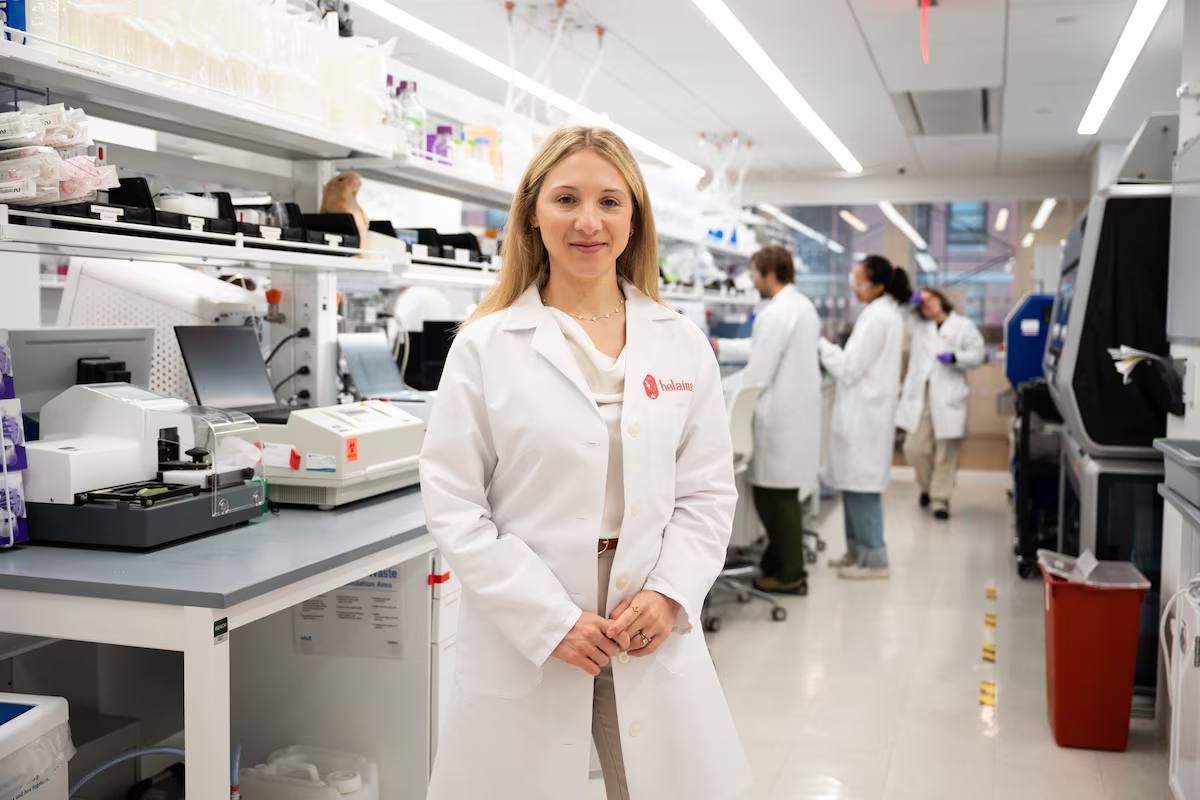
Laura Katz, CEO of Helaina, at her lab in New York City on Thursday.Kellyann Petry for the Globe and/The Globe and Mail
There’s nothing like mother’s milk. For years, infant formula makers have tried to match the health benefits of human milk. Thanks to a Canadian entrepreneur, they might just be that much closer.
Toronto native Laura Katz, 34, is the founder and chief executive of Helaina, a New York-based startup whose mission is to create, scale and commercialize lactoferrin, an immune-supporting protein found in human milk. Now, after seven years of building her company, Ms. Katz’s moment has arrived.
Last month, food giant Nestlé SA announced a multiyear partnership with Helaina to buy the ingredient and work together to advance infant nutrition.
Helaina’s mandate is to “bring human bioactive proteins to every baby and adult in the world,” Ms. Katz said in an interview from the company’s New York office.
Open this photo in gallery:
The fermentation process to make proteins for Helaina’s products.Kellyann Petry for the Globe and/The Globe and Mail
Lactoferrin helps support immune function, iron metabolism and the gut. Supplemental versions of the protein until now came from cows, whose milk produces one-tenth of the amount of lactoferrin found in human breast milk. Using a process called precision fermentation, Helaina creates lactoferrin proteins “bioidentical” to those found in breast milk.
AI-for-health care startup Signal 1 takes off as it borrows page from Shopify and Slack
The company has for the first time made this kind of lactoferrin available at commercial scale, primarily to adults. Details about the partnership with Nestlé, which has a long history in baby formula and infant nutrition, are currently scarce.
“We are a startup and have something really powerful here, but we need to work with players who can help amplify the value of this technology, and who already have the knowledge and the expertise,” Ms. Katz said.
Open this photo in gallery:
Matthew Cleere, scientist at Helaina, Ms. Katz and Vanessa Arcos, lab technician, measure RNA at the lab inside Helaina’s office in New York City.Kellyann Petry for the Globe and/The Globe and Mail
Making human proteins is no small feat, which is why Ms. Katz says most companies have steered away from it. The molecular structure is complex, the manufacturing is expensive and the regulatory hurdles are high.
But after seven years of work, 49 patents, 11 peer-reviewed papers and multiple completed clinical trials, Helaina has raised US$93-million in venture capital to make bioidentical lactoferrin available not just for infant nutrition, but for people of all ages.
Ms. Katz knew from an early age she wanted to be a food scientist and told her parents that when she grew up, she wanted to “feed people.” Her teen years consisted of selling baked goods from home to peers at her dance studio, and entering Food Network Canada competitions.
She became interested in the nutritional health benefits of breast milk in 2012, while studying food science and technology at Western University. Learning how women’s bodies had evolved to create a therapeutic food product, she knew it was something she wanted to stay close to.
Open this photo in gallery:
Ms. Katz at their New York City office.Kellyann Petry for the Globe and/The Globe and Mail
Three years later, Ms. Katz was on the subway in New York, where she had moved to pursue her master’s in food studies, listening to a podcast about the black market for breast milk.
The buyers weren’t just parents, she learned, but bodybuilders, cancer patients and people from all walks of life, seeking the bioactive components of mother’s milk.
Lactoferrin is best known as a component of breast milk that helps build the lining of the gut, but the body continues to produce it throughout life as an iron-binding and transport protein. Ms. Katz said that people’s internal production of this protein can change as their immune systems evolve with age.
Canadian social-media platform Gander officially launches this week, promising data sovereignty
“Mother’s milk is the first superfood, so it’s biologically designed for the gut in the immune system of a baby” said Ms. Katz. “It’s in your saliva, in your sweat, in your tears. It’s all over.”
She’s confident that lactoferrin could become a wellness product such as collagen or creatine – substances the body naturally produces, but which consumers are keen to supplement for their health and longevity.
Perhaps, Ms. Katz thought, there was a way to bring lactoferrin to the masses by synthesizing a replacement for human breast milk.
Open this photo in gallery:
Julian van der Made, Lead Fermentation Engineer and Ms. Katz running a fermentation process to make protein at their lab.Kellyann Petry for the Globe and/The Globe and Mail
Tom Williams, the sole general partner of Heron Rock Fund, a family office investing platform, has received a lot of cold messages on LinkedIn. Ms. Katz popped up in his inbox in September, 2019, and he was taken by her “tremendous passion for feeding the world.” Shortly after, they met at Battery Park and started discussing an idea that would morph into what Helaina is today.
“For me, an entrepreneur that is driven by deep meaning and purpose is the best type of entrepreneur to back, and so it was very clear to me that this was her life’s mission,” said Mr. Williams, who wrote his first $500,000 cheque for the company in October, 2019.
After founding Helaina in mid-2019, Ms. Katz and a small team spent three years developing a version of lactoferrin that matched the structure and function of the human protein. Precision fermentation, the company’s core technology, involves engineering yeast cells to produce the protein. This was initially a prolonged process, given it can take up to two weeks for the yeast to grow.
Their next goal was to ensure the same result was equivalent at a larger, industrial scale, so they could move into the regulatory and clinical work necessary to bring the ingredient to consumers.
Open this photo in gallery:
Julian van der Made pulling a sample from the fermentation at the Helaina lab.Kellyann Petry for the Globe and/The Globe and Mail
By 2025, Helaina was ready to take its branded lactoferrin, Effera, to market. The bioidentical protein is now licensed to adult nutrition and supplement brands to incorporate into products such as powders, capsules and gummies. It is not yet available for infant formula.
“This protein plays such a critical role in our health, and we now, for the first time, can replicate it and bring it to the diet,” said Ms. Katz.
Effera is meant to support iron metabolism, immune function, gut health and healthy aging. But Helaina also sees applications in women’s health, active nutrition and with the Nestlé partnership, infant nutrition.
Ms. Katz’s lack of prior commercial work experience before Helaina makes it even more “mind blowing” to Mr. Williams that she is the most “naturally gifted CEO” that he’s ever seen in a founder. In addition to her scientific expertise, he said she has carefully picked her team and has the drive required to control profit.
This is what Mr. Williams says attracted Nestlé, one of the world’s largest makers of infant food products, to Helaina. Where large companies conduct exhaustive searches for innovation startups only to find unsubstantiated claims, Ms. Katz has always been focused on the food science.
Helaina has run several clinical studies examining lactoferrin’s effects on inflammation, iron levels, gut health and more – some of those trials going beyond necessary requirements for supplements. It has also compared the effects of the lab-produced protein with those of lactoferrin found in cow’s milk. Ms. Katz believes when you’re bringing innovation to people – especially infants – no stone can be left unturned.
Nestlé “has always been at the forefront of advancing scientific knowledge on key nutrients and bioactives that are important during early life, including their interactions with the gut microbiome and the immune system,” said Isabelle Bureau‑Franz, head of the Nestlé Product Technology Center for Nutrition & Health, in an e-mailed statement.
Open this photo in gallery:
Kellyann Petry for the Globe and/The Globe and Mail
With 40 people behind the startup – mostly scientists, nutritionists and molecular biologists – Helaina hopes to remain “small and nimble” as it grows.
Ms. Katz would like to expand Helaina into her home country of Canada, and perhaps even locate a manufacturing site there. Currently, the product is manufactured in New York.
While she can’t say much, Ms. Katz said she is in conversations with Health Canada to begin the approval process.
Asked why she decided to build Helaina in the U.S. and not Canada – as a growing number of Canadian entrepreneurs have chosen to do in recent years – she said New York’s “hustle and pace” suited her drive to grow, and provided ready access to venture capital financiers.
But she complimented the Canadian government’s recently adopted biomanufacturing strategy, focused on building an innovative life sciences sector. Paired with free trade agreements, she thinks it could “make Canada such an interesting place” in the field.
Ms. Katz’s longer-term goals for the protein stretch beyond formula alone.
She would also like to partner with non-governmental organizations to provide lactoferrin for malnourished children, whose damaged gut linings can make it harder to absorb nutrients.
She wants to bring it into the neonatal intensive care unit, where she says studies show babies’ conditions improving with lactoferrin. She even wants to introduce it to prenatal spaces, pointing to its potential to support better iron regulation in the third trimester.
“All of this impacts mom and baby, and we know that that’s where we can go, and we can’t go there right away,” said Ms. Katz. “There’s so many places that we could actually materially change people’s health.”
With reports from Sean Silcoff