
Open this photo in gallery:
4th Line Theatre founder Robert Winslow in a 2005 production of That Summer. Mr. Winslow built the theatre on his family homestead in the Ontario countryside, crafting plays from local stories and staging them with help from local residents.Marlon Hazelwood/Photos courtesy of 4th Line Theatre
In 1990, Robert Winslow moved back to Millbrook, Ont., to look after his aging mother on the farm where he was raised, land that had been in his family since the 1880s. At that point he had been working for nearly a decade as a professional actor.
When she died, he inherited the farm, but he knew he didn’t want to be a farmer. He was a playwright, and he wondered if the rolling landscape where his roots ran deep could produce something other than crops.
At the time, Winslow Farm didn’t look like much of a theatre. The grass was overgrown. Rocks and rusted equipment littered the property. Kim Blackwell, then a young artist helping prepare Mr. Winslow’s first production, remembers looking around and thinking, “Nobody’s going to come and see theatre, but this is fun.”
His focus and drive to get the first play onstage were unlike anything she had ever seen.
In the summer of 1992, hay bales became seats and the farm became the setting for The Cavan Blazers, Mr. Winslow’s first full-length play, based on the violent conflict between Protestant and Catholic Irish settlers in the township. It was the beginning of 4th Line Theatre, co-founded by Mr. Winslow and Jerome Ackhurst in Peterborough, Ont.
Before the first Friday performance had opened, the planned six-show run had sold out. It eventually stretched to six weeks. Professional actors performed alongside community volunteers in a play rooted in local history, establishing a standard that 4th Line Theatre would follow for decades.
“He was going to make it happen no matter what,” said Ms. Blackwell, now 4th Line’s artistic director.
Open this photo in gallery:
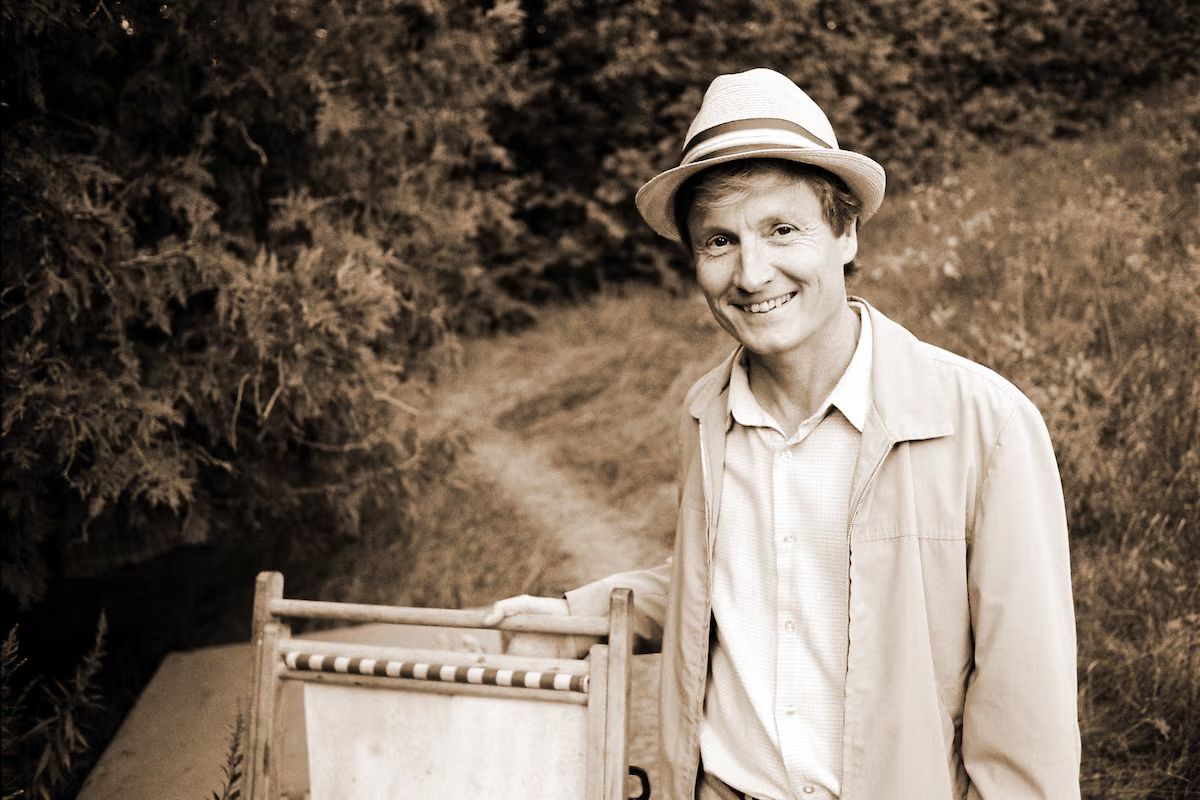
Mr. Winslow spent more than 45 years in the theatre industry as a playwright, actor, director, artistic director, teacher and mentor.Photos courtesy of 4th Line Theatre
The familiar Field of Dreams line, “If you build it, they will come,” has been invoked by many remembering Mr. Winslow, who died on Sept. 12 after playing hockey that morning and finishing a first draft of a play the night before. He was 73.
His legacy is a place where people come together – a stage where artists find their voice and generations of spectators who see themselves reflected in stories about the landscape they call home.
“There are some people who have a kind of an alchemy or a magic that is hard to quantify, and he had that. Robert gathered the stories of the people who lived around him and gave those stories back to his community as theatre,” Ms. Blackwell said. “He celebrated rural Canadian life without romanticizing it, exploring its humour, contradictions, hardships and humanity with an artist’s curiosity and a profound love of place.”
Through his theatre career, spanning more than 45 years, Mr. Winslow was a playwright, actor, director, artistic director, teacher and mentor. His honours included Queen Elizabeth II’s Golden Jubilee Medal, induction into the Peterborough and District Pathway of Fame and the Junior Achievement Peterborough, Lakeland, Muskoka Business Hall of Fame, and an Outstanding Senior Artist Award at the Peterborough Arts Awards.
Yet as a teenager, he couldn’t wait to get out of rural Ontario. After starting his career at the Peterborough Theatre Guild as a prompter in 1978, he went on to study at York University and St. Michael’s College, at the University of Toronto. By 1982, he was based in Edmonton, performing there at the Theatre Network, Northern Light Theatre, Citadel Theatre, Catalyst, Nexus Theatre and the Fringe Festival, and also appeared at the Blyth Festival, in Ontario’s Huron County.
Playwright Leanna Brodie first encountered him around 1983, when she was still in high school. Mr. Winslow was performing with Peterborough’s Magic Circus Theatre and wearing round John Lennon sunglasses and a T-shirt that read “Stop Rocky Five.”
She remembers thinking he was a “fully fledged artist”: cool, self-contained and “very rock and roll.”
“He embedded the arts in that community forever. So when people just think, oh, art is something that happens in downtown Toronto, he proved to generations of people that it literally can happen in the fields and the barnyards where he grew up, that it can be part of your life and part of your soul wherever you are,” Ms. Brodie said.
Mr. Winslow wanted to develop stories not just about the community, but with them. After he decided to transform his family farm into a theatre, his curiosity led him to talk with local Indigenous elders and transcribe their stories.
His choice to return to his rural homestead was unusual in an industry whose most prominent institutions, festivals and artistic leaders tend to be concentrated in cities. Mr. Winslow had worked in that world.
Open this photo in gallery:
Mr. Winslow in The Cavan Blazers in 2011. As a teenager, he couldn’t wait to get out of rural Ontario.Wayne Eardley, Brookside Studio/Photos courtesy of 4th Line Theatre
His wife, Janette Froncz, knows what it’s like to move to unexpected places to hone one’s craft. Before meeting Mr. Winslow, she had taught dance in Yellowknife before moving to Peterborough to run a ballet and dance studio. She would act in and choreograph his plays. They got married in 2000.
“This farming community and the surrounding region really became theatregoers, theatre actors. Someone would have been farming all day, and got off the tractor and got on stage,” Ms. Froncz said.
“We needed the farmers. We needed the people who weren’t professionals to help tell stories, and they had stories. You’re told that the only stories that get told are in the States and Hollywood. But we have an endless amount. Then people see that our stories matter and therefore, our lives matter,” she said.
In the 1970s, Mr. Winslow took a summer course in modern theatre at Trent University taught by former Cultural Studies chair and professor emeritus Ian McLachlan. They would become friends and writing partners for decades. Mr. McLachlan recalled that some area residents didn’t agree with Mr. Winslow’s honest approach to storytelling, and were afraid to open up their hometown’s memories.
“No one can escape the past by trying to bury it,” Mr. McLachlan remembers him saying.
Digging up the truth would take commitment. While researching his 2009 play Welcome Death, about the 1873 murder of Millbrook resident Elizabeth Deyell, Mr. Winslow retraced her roughly 35-kilometre journey from Millbrook through Port Hope to Welcome, Ont., on foot — in February. He later travelled to Ireland while researching the coroner who investigated her death.
In 2005, Mr. McLachlan and Mr. Winslow also created Doctor Barnardo’s Children, part of a series exploring the experiences of British home children sent to Canada.
Child actors as young as seven years old joined the production of Doctor Barnardo’s Children, and they began growing up around the theatre.
Some returned for other plays. Others put themselves through school as apprentices, stage managers or front-of-house workers. Some went on to become actors, but others became doctors, scientists and professors. Ms. Froncz and her husband didn’t have children, but said the ones they got to know over the years became like their own.
Generations of young people found opportunities at 4th Line Theatre. By the company’s 30th anniversary, around 2,000 young people had participated in 4th Line apprenticeships. The establishment of an endowment fund, called “30 to the Future,” will help sustain that work for years to come.
Open this photo in gallery:
Shelley Simester and Mr. Winslow in Queen Mari in 2012. Mr. Winslow wrote or co-wrote 18 original plays, directed 25 and acted in 30 at 4th Line Theatre.Wayne Eardley, Brookside Studio/Photos courtesy of 4th Line Theatre
This past summer, Mr. Winslow put on Ms. Brodie’s Schoolhouse, reprising a role he had performed 19 years earlier. On opening night, many of the actors who had played children in the earlier production returned to the farm. At the same time, one of Mr. Winslow’s scene partners was an actor fresh out of the National Theatre School, performing her first professional job.
Ms. Brodie has seen Mr. Winslow’s investment in young artists firsthand. As 4th Line’s first playwright in residence, she had to venture to farm kitchens and verandahs all over Cavan Township for research and interviews for her 4th Line plays, Schoolhouse and For Home and Country. There was one problem: She couldn’t drive.
“Rob would generally have to pick me up at the Peterborough Greyhound Bus station and then ferry me around from one cup of tea and plate of cookies to the next. Sometimes I even stayed with him and Janette. We stared at many a sunset together,” Ms. Brodie said.
She knew that initially they were only willing to open up because they trusted Mr. Winslow.
“They knew what it was to stand in those fields, in those barnyards, in those theatres, and have their stories, their parents’ stories, their grandparents’ stories honoured,” Ms. Brodie said.
After handing the position of artistic director to Ms. Blackwell in 2014, Mr. Winslow had more time to focus on what he loved. He taught theatre performance workshops and courses at Trent University until his death. Mr. Winslow wrote or co-wrote 18 original plays, directed 25 and acted in 30 at 4th Line Theatre.
In the final two years of his life, Mr. Winslow interviewed former students for a new play about the former Millbrook High School, carefully recording and transcribing everything himself.
On Friday, Sept. 11, he finished the first draft. That evening, he and Ms. Froncz sat together on the porch while he ran over scenes from the new play with her. She says they were “funny, sweet and entertaining.”
The next morning, Mr. Winslow, a big Montreal Canadiens fan, went to play hockey. He died later that day.
Ms. Froncz will continue to live on the farm, and next summer she will welcome audiences for 4th Line Theatre’s 35th season.
With its open-air stage, 4th Line is just as beholden to the weather as any other farm, Ms. Blackwell says. The weather comes in from the west, over the Oak Ridges Moraine, a 160-kilometre-long geological landform. As his kin taught him, Mr. Winslow would stand in a field and look west.
Now, hay bales have been replaced by proper seating, and the farm has equipment that measures how far off lightning strikes are. But he taught them how to watch the weather. So at the end of each summer day, Ms. Blackwell still walks into the field and looks west.
“We don’t farm food or animals,” Ms. Blackwell said, “but I have always said we farm plays.”
Mr. Winslow leaves his wife, Ms. Froncz.
You can find more obituaries from The Globe and Mail here.
To submit a memory about someone we have recently profiled on the Obituaries page, e-mail us at obit@globeandmail.com.