
Listen to this article
Estimated 5 minutes
The audio version of this article is generated by AI-based technology. Mispronunciations can occur. We are working with our partners to continually review and improve the results.
Quebec voters have elected a new, sovereignist government, the Parti Québécois, amidst negotiations on energy developments along the Churchill River — but Newfoundland and Labrador Premier Tony Wakeham is confident a deal will get done.
In August, Coalition Avenir Québec Leader Christine Fréchette signed a new agreement on Churchill Falls and other electricity projects in Labrador with N.L. and Ottawa. At the time, Fréchette told reporters the PQ was interested in “tearing up” the deal.
Then-PQ Leader Paul St-Pierre Plamondon said while he wouldn’t axe the deal, his party was committed to doing a due diligence review if elected. He had previously called the 2024 MOU “humiliating” for Quebec and asked that it be reviewed by members of the legislature.
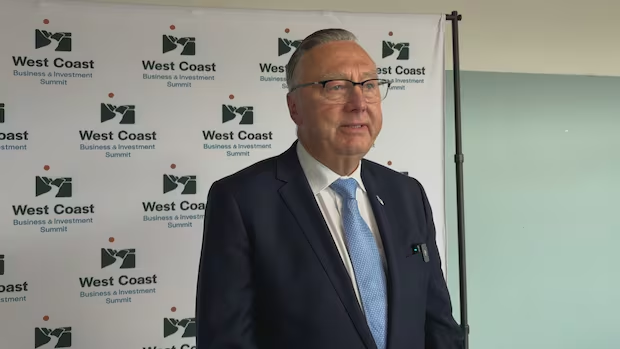
While speaking at an unrelated event in Corner Brook Tuesday morning, Wakeham said his team reached out to the PQ transition team Monday and he is planning to speak with the incoming premier sometime Tuesday. He added the new premier will need to get “up to speed” on the details of the agreement.
WATCH | N.L. officials meeting with representatives of new Quebec government:
Wakeham confident new Quebec gov’t will support Churchill Falls. Opposition says it’s a chance to revisit the deal
The political landscape in Quebec was dramatically reshaped following Monday’s provincial election. So what might this mean for the proposed new Churchill River energy deal? As the CBC’s Terry Roberts reports, it depends on what side of the political spectrum you ask.
“I’m confident that once he does that, that he will see that this is indeed an agreement that is good for Quebec, good for Newfoundland and Labrador,” Wakeham told reporters.
He said he doesn’t expect when talking to premier-designate St-Pierre Plamondon he will have to sell the project, as the benefits speak for themselves.
“I think that the agreement will sell itself,” Wakeham said, adding during the election he didn’t hear the PQ mentioning “tearing it up or ripping it up” the agreement.
Wakeham said their teams have continued to have discussion, adding there’s around 17 to 18 definitive agreements.
“We’re ready and willing to keep moving on that process. But as I said, we’ll reach out to the new premier and have those discussions and go from there,” he said.

Parti Québécois Leader Paul St-Pierre Plamondon fist pumps to supporters after winning the provincial election in Montreal, on Monday, Oct. 5, 2026. (Graham Hughes/The Canadian Press)
Energy and Mines Minister Lloyd Parrott dismissed the possible negative ramifications the PQ’s election could have on finalizing a deal.
“I don’t think it makes a difference. At the end of the day, this is a negotiation between two power utilities,” he told CBC Radio’s The St. John’s Morning Show.
He added it’s a deal Quebec needs and is also good for the people in Newfoundland and Labrador.
When the PCs were elected last year, they initiated an independent review committee to assess the previous MOU, which had been brought in by the previous Liberal government. It found the 2024 MOU was “not in the public interest.”
When asked if he was worried the new PQ government would also move to assess the new agreement, Parrott said “obviously that is their prerogative. If it’s something they want to do, then that’s entirely up to them. I don’t believe they will.”
Parrott added he believes at this stage of the negotiations, they will move forward.
Election is opportunity to reset: Hogan
Newfoundland and Labrador Hydro president Jennifer Williams said the Quebec election has been of “significant interest to us.”
“We welcome what the government of Quebec needs to do and we look forward to working with Hydro-Québec and their new government and our government to get this done in the next coming period of time,” she said.
When asked if there is room for further negotiations, Williams said the 2026 agreement “dealt with all the material issues between the two utilities, the things that made sense to both of us.”
She added what remains is to reach the final agreements on those issues, adding there are some issues that need to be wrapped up as part of final negotiations. She said both utilities have agreed they won’t renegotiate the material terms that they already agreed to.

N.L. Hydro Jennifer Williams says some aspects of negotiations remain ongoing. (Regan Burden/CBC)
Liberal Leader John Hogan said while it’s not a positive development a separatist government has been elected, it could be a way to get a better deal for N.L.
“Our message now is, look, you know, for the premier — listen to Newfoundlanders and Labradorians. Hear their frustration and hear their anger. Use this as an opportunity with a new government in Quebec to maybe reset. We don’t have to start from square one,” said Hogan.
Hogan said it was “troubling” to hear Williams say there was no room to renegotiate material issues, adding a new Quebec government might have a different stance. He then reiterated his call to Wakeham to talk to Quebec and try to get more favourable terms for N.L.
Download our free CBC News app to sign up for push alerts for CBC Newfoundland and Labrador. Sign up for our daily headlines newsletter here . Click here to visit our landing page .