
Listen to this article
Estimated 4 minutes
The audio version of this article is generated by AI-based technology. Mispronunciations can occur. We are working with our partners to continually review and improve the results.
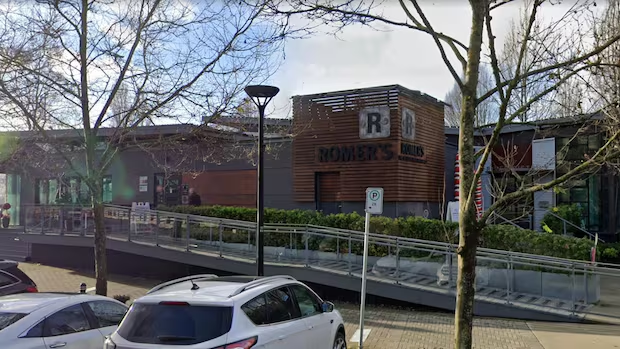
After 16 years in business, a Vancouver burger chain has announced the permanent closure of its restaurants because of ongoing financial challenges. It’s the latest in a series of closures highlighting the pressures facing the food service industry.
In an Instagram post on Nov. 16, the Romer’s Burger said it had no choice but to shut down its burger bar restaurants.
“This is not how we imagined saying goodbye, and we’re deeply sorry for the sudden nature of this closure,” the statement said.
Founded in 2010 by chef Jim Romer, the chain began with a restaurant on West Fourth Avenue in Kitsilano before expanding across the Lower Mainland. Its original Kitsilano location closed in 2024.
The company’s locations included Romer’s Burger Bars in Vancouver’s River District, North Vancouver’s Lynn Valley, Port Moody and a Romer’s Fresh Kitchen & Bar inside the Vancouver International Airport.
Steamship Grill and Bar in Victoria, which operated under the same parent company, also closed permanently after nearly 13 years in business.
CBC News has contacted Romer’s to clarify the status of its Vancouver International Airport location.
WATCH | Restaurants struggling to make ends meet:
How Vancouver restaurants are struggling to survive
In this episode of Recipe for Change, we examine the significant challenges facing Vancouver’s restaurant industry in the aftermath of the pandemic.
Ian Tostenson, president and CEO of the B.C. Restaurant and Foodservices Association (BCRFA), said the closure is particularly concerning because Romer’s was operated by people with years of industry experience.
“We’re just seeing closures like the Romer’s, people that are experienced and just go, you know what, we can’t do it anymore,” he said.
Tostenson said restaurant sales in B.C. have risen nearly six per cent this year but he says much of that increase reflects higher menu prices rather than more customers.
He said operators are raising prices to offset growing expenses while consumers remain cautious about spending.
Restaurants struggling to turn a profit
The closure comes as restaurant operators across Canada are struggling to absorb rising expenses.
A report from Restaurants Canada earlier this year found that 44 per cent of its surveyed restaurant operators were either losing money or just breaking even as of November last year.
More recent findings from EconoLease’s 2026 Hospitality Operator Report suggest the pressure on businesses continues.
Its survey of 250 Canadian hospitality operators found that 80 per cent had raised menu prices over the previous year, while nearly half planned further increases in the coming year.
WATCH | New study shows thousands of restaurants in Canada have closed:
Thousands of restaurants to close in 2026
With rising food prices, labour shortages and changing consumer habits, the restaurant industry is in for a tough winter, without the help of last year’s GST/HST holiday on restaurant meals.
An analysis by Dalhousie University also projected that more than 4,000 restaurants across Canada could go out of business this year, while 7,000 restaurants closed in 2025 as a result of rising operating costs, weakening consumer demand and financial pressures.
The challenges are also evident locally.
According to a report by LOCO B.C., a non-profit organization advocating for local businesses, 257 businesses publicly reported closures in 2024 and 2025, mostly in Greater Vancouver. Restaurants accounted for 81 per cent of those closures.
Profit margins in the restaurant industry are already razor-thin, adds Tostenson, leaving operators with little room to absorb rising costs.
According to the BCRFA, a B.C. restaurant generating $2 million in annual sales could be left with just $60,000 in pre-tax profit, which is a margin of three per cent.
It estimates that about $300,000 of the restaurant’s revenue goes toward government taxes, liquor markups, licensing and other charges.
“Our point to the government is it’s in your best interest to keep restaurants strong because you’re making a lot of money from us,” Tostenson said.
The association estimates B.C.’s restaurant industry has approximately 15,000 establishments, employs 190,000 people, generates $21 billion in annual revenue and also contributes about $1.4 billion annually to provincial government revenues through sales taxes, liquor markups and other fees.
Tostenson warns that restaurant closures have consequences beyond individual owners.
“When a restaurant closes, there’s a loss of jobs, there’s a huge loss to the government,” he said.