
Listen to this article
Estimated 4 minutes
The audio version of this article is generated by AI-based technology. Mispronunciations can occur. We are working with our partners to continually review and improve the results.
With 37 candidates competing for eight seats on Kelowna city council, some first-time candidates are looking beyond traditional signs, pamphlets and door-knocking to get voters’ attention.
For Brady Rogers, that means humour.
The 33-year-old engineer and entrepreneur has built much of his campaign around deliberately self-deprecating messaging, using deadpan signs and social media to make his campaign stand out from the crowded field.
Rogers said the idea was to inject some fun into what can otherwise be a repetitive part of an election campaign.
He says the messaging is a reflection of his personality, rather than an engineered strategy.
“I like to be just genuine and transparent in everything I do, whether it’s running my business or now campaigning,” Rogers said.
“Whether people like me or hate me, it gets them to ask questions about why I’m doing this, and what I’m thinking and what plans I have.”

A screenshot from Brady Rogers’ campaign website. The candidate has turned to self-deprecating humour as a part of his bid to break through in a crowded municipal election race. (Brady Rogers)
The approach has attracted attention beyond Kelowna.
Rogers said images of his campaign signs were recently shared widely in the United States, generating some two million views. He said the response has been overwhelmingly positive.
But the candidate recognizes that making humour a central part of a political campaign comes with a risk.
“I may have undercut myself a little bit,” he said.
Wake-surfing wake-up
First-time candidate Teresa May is also trying to break through the campaign clutter, but her approach combines traditional voter contact with eye-catching video.
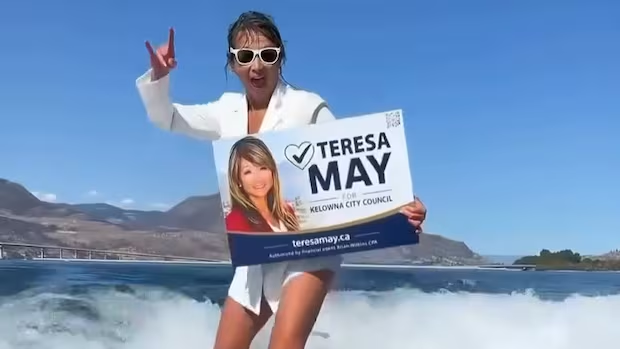
The entrepreneur and community volunteer has been wake-surfing for more than a decade, and said her children encouraged her to combine her hobby with her campaign.
The result is a series of widely shared Instagram videos of May, in high heels, wakeboarding on Okanagan Lake while waving campaign signs.

Teresa May wake-surfs on Okanagan Lake in a campaign video. (Teresa May/Instagram)
May said she is trying to engage younger voters “by doing something fun, something that stands out.”
“It really it’s just a way of getting like your name and your sign out there,” she added.
“I’m not producing that many signs. How do I get my signs out in front of, well, now probably 500,000 people?”

May has also shared behind-the-scenes footage of her early attempts at the wakeboard stunt. (Teresa May/Instagram)
Like Rogers, May describes the strategy as an icebreaker, something that gets people interested before directing them toward her website and policy positions.
“I’ve had other candidates from other places saying, ‘You know what, I got to step up my game,'” she said.
‘My human’ touch
In West Kelowna, one candidate seeking re-election has turned to a furry friend for help.
Garrett Millsap’s election signs feature his 10-year-old Beaglier Cooper, and the tagline “re-elect my human.”

Garrett Millsap’s dog Cooper standing in front of one of his election signs. (Garrett Millsap/Facebook)
Millsap has been encouraging supporters to take selfies with the sign.
“Election signs don’t need to be boring and love that these will put a smile on some people’s faces on their commute to work in the morning,” Millsap wrote on Facebook.
Why unconventional campaigns can work
David Black, an associate professor at the School of Communication and Culture at Royal Roads University, said unusual campaign tactics are not new — but social media has created more opportunities for candidates to experiment.
“I think it’s good for our politics, in the sense that it gets us away from the plague of ‘message discipline’, everything is very locked down,” he says.
“It’s a way for campaigns, even from candidates and parties that are well known to us, to seem fresh, and different, and a little irreverent.”
Black said municipal candidates have a larger hurdle: the need to establish their own identity outside formal party labels, ideologies and structures.
“Every individual candidate … is their own brand, their own political party,” he said.
“They have to lead with their personality in what is a very, very cluttered and busy field.”
But he cautioned that unconventional campaigns are a calculated risk.
Humour can attract attention, but it can also undermine a candidate if voters interpret the approach as evidence they are not serious about public office.
“All publicity is good publicity in a sense,” the professor said.
“It’s difficult to get right.”