
Open this photo in gallery:
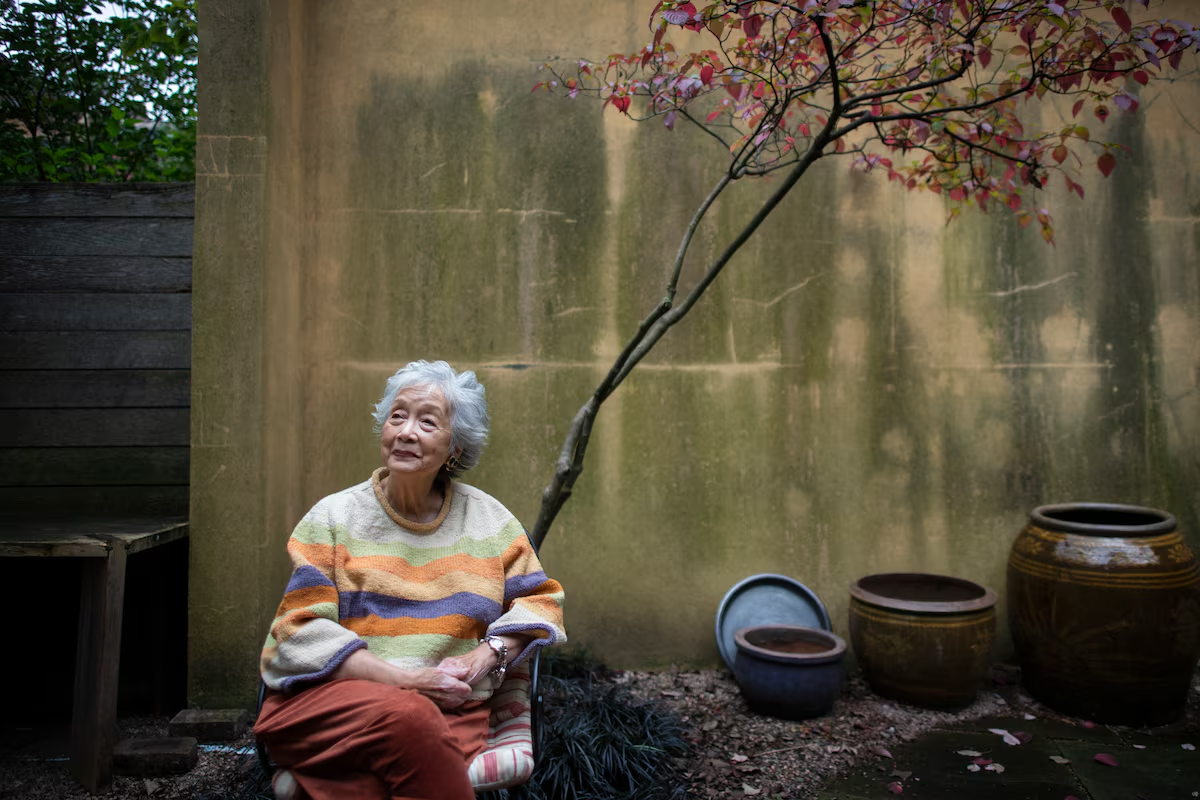
Adrienne Clarkson, former governor-general of Canada, at her Toronto home on Oct. 1. Ms. Clarkson says Canada has failed to make progress on endometriosis.Fred Lum/The Globe and Mail
More than six decades after being diagnosed with endometriosis, former governor-general Adrienne Clarkson considers herself “one of the very lucky ones.”
At 21, after learning she had the painful inflammatory disease, Ms. Clarkson soon had surgery at Toronto General Hospital. She credits her gynecologist at the time, Douglas Cannell, for preserving part of an ovary.
At the time, a nurse told her any other surgeon would have done a hysterectomy because her situation was “a mess.” Dr. Cannell spent two hours in the operating room with her.
Ms. Clarkson is grateful to have had access to his expertise so she was later able to bear children – something that isn’t always possible because endometriosis is associated with infertility in about 30 to 60 per cent of cases. Many patients require fertility treatments to conceive.
Endometriosis is an inflammatory condition that sees cells similar to those on the inside of the uterus grow outside of it. It is commonly associated with severe pelvic pain, which adversely affects patients’ well-being, productivity and relationships.
It also carries a high cost burden for the health care system. A population study published in 2020 looked at hospital admissions in Canada over a five-year period for every province except Quebec. It recorded that there were 47,000 admissions, totalling $152.2-million in health care costs, which amounts to $30-million a year.
Open this photo in gallery:
Ms. Clarkson, a former CBC tv host, served as governor-general from 1999 to 2005.Fred Lum/The Globe and Mail
Ms. Clarkson, who worked as a CBC broadcaster before she served as governor-general from 1999 to 2005, is speaking out now after hearing stories about poor access to endometriosis diagnostics and the state of care for Canadian patients.
Many patients have to wait more than half a decade to be diagnosed and some, in the face of their persistent pain, travel out of Canada, including to Europe and the United States for surgery.
Ms. Clarkson, now 87, said it is “appalling” Canadian patients feel they have to leave the country and pay out of pocket to access surgery.
“I look at it on the large scale of things, and not my own fortunate circumstance, which depended upon a wonderful doctor in a city of a million people at a wonderful university hospital,” Ms. Clarkson said in a recent interview. “I think of the woman who is in Maple Creek, British Columbia, who does not have access to any of this and wonders what’s going to happen.”
She added: “It really, really bugs me that we have not made progress on endometriosis.”
Ms. Clarkson’s concerns are echoed by members of the medical community. A growing number of patients and surgeons are pushing for improved access to care.
Sukhbir Singh, who heads the Department of Obstetrics, Gynecology and Newborn Care at The Ottawa Hospital, says its minimally invasive gynecology research group documented how the current state of endometriosis surgical care amounts to a national problem.
Dr. Singh said the problem is underscored by the fact that Canadians are seeking care outside of the country because of factors including long wait times for referral and surgery.
And while the Society of Obstetricians and Gynaecologists of Canada’s guideline is clear on the need for access to complex care for endometriosis, Dr. Singh describes this as virtually non-existent; many health care providers have limited access to resources, including lacking time in operating rooms.
Surgery may be required for some patients to remove scar tissue and lesions. There is no cure for endometriosis, but some patients use medication, such as progesterone, as part of treatment.
But despite the prevalence of endometriosis, the SOGC says it remains an underdiagnosed and misunderstood disease, leaving many to suffer for years before they receive proper medical care.
Open this photo in gallery:
Ms. Clarkson says she looks at the situation of lacking diagnostics and treatment through a feminist lens.Fred Lum/The Globe and Mail
This May, physicians Olga Bougie and Catherine Varner co-authored an editorial in the Canadian Medical Association Journal that described how endometriosis care is often delayed and fractured and needs an overhaul.
They said consequences associated with it can be profound and range from “adverse reproductive outcomes to severe, multisystem disease.”
“Addressing these challenges requires a fundamental shift toward co-ordinated, evidence-based, and patient-centred care,” they wrote. “Strengthening interdisciplinary collaboration, expanding training and resources, and prioritizing equitable access to care are essential steps to improving outcomes and restoring trust for those living with endometriosis.”
Earlier this year, Elize Nocente, a Grade 11 student who lives in Vancouver, started a House of Commons petition, sponsored by B.C. NDP MP Jenny Kwan, to raise awareness of endometriosis in schools. She does not have the condition herself but knows others who do, and she aspires to be an obstetrician/gynecologist one day.
The petition calls for the federal government to establish a national advisory board on endometriosis education and to work with provincial and territorial governments to support the mandatory inclusion of endometriosis education in curricula.
Ms. Clarkson reached out to The Globe and Mail after reading about the high-school student’s push for more awareness. She looks at the situation of lacking diagnostics and treatment through a feminist lens.
“If it was something that was in men’s testicles, it would have been handled ages ago,” she said.
All patients should be able to choose what they do with their own bodies, Ms. Clarkson added.
“Women want choice of whether they have children or don’t have children,” she said. “They don’t want to be held up by something as vicious as endometriosis.”