
Open this photo in gallery:
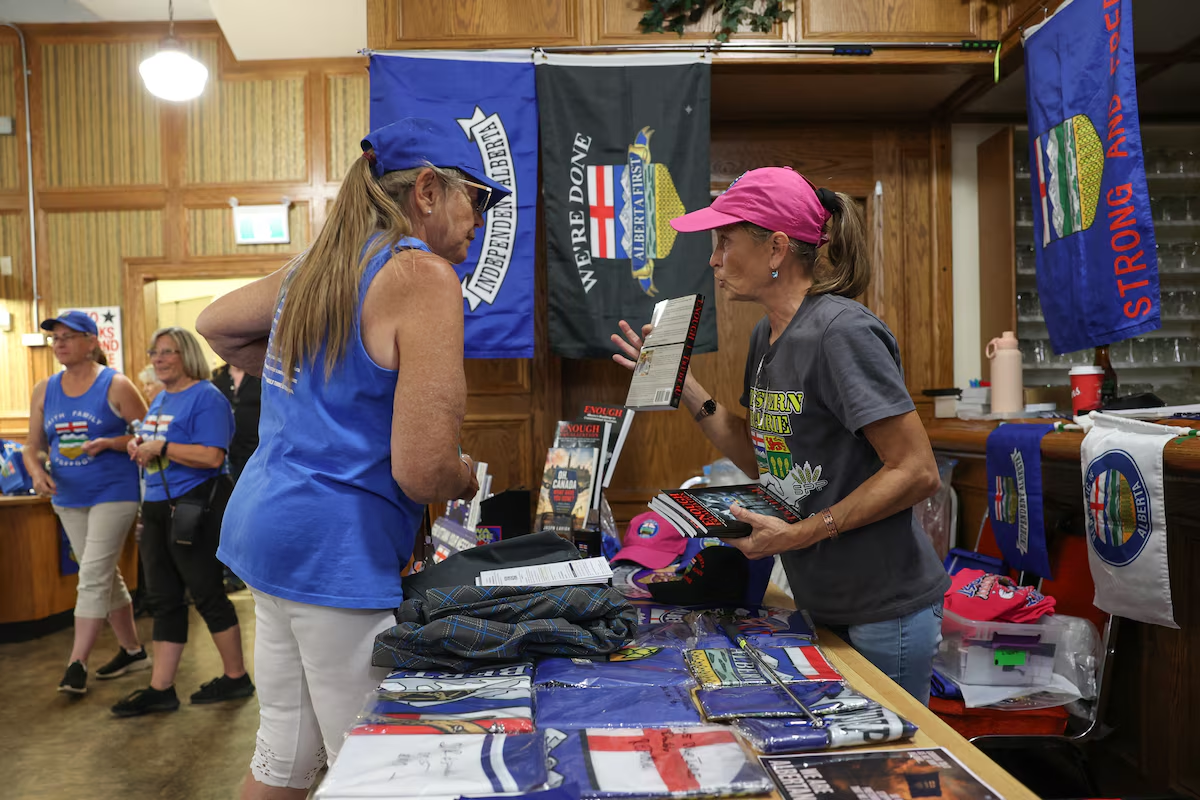
Alberta separatists participate in a rally in Redcliff, Alta., on Sept. 23. MP Corey Hogan says Canada needs to consider overhauling its laws to address the kind of freelance negotiating trips that separatist leaders have made to D.C.ABED ZAQ/AFP/Getty Images
Revelations about talks in Washington where Alberta separatists suggested exchanging water and oil for U.S. support, and in Calgary where separatists met secretly with Republican strategists, have sparked an outcry from federalists – and a call for legislative change.
Corey Hogan, Calgary’s lone Liberal member of Parliament, said on Sunday that Canada needs to consider overhauling its laws to address the kind of freelance negotiating trips that separatist leaders have made to D.C. in advance of the Oct. 19 provincial referendum.
Mr. Hogan does not think the discussions between the separatists and the U.S. State Department meet the bar for treason, but that does not make the cross-border talks innocent.
“They’re wrong,” he said in an interview Sunday. “If we don’t have a law that covers them, I think we should at least be thinking about whether we need one.”
How some Alberta separatists are courting U.S. support for independence
A Globe and Mail investigation on Saturday reported that Republican political operatives were on the ground in Alberta this year to assist the separatist campaign in its bid to leave Canada, while harbouring their own aspirations for the province to secede.
The investigation also found that when Alberta separatist leaders went to Washington to meet with the State Department, they offered up key assets from the province’s resource portfolio, including access to fresh water and royalties on crude oil, in exchange for help transitioning to independence.
Mr. Hogan, a former campaign strategist, noted that Canada and the United States have a long history of political consultants doing business on both sides of the border. But, he said, Alberta’s experience illustrates how the rules governing those activities need to be re-examined.
“A principle seems to have been violated here, even if a rule hasn’t,” he said.
As detailed in The Globe’s investigation, Dennis Modry, a former Alberta heart surgeon who is co-founder of the Alberta Prosperity Project, said in an interview that the separatists proposed a number of ideas in a document that was put on the table for discussion during meetings at the State Department last year.
They included access to valuable resources such as fresh water, agriculture, forestry, mining and precious metals. Land for a railway to Alaska was one potential idea, as was a new oil pipeline to the Pacific that would run through Washington State, with royalties from crude oil offered up as compensation, Dr. Modry told The Globe.
Such an arrangement would upend the traditional structure of petroleum extraction, in which royalties flow to the owner of the resource.
The document put into writing “the potential benefits of Alberta sovereignty to the United States of America – and to Alberta,” Dr. Modry said.
“We just brought up water as a possible issue. Does the U.S. need more water? Can Alberta provide some more water to them?” Dr. Modry said.
Opinion: Alberta’s separatists would sell us out to the Americans
His comments have drawn the ire of fellow separatist leader Jeffrey Rath, who arranged the State Department meetings and disputes Mr. Modry’s characterization of the talks.
Mr. Rath told The Globe that the talks were general in nature, “about the aspirations of Albertans and Alberta for independence. And that was it.”
In response to the article, Mr. Rath wrote on social media Saturday, “We were private citizens. We had no government mandate to offer anything. We only went to Washington to express the aspirations of hundreds of thousands of Albertans for a free and independent Alberta and to gauge U.S. support for such a project.”
“We were gratified by the expressions of enthusiasm by U.S. officials and the fact that Citizens of Alberta receive a far warmer welcome in Washington than we would ever receive in Ottawa.”
Mr. Rath told The Globe previously that he believes the Albertans’ overtures to Washington garnered attention at the highest levels of the U.S. administration. In January, Treasury Secretary Scott Bessent described a “wealth of natural resources” in Alberta, which he said had been trapped by domestic opposition to a Pacific pipeline.
The investigation also revealed that separatist advocate David Parker brokered an invitation-only meeting near the Calgary airport in January, where Republican strategists from Michigan discussed software that could be used to boost the sovereignty campaign and help sway the referendum outcome.
The meeting involved representatives from 10X Votes, a U.S. company co-founded by Drew Born, who is part of an influential and wealthy family of Republican donors and has publicly advocated for Alberta separation and annexation by the U.S. On July 1, Mr. Born wrote on social media: “On this Canada Day, I hope this is the last year Alberta is part of Canada.”
Mr. Parker did not acknowledge multiple attempts to reach him for comment regarding The Globe’s investigation that detailed the meeting in Calgary, which had not been publicly revealed. He wrote on social media Saturday that the Republicans from Michigan were “friends who agree with me politically.”
Opinion: We must call Alberta separation what it is
Alberta Premier Danielle Smith’s spokesman said on Sunday that she “is not affiliated with these individuals and has no knowledge of these alleged meetings.”
“She also opposes separation or becoming a U.S. state,” Sam Blackett said in an e-mail. “In fact, many of these individuals in question have been relentlessly attacking the Premier for her support for remaining in Canada.”
Jason Kenney, the former Alberta premier who has spent months sparring with independence advocates online and at town halls, said The Globe’s investigation highlighted “incoherence and chaos” within the separatist movement.
The separatist cause has never made a sustained push past 30-per-cent support in polling. Separatist leaders have called on Albertans to send a message to Ottawa by voting in favour of pursuing sovereignty. But Mr. Kenney said the discord should give Albertans frustrated with Ottawa pause.
“I just hope that severely normal, frustrated federalists who think this is a clever way of sending a message start paying attention to the movement,” he said in an interview Sunday. “They will be empowering this shambolic movement of people, including those who are colluding with a foreign power and offering to give away aspects of Alberta sovereignty.”
Mr. Kenney wants Albertans to curtail their influence.
“There’s lots of ways to send a message about the need for reform in the federation, without turning these MAGA bootlickers into a major part of Alberta politics.”
In Depth: A country with its elbows up faces separation threats on two fronts
Mr. Kenney has a history with some of Alberta’s most prominent separatist advocates. They railed against the public-health measures his government imposed during the COVID-19 pandemic, such as vaccine passports, and campaigned against his leadership of the United Conservative Party.
The former politician does not believe the trips to Washington meet the legal threshold to be considered treasonous or seditious.
“But it’s certainly disloyal and unpatriotic,” he said.
He stops short of calling on Canadian lawmakers to revise the rules in light of Alberta’s experience.
“You can’t prevent Canadian citizens from talking to representatives of a foreign government, as long as it doesn’t constitute a violation of actual treason, sharing national secrets.”
Alberta NDP opposition leader Naheed Nenshi said he sees nothing normal about the U.S. interest and involvement in the separatists’ campaign.
“It’s intensely bizarre, and the question is who is really pulling the strings here,” Mr. Nenshi said in an interview Sunday.
“Mr. Rath, whom I’ve never met, is perfectly happy to brag about his connections to the Trump administration,” Mr. Nenshi said. “Until it’s pointed out to him that these could be seen as potentially dangerous and seditious acts, then suddenly he backs away and says, ‘we just had a meeting with no mandate.’ ”
Mr. Nenshi said no other Canadian representative would likely get a meeting at the State Department if they just “strolled up with no mandate.”
“There’s a lot going on here.”