
Open this photo in gallery:
A rendering of the high-speed rail line between Quebec City and Toronto. The Parliamentary Budget Officer said this week its projected cost could be $75-billion to $113-billion, considerably more than the government’s estimate of $60-billion to $90-billion.Supplied
The federal government’s plan to build a high-speed rail line from Toronto to Quebec City is rushing ahead.
Alto, the Crown corporation quarterbacking the effort, is getting ready to present its proposed route for the first stage of the 1,000-kilometre line: between Ottawa and Montreal. It has already started buying the land required to make it happen.
The Prime Minister is fired up. He says the project will add $35-billion to the economy and create more than 50,000 jobs. “It’s more cost-effective, it’s more sustainable, it’s connecting our communities, it’s going to be faster,” Mark Carney said last spring.
All this is exciting news for rail enthusiasts. After years – no, decades – of talk, this project finally has unmistakable momentum.
But before we get too carried away, we might want to take a look across the pond at a similar effort in Britain. It’s a cautionary tale if there ever was one.
Like Canada, the United Kingdom is far behind other countries when it comes to fast trains. Spain, France, Italy, Germany – all have good, efficient networks. China has more than 50,000 kilometres of high-speed track, the biggest system in the world. Though the British invented the modern railway, they still have just one true high-speed line: the one that carries the Eurostar train from London to the coast en route to Paris. Even that one took years to get up and running.
So it seemed to make perfect sense for Britain to join the high-speed party and build a second line: HS2, a successor to the HS1 train that goes to Paris. Approved in 2012, it was to link London with Birmingham and Manchester in the north, with an eastern leg reaching as far as Leeds. The cost would be about 32-billion pounds, or around $60-billion at today’s exchange rate. Trains would start running in 2026, whipping along their tracks at 360 km an hour, faster than any other similar high-speed railway using conventional technology.
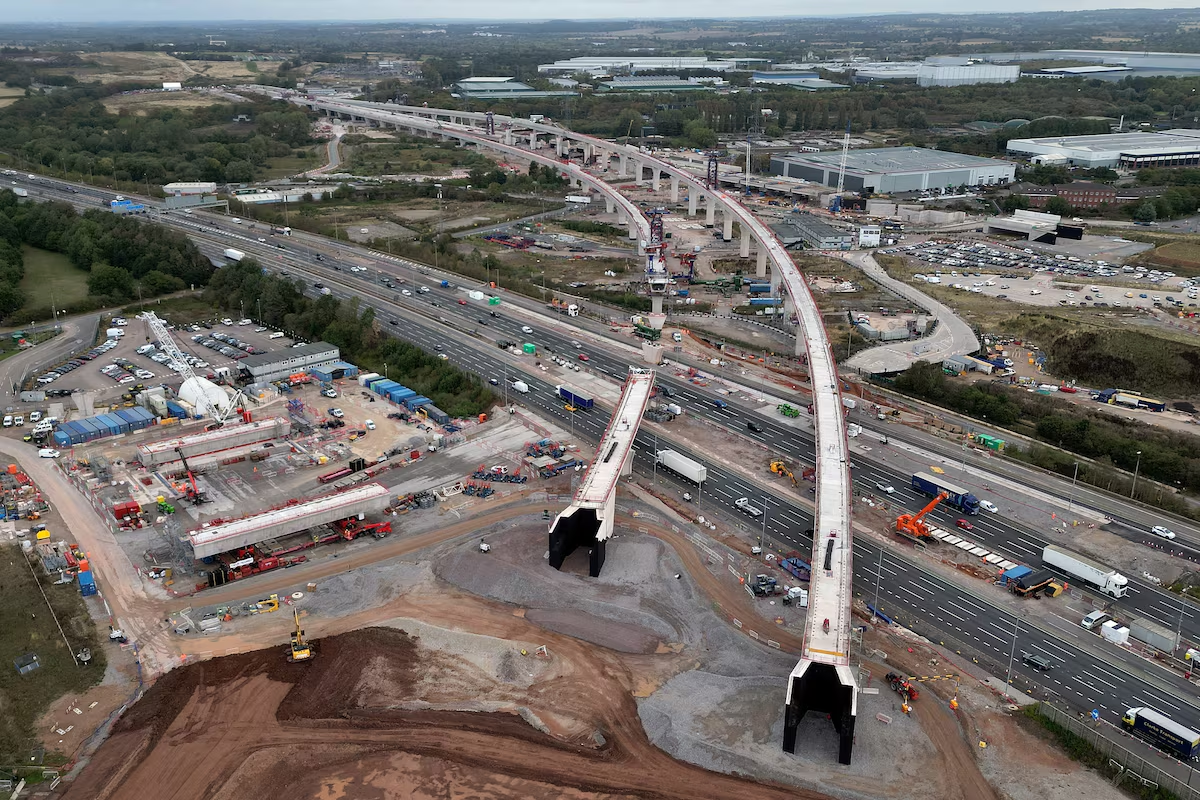
Open this photo in gallery:
Construction work continues on the Water Orton HS2 viaduct in Coleshill, central England, Sept. 3. The two viaducts holding HS2 railway tracks 20 metres high over the River Tame and the M42 motorway will be supported by 32 giant piers and run for 700 metres and is part of HS2’s complex Delta Junction over existing roads and rivers.PAUL ELLIS/AFP/Getty Images
It wasn’t long, though, before cost estimates started rising and opening dates receding. In their zeal to get cracking, authorities underestimated how much it would cost to push such a line through England’s green and pleasant land. It meant building a giant rail bridge, the Colne Valley Viaduct, the biggest in the country, and a massive tunnel, 16 km long, under parts of the lovely Chiltern Hills.
Complaints from residents and activists about the impact on the English countryside led planners to make design changes, adding extra tunnels and, in one forested section, a special arched shield to prevent protected species of bats from being killed by the onrushing trains. By the time construction started in 2020, the estimated cost had soared to 80 billion pounds and a parliamentary committee was warning that the project was “badly off course.”
To get it back on track, the government axed first the leg to Leeds (in 2021) and then the one to Manchester (in 2023). The trains will now stop at Birmingham, which is only an hour and half from central London on the current train service. To save more money, it reduced the planned top speed to 320 km an hour.
Still, the cost has continued to grow, with estimates reaching more than 100 billion pounds. The opening has been pushed back yet again to somewhere between 2036 and 2039.
Britain’s Labour government naturally blames the previous Conservative one. Transport Secretary Heidi Alexander told the House of Commons in May that the government had inherited a “litany of failures.”
Of course, other countries have managed to build high-speed rail lines without making such a hash of it. The Paris-Bordeaux line, for example, whisks you to the southwest of France in just over two hours.
Sadly, there are reasons to think we might repeat Britain’s high-speed mistakes.
Toronto-Quebec high-speed rail project could cost more than Ottawa’s estimate, PBO says
Farmers and homeowners are already complaining the line would gobble up valuable agricultural land and shatter the peace and quiet in rural communities. Politicians are already mucking about with the plans. Transport Minister Steven MacKinnon said in June that the federal government would like the line to have a stop in Kingston, which would add billions to the cost and add to the length of the route.
The projected cost is already rising. The Parliamentary Budget Officer said this week it could be $75-billion to $113-billion, considerably more than the government’s estimate of $60-billion to $90-billion.
Then there is the issue of urban stations. One of the big challenges facing HS2 is getting the rail line into dense central London, which will require a tunnel and new station at Euston – immensely costly undertakings. When it first opens, the train will stop short of the city centre and passengers will have to transfer to subway or commuter rail to get into town.
Similarly, one of the big challenges for Alto is getting high-speed rail into central Toronto and Montreal. Union Station, the obvious Toronto terminus, is already the hub for VIA trains, GO commuter trains and the airport shuttle, UP Express. Even if Union could be redesigned to accommodate high speed as well, it would be hard to get the line into downtown along the existing, cramped the rail corridor. So Alto is talking, in a vague way, about an elevated or tunnelled route – enormously difficult and expensive options.
Of course, Alto could avoid these problems and build a whole new station instead, but that would defeat the purpose. High speed only makes sense if it goes straight from downtown to downtown. Who is going to ride a train that dumps them in the suburbs?
Mr. Carney’s enthusiasm for high speed is understandable. It is just the kind of nation-building project he wants the country to embrace at a time of confrontation with the United States.
But the same gung-ho, damn-the-torpedoes spirit gave Britain the national embarrassment that is HS2. Let’s not make the same mistake.