
Open this photo in gallery:
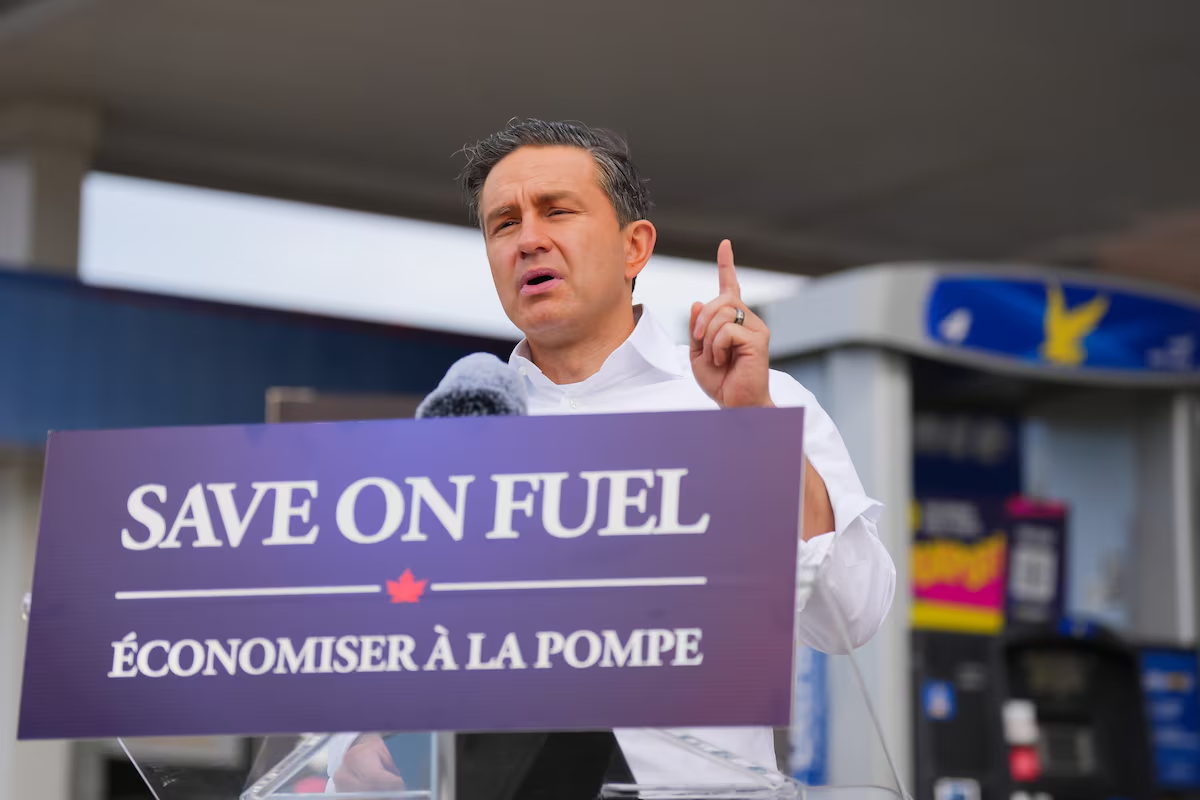
Conservative Leader Pierre Poilievre wants to see the price gap between Canada and the U.S. eliminated within a five-year period by increasing domestic production of diesel and other refined fuels.Chris Tanouye/The Canadian Press
Canada faces a diesel-price emergency and must be energy independent, Pierre Poilievre said Sunday, while calling for a cut to federal taxes on the fuel in order to boost domestic production to a million barrels a day in the next five years.
Speaking at a gas station in suburban Ottawa, the Conservative Leader made a policy announcement calling for the removal of all taxes on the “vital fuel” until at least Canada Day. He proposed doing so by extending the excise-tax cut and removing the GST from the fuel purchase.
Currently, the federal government charges 5 per cent GST on diesel, which amounts to about 13 cents a litre. A federal excise tax, which usually amounts to about 4 cents per litre, is currently suspended by Ottawa until the end of next January.
Mr. Poilievre’s Sunday fuel proposal was made amid global turbulence that includes the wars in the Mideast and in Ukraine, has placed enormous pressure on the world’s energy supplies, spurring soaring diesel prices.
The Conservative Leader said that while there are global factors, it does not explain why Canada is paying about 32 cents more per litre than the U.S. for diesel.
Robyn Urback: Pierre Poilievre should oppose the government – but he can support it, too
Canada produces most of the diesel used in Canada, with refining capacity spread out across more than a dozen refineries.
In 2024, Statistics Canada reported a record production level of about 718,000 barrels per day. Industry experts say, depending on the year, that about 10 to 20 per cent of diesel is imported from outside the country.
Mr. Poilievre wants to see the price gap between Canada and the U.S. eliminated within a five-year period by increasing domestic production of diesel and other refined fuels.
“The goal is to immediately reduce prices through lower taxes, and within five years break our dependence on American diesel to ensure that every single Canadian has access to Canadian-made diesel,” he said.
South of the border, skyrocketing diesel prices are being debated ahead of the November U.S. midterms.
Republicans in key states such as Michigan and Iowa have urged an end to exporting diesel from refineries in America. U.S. President Donald Trump signalled that he supports the idea, but his energy secretary recently indicated a “blanket ban” will not happen.
Diesel prices hit record highs as wars squeeze global supplies
Diesel prices have hit a historic high in Canada. At the same time, the country uses more than 80 million litres of it per day, according to the Canadian Fuels Association.
Data show that the average cost of the fuel here is approximately $2.74 a litre, representing an 80-per-cent increase since last fall.
Diesel is typically used to power large transportation vehicles, buses, freight and passenger trains, cargo ships, as well as equipment for agriculture and construction.
Additionally, Natural Resources Canada says that nearly three quarters of the country’s 280 remote communities rely on diesel generators to produce their electricity. It also says that fossil fuels for heat and power contribute to local health and environmental issues.
The federal government previously set a goal of eliminating diesel-powered electricity generation in remote communities by 2030.
When asked Sunday if he sees Canada transitioning away from diesel in the future, Mr. Poilievre said he does not want to phase out Canadian oil and gas.
“I want to produce more of it and at a lower price,” he said.
Poilievre dismisses Bill C-39 as all talk, no action at outset of Commons debate
Mr. Poilievre said there is “no question that the use of Canadian energy, including Canadian oil and gas, has made the world a better place,” while he emphasized that the focus must be on its affordability.
His plan also calls for additional measures, such as granting pre-permits for areas that could be used as diesel refineries, transportation, as well as storage so companies can build as long as they follow safety and environmental rules.
As well, he sees the need to break down interprovincial trade barriers as central to helping to reduce diesel prices.
“Transportation regulations across the provinces and territories present a key obstacle to moving fuel across the country,” Mr. Poilievre said.
“I think that we should have national trucking regulations that are signed on to by all provinces to simplify the movement of those goods.”
In June, the Mark Carney government signed a memorandum of understanding on interprovincial trucking.
At the time, the Canadian Trucking Alliance said it was a “significant step toward reducing regulatory barriers and improving the efficient movement of goods across Canada.”
With a report from the Associated Press