
Open this photo in gallery:
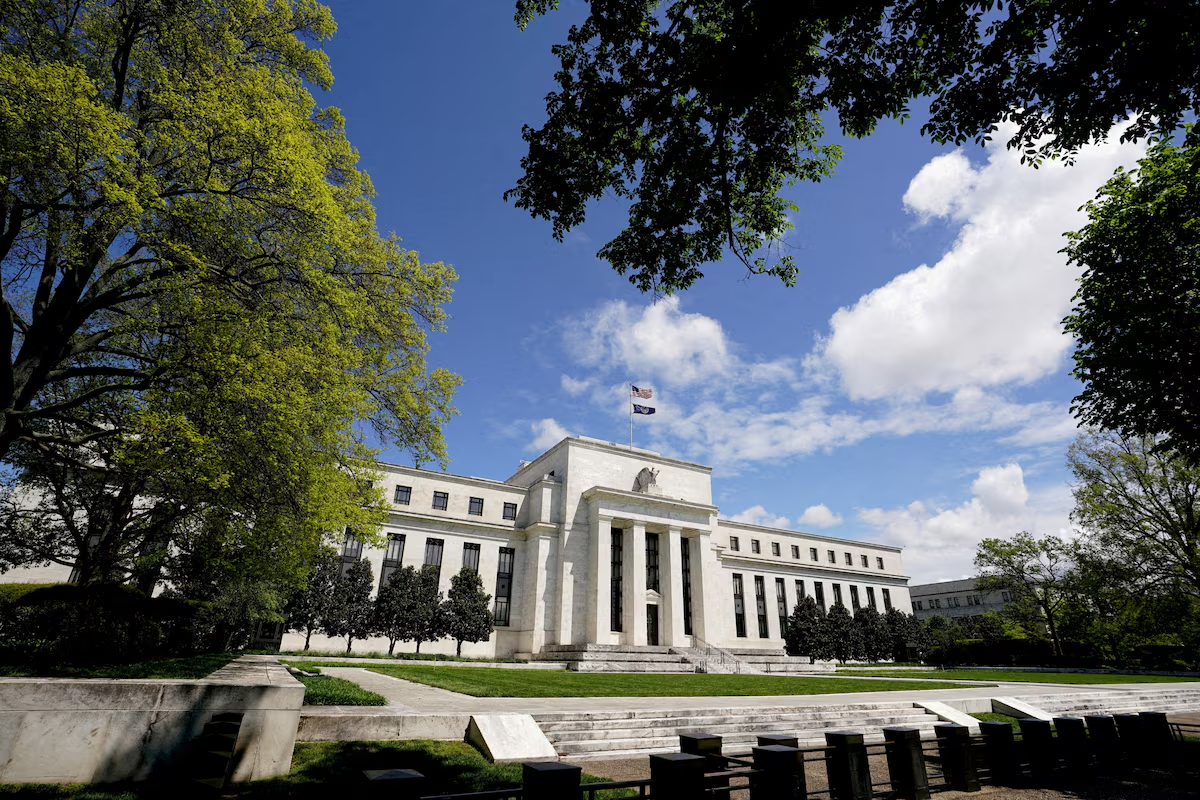
The Federal Reserve building in Washington. The central bank is expected to propose reindexing the thresholds at which banks become subject to stress tests.Kevin Lamarque/Reuters
The U.S. Federal Reserve is working on a plan to raise the asset thresholds that trigger stricter oversight of big banks, four people with knowledge of the matter said, which would allow some lenders to avoid costly additional regulation and potentially spur consolidation.
The central bank is expected to soon propose reindexing the thresholds where banks become subject to stress tests of their balance sheets, liquidity, capital and other more stringent rules, to account for inflation and economic growth, the people said. Three of the people said they expect the Fed to propose the changes later this year.
Current rules impose stricter requirements when a bank reaches US$100-billion in assets, stepping up at US$250-billion and again at US$700-billion. Lenders say those thresholds, set in 2019, haven’t kept pace with the economy, subjecting banks to increasingly stringent oversight that exceeds the risks they pose.
Banks say crossing the US$100-billion threshold typically requires major investment in compliance staff, risk management systems, stress-testing capabilities and regulatory reporting infrastructure that can run into tens of millions of dollars annually.
The Fed is planning to reindex the highest threshold closer to US$1-trillion and some of the requirements triggered by the lower threshold closer to US$150-billion, said the people, who declined to be named as they were discussing sensitive regulatory issues.
Banks that stand to benefit include U.S. Bancorp USB-N, Capital One COF-N, PNC Financial PNC-N and Truist TFC-N, which are closest to the US$700-billion threshold, giving them more room to grow without incurring some of the toughest Fed oversight, including aspects of new incoming capital rules and daily reporting requirements to supervisors.
Western Alliance WAL-N, Zions ZION-Q and several others, meanwhile, could grow beyond US$100-billion without incurring all the requirements currently imposed on lenders in that category. Pinnacle Financial Partners PNFP-N and one or two other lenders sitting between US$100-billion and US$150-billion could even shed some requirements.
A Fed spokesperson declined to comment. In January, Fed vice-chair for supervision Michelle Bowman said the central bank would consider reindexing the thresholds and suggested using nominal GDP, but the Fed has not commented since then.
“The U.S. economy has grown significantly over the past seven years, and it makes sense to have rules for all banks that will help consumers and small businesses through increased bank lending capacity and more competition,” said a U.S. Bancorp spokesperson.
The other banks either declined to comment or did not respond to requests for comment.
Changes could spur midsize bank deals
The plan is part of a broader effort by U.S. President Donald Trump’s administration to reform bank oversight which officials say is stifling lending and the economy. Bowman is also overhauling capital rules and other aspects of the Fed’s supervisory regime.
The changes could lead to a wave of consolidation among midsize lenders which have been holding off for fear of breaching the thresholds, the people said.
Banks with US$50-billion to US$700-billion of assets announced just 33 bank and thrift acquisitions over the past decade, according to S&P Global Market Intelligence, with just seven such deals last year, including Fifth Third’s FITB-Q US$10.9-billion acquisition of Comerica.
“We would expect this to unlock M&A activity among midcap and regional banks that have been in a holding pattern,” said James Stevens, partner at law firm Troutman Pepper Locke, adding bank boards would be able to assess deals on merit “rather than on the regulatory math.”
One banking industry executive said raising the US$700-billion threshold would allow larger lenders to more effectively compete with the country’s four biggest consumer banks.
Critics of bank consolidation argue it harms consumers by reducing competition and services, while increasing systemic risks.
Banks have long argued thresholds are arbitrary
Following the U.S. financial crisis, the 2010 Dodd-Frank Act set supervisory thresholds, which Congress softened in 2018. That law mandates some requirements that only Congress can change, including stress tests for banks in the US$100-billion bucket and “enhanced prudential standards” for those above US$250-billion.
But the law also gave the Fed broad discretion, and the central bank imposed additional capital planning, liquidity and reporting requirements for the US$100-billion category. It also created the US$700-billion category to ensure sufficient oversight for big banks not deemed globally systemically important banks, which are subject to a separate regime.
Banks have long said the thresholds are arbitrary and can distort business decisions by encouraging banks to stay below them.
Reindexing using nominal GDP would incorporate inflation and economic growth. It could push the highest threshold to around US$960-billion and the lower threshold for the additional Fed requirements to roughly US$150-billion.
Democrats say Congress already watered down the rules in 2018, and asset thresholds, though imperfect, offer a simple way to calibrate requirements.