
Good morning. Whether the opposition is ready or not, British Columbia is headed for a snap election next month. More on that below, along with a visit from India and a new wildfire to watch.
Open this photo in gallery:
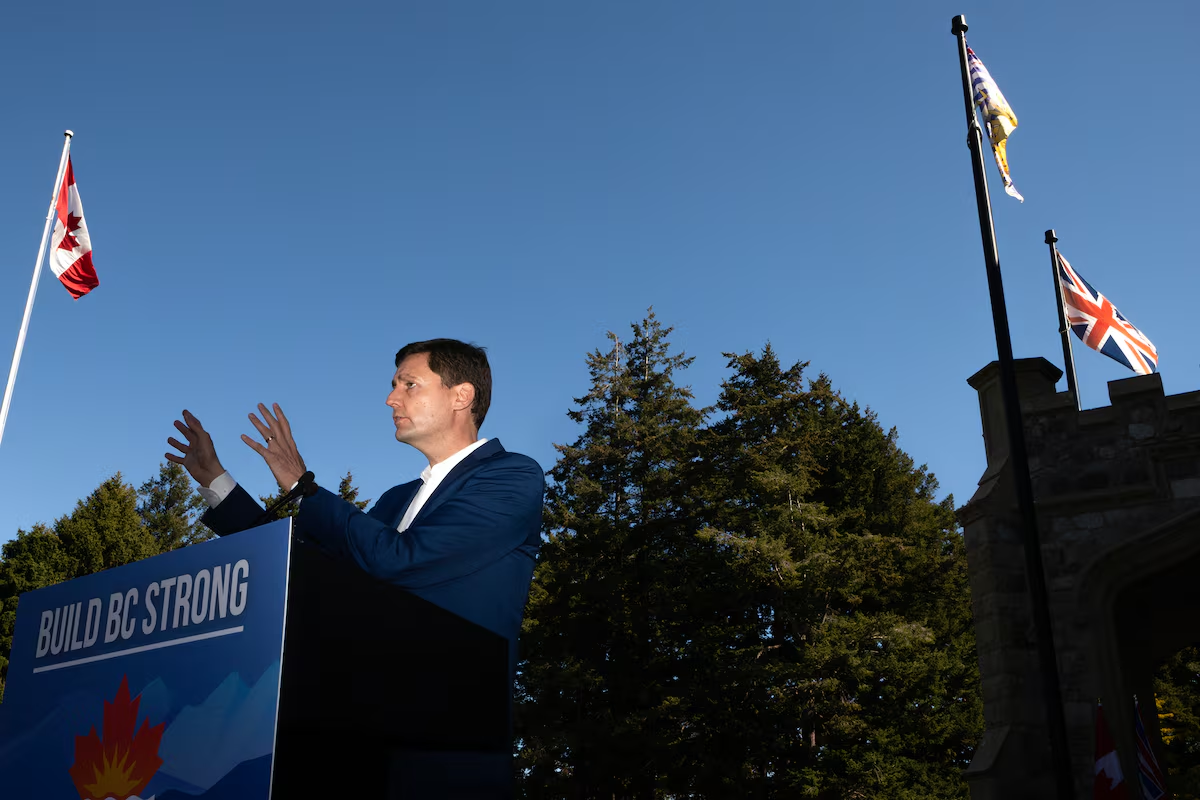
B.C. Premier David Eby is joined by his wife Cailey Lynch at Government House in Victoria on Tuesday as he announces a snap election.Chad Hipolito/The Canadian Press
TOP STORIES
B.C. Premier David Eby calls a snap election
British Columbians will head to the polls Oct. 24 for a snap provincial election. Premier David Eby called the election yesterday, and will be sending voters to the polls two years early, saying that he needs a strong mandate to deal with the economic chaos caused by Donald Trump’s trade war.
The details: Right after asking the Lieutenant-Governor to dissolve the legislature, Eby held a press conference in Victoria, in which he denied it was unethical to call the election while the BC Conservatives, who form the province’s Opposition, are without a permanent leader.
What else: Municipal leaders had asked Eby to hold off on calling an election because municipal elections across the province are scheduled for seven days earlier on Oct. 17. Eby said he had confidence that voters will not be confused when the provincial campaign overlaps.
Ask us: For our election coverage, The Globe wants to hear your questions about the early vote.
Sign up for Morning Update:
Reading this online? Start your morning with context and insight on the day’s biggest stories, in your inbox every weekday.
Open this photo in gallery:
Prime Minister Mark Carney meets with Indian Prime Minister Narendra Modi during the G7 summit in Evian-les-Bains, France, in June.Christopher Katsarov/The Canadian Press
Modi expected to visit Canada and make a deal
Indian Prime Minister Narendra Modi is expected to visit Canada in December to sign a completed trade deal between the two countries. India’s high commissioner to Canada said he expects a free-trade agreement under negotiation will be ready by November and that his country’s leader will arrive in Canada the following month.
The context: Canada launched talks on a deal to lower trade barriers with India in 2025, as part of a push to reduce economic dependence on the U.S.
Open this photo in gallery:
Police monitor the scene after a shooting outside the Sons of Jacob Synagogue in Belleville, Ont.Sammy Kogan/The Globe and Mail
Advocates call attention to escalation of attacks on Jewish community
The recent shooting at a tiny synagogue in Belleville, Ont., represents a dramatic escalation of attacks targeting Jewish institutions in Canada, one that has left many in the community shaken and has led advocates to call on authorities to tackle the issue.
The latest: The suspect in Sunday’s shooting died late Monday night, according to Ontario’s Special Investigations Unit. A postmortem is scheduled to take place in Kingston on Wednesday.
Open this photo in gallery:
U.S. President Donald Trump, centre, speaks at a Gulf Cooperation Council multilateral meeting on the sidelines of the UN General Assembly in New York on Tuesday.BRENDAN SMIALOWSKI/AFP/Getty Images
More from the UN General Assembly meetings
U.S. President Donald Trump said American and Iranian officials met on the sidelines of the UN General Assembly. While details were scarce, the meeting was an unexpected engagement that came after he threatened in a speech that he may “annihilate” the Islamic republic if a deal isn’t reached soon to end the nearly seven-month war.
What else: After his speech, Trump met with Danish Prime Minister Mette Frederiksen and Greenlandic Prime Minister Jens-Frederik Nielsen to sign a new agreement that falls well short of granting U.S. control of Greenland, but allows the American military to expand its presence there.
Analysis: Trump uses his UN address to threaten and deride foes and allies alike, as usual, David Shribman writes.
Up next: Trump will meet with Chinese President Xi Jinping this week as they aim to avoid disruptions in their relationship.
Open this photo in gallery:
Children play along the shore at Grise Fiord, Nunavut, in early August, with ice in the bay.Jenn Thornhill Verma/The Globe and Mail
A snapshot of Canada’s climate vulnerabilities
Ahead of a major climate conference, The Globe asked scientists to map out where Canada is most vulnerable. First stop: Grise Fiord, Nunavut. The community’s Inuktitut name, Ausuittuq, means “the place that never thaws.” But now the glacier above town is retreating, taking a key component of the local water supply with it.
What’s next: Now in its third year, Adaptation Canada is the national climate conference that opened this week. Before the summit began, climate scientists also shared with us the biggest environmental changes ahead and how certain they are about them. The threats listed here are the most direct physical consequences of a warming atmosphere.
The Take
If we’re going to coerce wannabe doctors to practise in rural and remote areas, why pick only on those trained outside the country? Are they inherently more suited to rural medicine? Or are they being treated as second-class citizens?
— André Picard, health columnist
André Picard asks, should some doctors be forced to practise in underserviced areas?
The Shot
Open this photo in gallery:
RCAF members and aircraft maintenance engineering students are seen at BCIT’s Aerospace Technology Campus in Richmond, B.C., last week.Jennifer Gauthier/The Globe and Mail
For the first time, civilian schools are training the air force’s next generation of technicians.
The Wrap
What else we’re following
On fire: BC Wildfire Service says a new blaze called the Mount Jack wildfire is burning out of control on southern Vancouver Island.
At home: The City of Calgary says 911 operators broke rules, leading to a delayed alert for missing 11-year-old Parker Wells, who was found dead.
Abroad: Kyiv is releasing photos of its security forces in Africa for the first time, in the latest escalation of the shadow war between Russia and Ukraine.
At home and abroad: Carney says Canada is pledging $100-million in new aid for Palestinians in Gaza and the West Bank.
AFN: The National Chief of the Assembly of First Nations is criticizing Ottawa’s push to set firm timelines for decisions on major new infrastructure projects.
TMX: Ottawa is reviewing its approach to selling the publicly owned Trans Mountain pipeline.
TMI: Here’s what to know about “ghost posting,” the crafty social-media tactic that gives young users more control over their feeds.