
Open this photo in gallery:
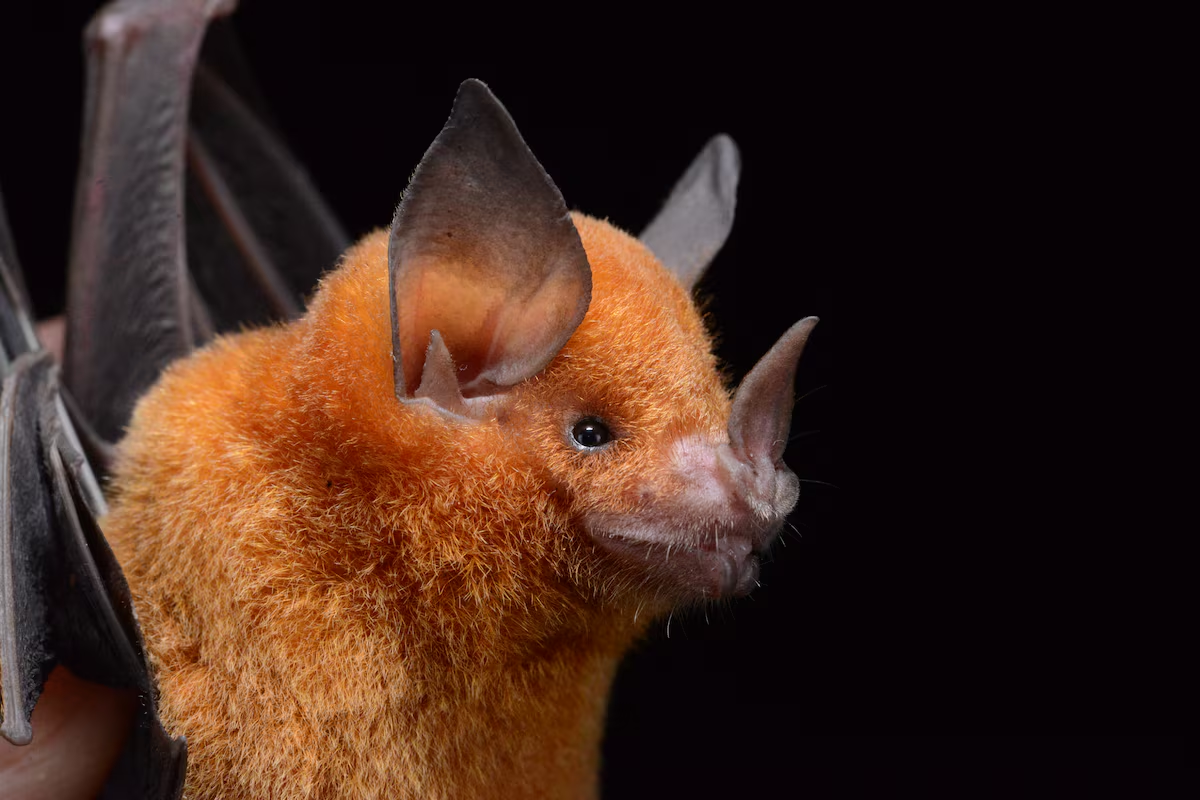
Niceforo’s big-eared bat (Trinycteris nicefori), found in South and Central America, is one of several species collected by the Royal Ontario Museum whose genome was used to help determine a new bat family tree in an international study.Burton Lim/Supplied
If someone threw a party for every type of mammal on Earth, a large portion of the guest list would be taken up by bats.
Bats account for about 20 per cent of total mammal diversity, with more than 1,500 documented species worldwide.
Now, a multiyear, international effort to explore the underlying genetics behind that diversity has yielded a new family tree and a better understanding of where and when bats arose.
The results, published online Wednesday by the journal Nature, suggest that bats, with their distinctive mode of powered flight, first arose in Europe some 65 million years ago.
That’s about 10 million years earlier than the oldest known bat fossils and coincides with the abrupt disappearance of dinosaurs along with three quarters of Earth’s plant and animal species in a mass extinction event.
If bats first appeared at that time, it implies they were able to exploit an ecological niche that was available after the mass extinction but not filled by birds. The genetic analysis suggests that bats evolved their powers of echolocation at a similarly early date. This method of using soundwaves to identify both obstacles and prey made bats ideal nocturnal hunters.
More than 100 researchers from 64 countries were involved in the effort, called Bat1K. It included sequencing and comparing the genomes of 103 species, which cover each of the 21 known families of bats.
About one-third of the species sampled in the study came from just one source: a freezer at the Royal Ontario Museum in Toronto that contains tissue gathered over decades from a wide range of bat species.
Canadian among researchers to discover dinosaurs nested farther south than previously known
In a small B.C. town, a grizzly family stirs unease
Burton Lim, assistant curator of mammals at the museum and a co-author of the study, said the ROM’s collection proved invaluable because researchers opted to store the bat tissue in liquid nitrogen, which they brought with them into the field.
“The colder the better, to keep the DNA intact,” Dr. Lim said.
The preservation enabled researchers to assemble whole bat genomes from longer strands of DNA than would have been available through other methods. In addition to comparing different species more easily, it meant researchers could determine that the ancestral bat genome was likely organized into 26 chromosomes.
“This is a landmark study for bat biology, and for comparative genomics more generally,” said Josefin Stiller, a biologist at the University of Copenhagen, in an accompanying commentary in Nature.
Dr. Lim added that in addition to illuminating bat evolution, results from the Bat1K project can inform both conservation and health. In a 2025 study, the project revealed the genetic information it gleaned about how bats tolerate viruses, including those that can be passed to humans, such as the coronaviruses responsible for SARS and COVID-19.