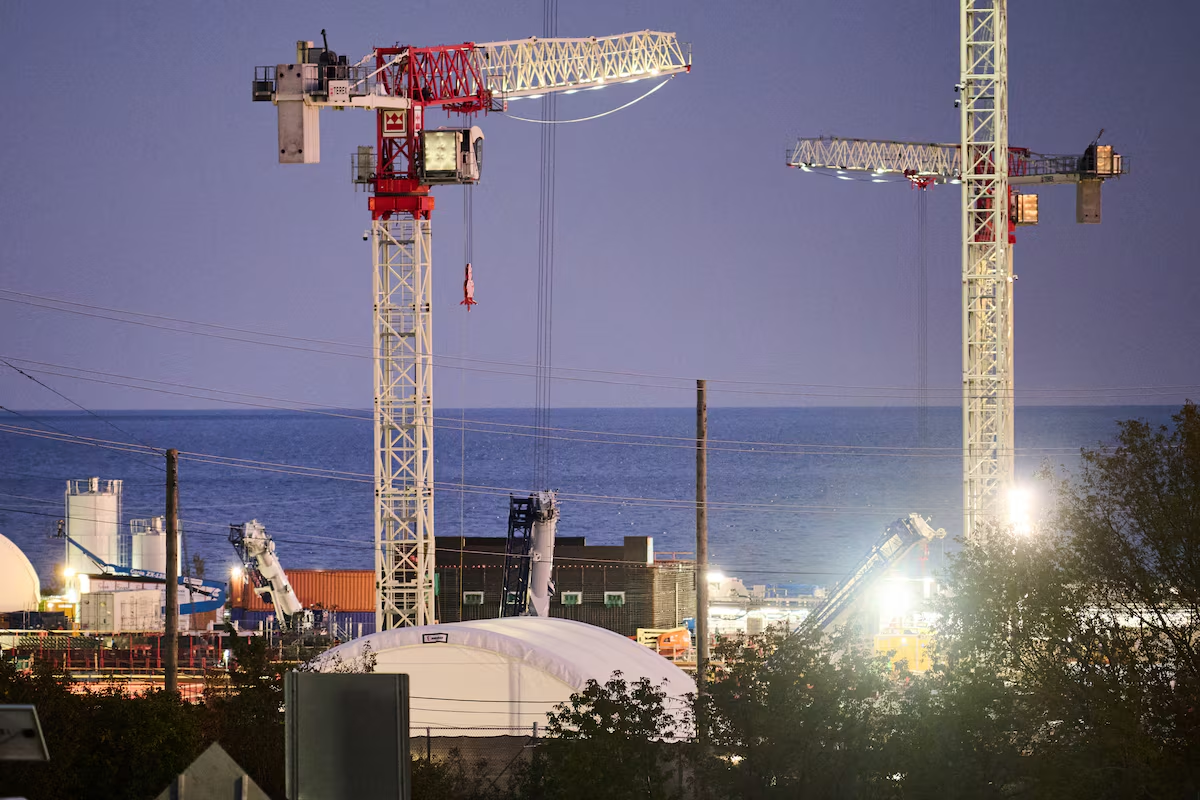

Open this photo in gallery:
Construction continues at the Darlington New Nuclear Project’s planned site for four small modular reactors in Clarington, Ont., last month.Sammy Kogan/The Globe and Mail
The federal government is shrugging off an engineering setback at Ontario’s Darlington small modular reactor project, with Energy Minister Tim Hodgson calling it “a reality in all first-of-a-kind projects.”
Mr. Hodgson defended the Canada Growth Fund’s $2-billion equity investment in the project, saying it aligns with the taxpayer-backed fund’s mandate to shoulder risk for technologies that can drive economic growth and advance climate goals.
“It’s important for Canada that we do not balk on making these important investments,” he said.
Earlier this week, Ontario Power Generation said it would undertake a comprehensive assessment after filings with the Ontario Energy Board indicated the Darlington SMR project is facing cost overruns and delays.
To get its first new nuclear reactor in decades, Canada must beat the clock – and the odds
The Crown corporation reported that the overruns reflected the “ongoing engineering” work of its partner, GE Vernova Hitachi Nuclear Energy, which is responsible for designing the BWRX-300 reactor and other aspects of the facility.
In a statement, GE Vernova Hitachi spokesperson Jonathan Allen pointed to other factors outside his company’s control.
“While engineering and design maturity are important considerations, as OPG’s update recognizes, there are multiple interconnected contributions across engineering, procurement and construction, as well as evolving market conditions, including inflation and geopolitical risks.”
In quarterly financial statements released Tuesday, OPG said the first reactor unit would not be completed within its previously disclosed $7.7-billion budget.
The utility did not specify the size of the cost overrun or the extent of the delay, although a production forecast included in the filing suggests the project’s timing could slip by at least a year. OPG had previously targeted an in-service date of October 2030.
The delay could ultimately prove shorter than a year, depending on the outcome of an assessment that is expected to be completed by mid-2027.
Inside the agency advancing Carney’s major projects agenda
The project was among the first to be shepherded through the Major Projects Office last year and later received significant equity commitments from the federal and provincial governments via the Canada Growth Fund and the Building Ontario Fund.
In an e-mail, CGF spokesperson Mathieu St-Amand wrote that “the equity commitment is being deployed over time.”
A corporate presentation from the fund said the investment is subject to certain conditions, but Mr. St-Amand declined to say whether those conditions were tied to specific project timelines or cost estimates.
In a separate corporate presentation, the CGF says its capital will be deployed in two tranches: one tied to the first reactor unit and another for the remaining three units, contingent on the achievement of certain milestones.
Asked about whether the investment is a prudent use of public funds, Mr. Hodgson said every project has contingencies built in.
“There are on and off ramps for the CGF to be involved, and I’m confident that it is well structured project-to-project to protect the CGF,” he said.
The Darlington New Nuclear Project (DNNP), with a total budget of $20.9-billion, involves building four BWRX-300 reactors and accompanying infrastructure adjacent to the existing generating station in Clarington, Ont.
Open this photo in gallery:
The Darlington Nuclear Generating Station in Clarington, Ont., last month.Sammy Kogan/The Globe and Mail
The project is being watched globally because it’s the first small modular reactor to begin construction in a Group of Seven country. There are also proposals to build BWRX-300s in several other countries including the U.S., Britain and Poland.
In the U.S., GE Vernova Hitachi has partnered with the Tennessee Valley Authority to build the first single BWRX-300 on American soil at its Clinch River site. Although no construction date has yet been announced, the U.S. Nuclear Regulatory Commission recently issued a construction licence for that project.
“It would be premature to speculate on any direct impact to TVA’s potential projects,” wrote TVA spokesperson Elizabeth O’Connor in a statement.
“TVA remains committed to a disciplined approach to deploying advanced nuclear technology and will continue working through partnerships to ensure costs are managed responsibly to protect TVA customers.”
Ontario’s Independent Electricity System Operator did not respond directly to questions about how the DNNP delays might affect plans to supply electricity to Ontarians in the early 2030s.
Global conflict pushes countries to focus on domestic energy security, report finds
IESO spokesperson Michael Dodsworth noted that the IESO was in the middle of a large competitive electricity procurement known as Long-Term 2, “which was expanded from 5,000 to 7,500 megawatts to meet growing electricity demand.” The organization was also promoting electricity efficiency to reduce peak demand.
He added: “The IESO will continue to work with OPG as the Darlington New Nuclear Project advances, and relevant information will be considered as part of future system plans to determine if any incremental actions are needed.”
Pierre-Olivier Pineau, chair in energy sector management at HEC Montréal, said the challenges facing the Darlington SMR project “underscore the fact that we need to be very cautious and honest in our energy and electricity policy across Canada.”
He argued governments should take their time to evaluate any potential future investment in the project.
“We should never think because we’ve invested so much, we should keep investing,” he said, describing the initial costs as already more than what anyone would ever want to pay for electricity.
“If they add more billions to this already expensive experiment, then we definitely can take a few more years to think about it.”