
Open this photo in gallery:
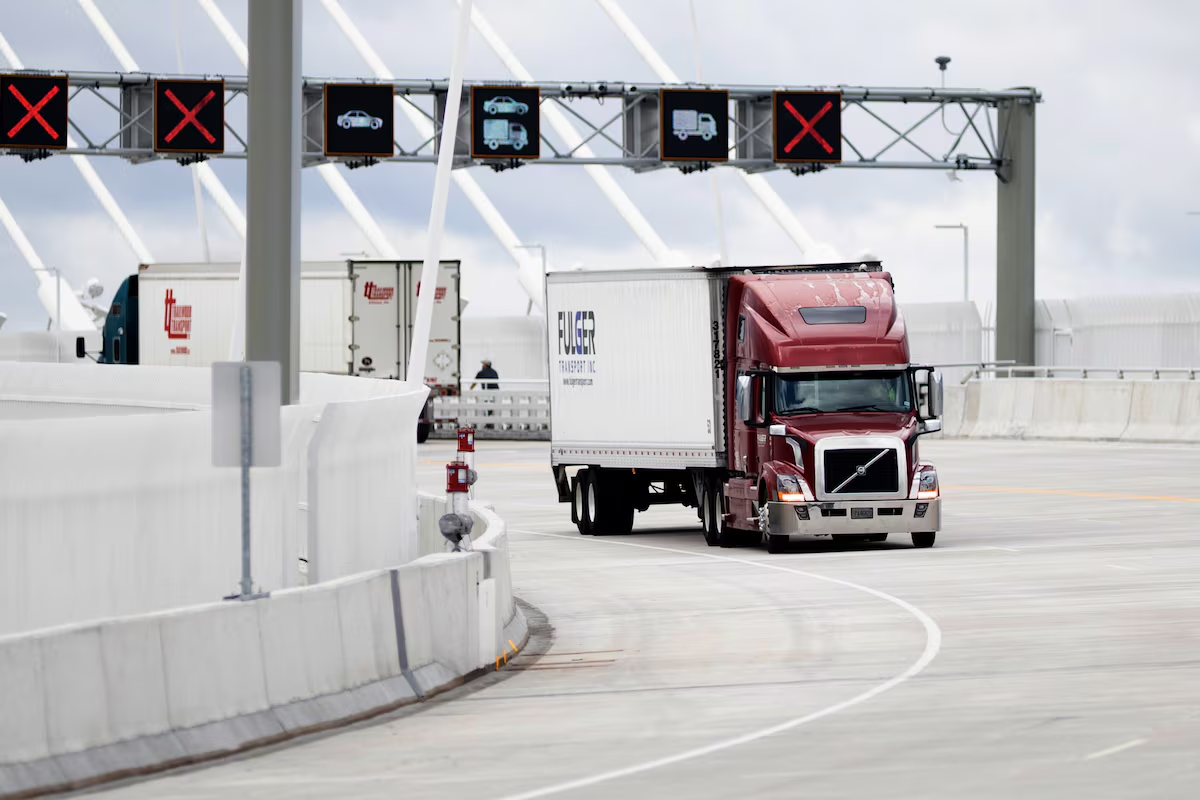
Trucks cross the Gordie Howe International Bridge, connecting Windsor to Detroit.Dax Melmer/The Canadian Press
The Ontario government says it will standardize commercial truck driver training in the wake of a scathing Auditor-General report that identified widespread issues with instruction and licensing in the province.
Ontario will work with industry stakeholders to develop a new curriculum aimed at strengthening road safety, Minister of Transportation Prabmeet Sarkaria said on Monday. But some representatives of the trucking industry say additional measures are required to address their concerns with training and oversight of commercial truck drivers.
The announcement follows a May report from provincial Auditor-General Shelley Spence, which found some private career colleges in Ontario were accrediting drivers without the minimum training requirements, and in some cases had altered student records to falsify their qualifications.
Trucking association calls for overhaul of commercial truck driving school inspections in Ontario
Currently, aspiring commercial truck drivers in Ontario must complete mandatory entry-level training, which consists of a minimum of 103.5 hours of instruction. Private career colleges must submit their curriculum details for approval to the Ministry of Colleges, Universities, Research Excellence and Security to ensure they meet provincial standards.
The Transport Ministry said that under the new approach schools will be required to follow a standardized curriculum that will include “more than 103 hours of clear, robust and consistent training.” The plan is expected to be implemented by early 2027, after consultation with industry stakeholders.
While large trucks represent about 3 per cent of all vehicles on provincial roads, they accounted for 12 per cent of all fatal collisions between 2019 and 2023, Ms. Spence’s report noted. Truck driver violations in Ontario have also spiked in recent years. For example, between 2020 and 2024, the percentage of truck drivers found in violation of rules requiring them to keep daily vehicle inspection logs increased by 135 per cent.
It is not clear how the new curriculum proposals will differ from the province’s existing practices, but the province said it is considering additional training subjects such as fatigue management and rural driving.
Rolf VanderZwaag, one of the architects of Ontario’s mandatory entry-level training standards, which were implemented in 2017, said the essential driving skills program he helped develop is “effectively a standardized curriculum.”
“Most Ontario schools already use it,” said Mr. VanderZwaag, who is the CEO of Techni-Com Inc., which produces compliance and training products for the trucking industry.
Mike Millian, president of the Private Motor Truck Council of Canada, a national association representing companies with in-house commercial trucking fleets, said any improvement in training standards are welcome.
However, additional reforms are urgently needed to address industry’s concerns around training and oversight, he said.
“Having a standardized curriculum is not what our key issue is. Our key issue is people aren’t following the curriculums that they’re submitting,” he said.
Around one quarter of the 216 private colleges offering truck driver training in the province had never been inspected by the provincial colleges ministry, the report found – noting the ministry employed just eight inspectors to audit all 595 private colleges in Ontario.
As part of the research conducted for the May report, Ms. Spence’s office sent students undercover to five unnamed private colleges and found that some students were not taught the required elements of truck driving, including reverse parking and emergency stopping.
As previously reported by The Globe, industry groups have called on the province to overhaul training and licensing procedures, and for the Transport Ministry to take full carriage of the file from the Ministry of Colleges and Universities.
The Private Motor Truck Council of Canada has called for more inspections at private career colleges and heftier fines for those who fail to meet provincial training standards for truck drivers.
Currently, private career colleges face fines of between $250 and $1,000 for first offences, according to the Auditor-General report.
In its statement Monday, the Transport Ministry said it was introducing a dedicated integrity manager for truck driver testing across the province and weekly reviews of commercial driver training schools.
Alberta mulls restrictions on new truck drivers but industry groups urge caution
The Professional Truck Training Alliance of Canada (PTTAC), which advocates for progress in education and training in the transportation sector, has also called for numerous reforms, including stricter screening of aspiring drivers’ criminal record and driver abstracts. The organization has also advocated for testing instructors to be equipped with body cameras as a fraud prevention tactic, and has called for dual-facing cameras to be required in training vehicles.
“We want to continue to see improvement, but at the end of the day, regulation and compliance without any enforcement falls on deaf ears,” said Kim Richardson, a senior adviser to PTTAC.
The Private Motor Truck Council’s Mr. Millian said any improvements to the provincial curriculum must include more one-on-one training time for drivers.
“The key area that we see as an issue in the industry is people’s ability to back up the vehicle and operate the truck safely up and down the highway,” he said.
After completing entry-level training, aspiring drivers must take road exams at DriveTest centres. These are run by a third-party provider, Serco, for the Transport Ministry.
As previously reported by The Globe, five employees of driver-licensing centres in Ontario were also charged earlier this year with allegedly accepting bribes to manipulate the results of commercial truck-driving tests.
Mr. Millian says Serco’s Brampton, Ont. testing campus already employs two integrity officers to prevent cheating on road tests.
“We have seen some increases in enforcement, which is welcome,” he said. “But we need to go further.”