
Open this photo in gallery:
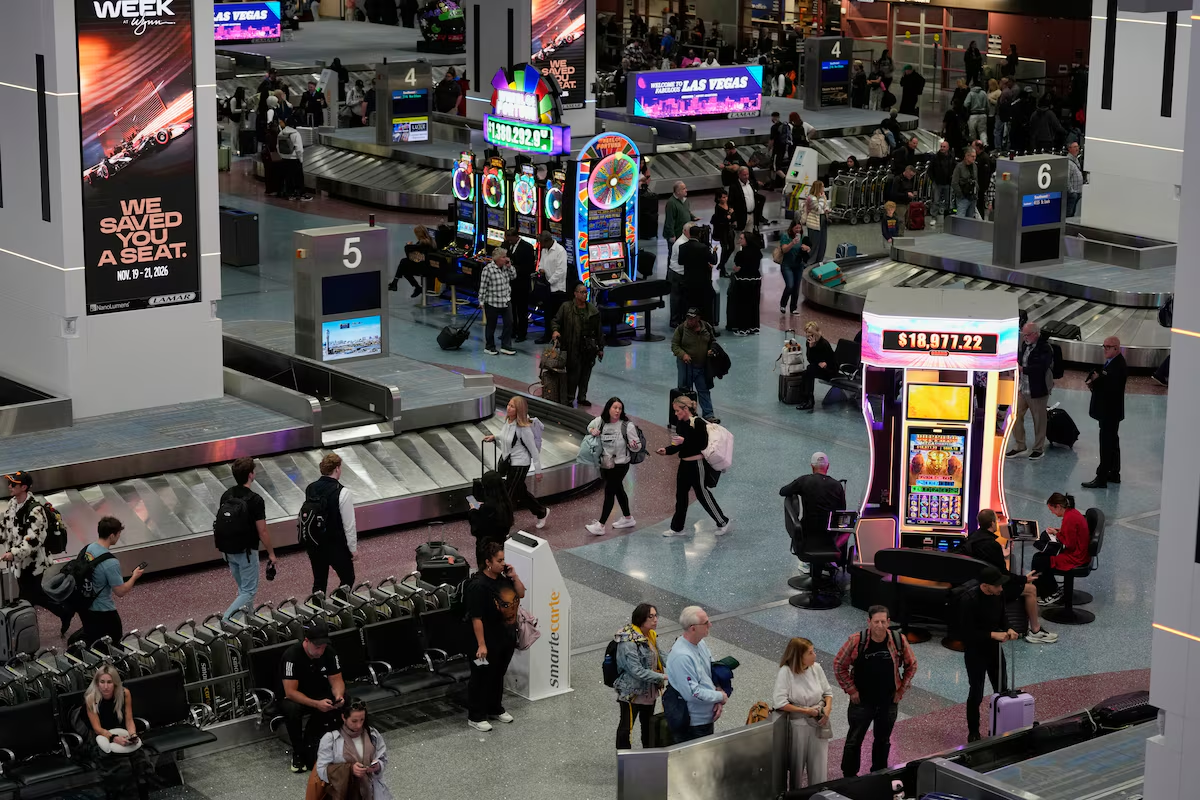
People walk through the baggage area at Harry Reid International Airport, on Nov. 13. Tyler Rowen’s three-day getaway to Las Vegas turned into a week-long stay after her flight to Edmonton was cancelled.John Locher/The Associated Press
Canadian air travellers dealt with fallout from Friday’s U.S. aviation ground stop throughout the weekend as airlines worked through further cancellations, delays and a backlog of displaced passengers and aircraft.
The U.S. Federal Aviation Administration said more than 12,400 flights were cancelled or delayed on Friday when the agency halted all air traffic in the country for nearly five hours because of what it called a “communication issue.” The disruption had a knock-on effect for international travel, including Canadian flights to and from the U.S. and those transiting U.S. airspace.
Air traffic resumed on Friday night, but at least 260 Canadian flights were cancelled on Saturday and Sunday, according to Cirium, an aviation analytics company. This includes flights from the U.S., Mexico and the Caribbean. The disruptions have left some passengers stranded for days, facing unexpected expenses and scrambling to find their way home.
The FAA said Sunday that an initial investigation pointed to a technical problem with legacy equipment that became unstable, potentially because of work being done by its network service provider, L3Harris, including the deployment of a new router.
Latest travel disruption could cost Canadian airlines millions, expert says
The agency began “experiencing instability” at 17 of 22 air-route traffic control centres, which spread to several facilities that manage aircraft approaching and departing airports, the FAA said on its website Sunday, in explaining what happened on Friday. It then implemented a countrywide ground stop out of an abundance of caution.
Air Canada cancelled about 250 flights on Friday, affecting about 27,000 passengers, spokesperson Sean Davidson said in an e-mail on Sunday. Additional flights were cancelled on Saturday as aircraft and crews were out of position across the airline’s network, he said.
It is impossible to place a price tag on the impact of the ground stoppage, but Canada’s airlines could face millions of dollars in new costs.
For Tyler Rowen, a mother and realtor from Sherwood Park, Alta., a three-day getaway to Las Vegas with a friend has turned into a week-long stay. The two were supposed to fly home on Saturday when she received an e-mail from WestJet saying that their flight to Edmonton had been cancelled.
After enduring hours navigating a chatbot and waiting on hold to speak with an agent, the two were rebooked for a flight on Tuesday – three days after their planned return. The friends “bargain hunted” for cheaper accommodations but will still be paying an extra US$800 on their hotel bill, along with food and other expenses.
U.S. lifts nationwide ground stop after FAA order triggers widespread flight disruptions
“We were pretty stressed there from the start, worried, trying to make all of these arrangements we needed to arrange,” Ms. Rowen said in an interview. “Once we had a flight locked in and we were able to know when we’d be coming home, then we just decided, okay, let’s make the best of it, try to have some fun and try not to spend too much money, in case we don’t get reimbursed for anything.”
Passengers may have more recourse than airlines initially suggest, according to Gábor Lukács, president of the air travel watchdog Air Passenger Rights.
While Friday’s ground stop was beyond airlines’ control, Canada’s Air Passenger Protection Regulations require large carriers to offer passengers a refund or rebook them on the next available flight operated by any airline if they cannot get them onto their own or a partner airline within 48 hours of their original departure time, Mr. Lukács said. If the only available alternative is a higher class of service, the airline cannot charge passengers the difference in fare.
Mr. Lukács also cautioned against airlines using Friday’s FAA ground stop as a blanket justification for subsequent cancellations. He cited the B.C. Court of Appeal’s August ruling in Air Passenger Rights v. WestJet Airlines Ltd., which found that airlines must establish a direct and causal link between the circumstances they cite and the specific flight cancellation.
Trump breaks silence on nationwide ground stop, demands more money from Congress for FAA
“We all understand that whatever happened on Friday was outside of carriers’ control, but I have heard about passengers who were told that their flight from St. John’s to Toronto was cancelled somehow, allegedly because of the U.S. situation, and you know that’s sheer nonsense,” he said. “So, I caution passengers to always be very critical when airlines make the causation claim.”
Meanwhile, U.S. President Donald Trump on Sunday broke his silence on the travel disruption, blaming the Biden administration.
“Everything they touched turned bad,” Mr. Trump wrote in a post to Truth Social. “Big money spent unwisely, making an old and broken system worse than when they began. We have the knowledge and plan for the Flight Control Systems, we need Congress to give the money, FAST!”
Congress, which Republicans have controlled for nearly two years, approved US$12.5-billion for the FAA last year. Democrats are set to take control of Congress in January.
Transportation Secretary Sean Duffy said at a news conference Friday that the agency had received that funding and is “spending it well,” before requesting an additional US$50-billion to “finish the build.”
With a report from Eric Atkins