
Open this photo in gallery:
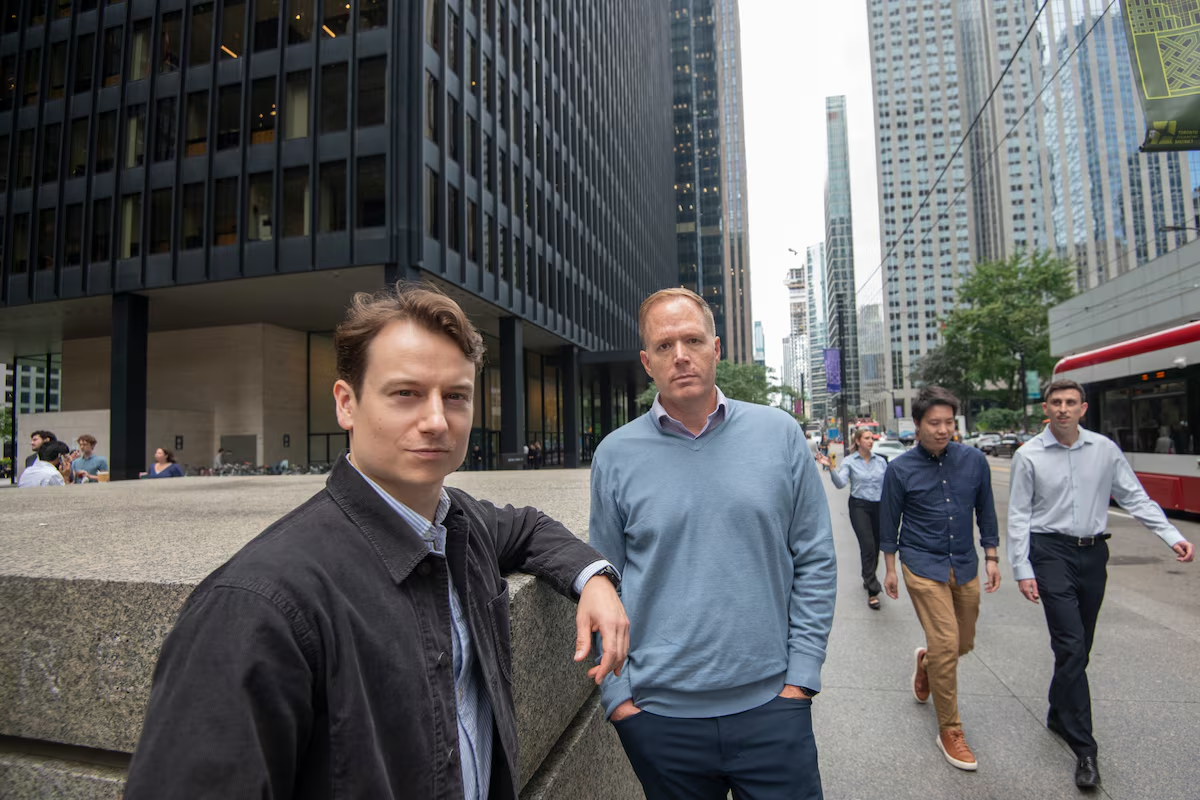
Deep Sky executives Charlie Renzoni, left, and Jason Vanderheyden helped pitch the carbon capture and storage startup’s planned Alberta megafacility to global investors in Toronto.Fred Lum/The Globe and Mail
When Deep Sky Corp. was invited to apply for Prime Minister Mark Carney’s Canada Investment Summit, chief executive Alex Petre knew her carbon capture and storage startup had no time to spare.
It was May 29; foreign direct investment agency Invest Alberta Corp. wanted to know if Montreal-based Deep Sky, with whom it had worked for two years, was interested in being considered for the summit less than four months later.
Ms. Petre and her team recognized what that meant – a chance to parade before the world’s most deep-pocketed investors at an unprecedented event on home turf. The answer was a resounding yes.
“We knew we had to be there, we had to show up, so we put all the pieces together,” said Jason Vanderheyden, Deep Sky’s Toronto-based vice-president of government affairs and public policy. Even if it wasn’t selected, he said the company “already had a plan in place to approach this summit as a key opportunity for Deep Sky.”
The 40-person remote team sprung into action. By the time they found out in the second half of August that their carbon capture project made it into the government’s coveted summit prospectus deal book, Deep Sky was ready to pitch investors.
Their effort culminated in three days of wall-to-wall events, investor meetings and shoulder-rubbing for Ms. Petre and three other senior leaders in Toronto’s financial district.
Canada has a post-summit glow. Here’s what’s still needed to spur major investments
At every turn, they made the case for their company, which is testing eight different direct air capture technologies that pull carbon from the sky at a demonstration plant an hour north of Calgary. (The startup chose Alberta because of its favourable regime for such projects.) It became the first such facility in North America this year to issue carbon credits to offset emissions by corporations.
The company’s project featured in the deal book is the first phase of a planned Alberta-based megafacility called Deep Sky One. The facility will eventually suck 500,000 tonnes of carbon from the sky each year; Deep Sky will then store that carbon underground. The first phase will target 30,000 tonnes a year, with a goal to be operational in the second half of 2028.
Deep Sky is seeking up to US$200-million in project equity, construction debt and strategic investment to finance the facility’s US$328-million first phase. It will sell the offset credits to its customers, which include Royal Bank of Canada, Microsoft Corp., Lufthansa, Sumitomo Mitsui Banking Corp. and 21 others.
At a summit reception at Toronto’s Royal Ontario Museum on Sunday, Ms. Petre navigated a room full of hundreds of attendees – none wearing nametags – and snagged more than 40 business cards from investors, leading to 12 meetings. By Thursday, she had lost her voice.
She, Mr. Vanderheyden and vice-president of carbon markets Charlie Renzoni divided and conquered the events they wanted to attend, including two separate dinners with Australian delegations. On Monday, the trio attended the ringing of the Toronto Stock Exchange closing bell with Alberta Premier Danielle Smith and other project purveyors from the province. “It was a pretty crazy journey over a fairly short period of time,” Mr. Vanderheyden said.
Ms. Petre, who is based in Calgary, estimates that meeting such a concentration of interested capital providers in Canada’s largest city saved her company months of outreach and close to $50,000 in travel costs. (She stayed with her parents in Aurora, Ont., while Mr. Renzoni flew out from Vancouver and camped out with his grandparents in Toronto.)
Deep Sky started planning for the summit almost as soon as Mr. Carney announced the event in April. Even though Invest Alberta didn’t contact the company for more than a month after that, “we organized ourselves to figure out what is the best way to actually be in the summit,” Ms. Petre said.
What are Carney’s next moves after EU meetings and the investment summit? Ask us your questions
The company went on a fact-finding mission to determine how the project-selection process would work, and tapped their board members to make connections with investors who would be attending.
Five days after Invest Alberta reached out, Deep Sky made its initial, two-page submission to the province for inclusion in the summit. Five weeks later, Deep Sky was invited to submit its project for inclusion in the deal book.
At that point, Deep Sky’s leaders had no idea if they would prevail, and they wouldn’t for more than a month. Ms. Petre told the team to plan for the next stage assuming they were in, and the company devoted a Slack channel to track summit plans.
In the lead-up to the summit, the company’s leaders contacted 70 organizations in 15 countries as they also set up meetings for New York Climate Week, which starts Sunday.
Just getting into the deal book proved to be a calling card, and led to 11 inbound inquiries from investors before the summit. Deep Sky’s outreach resulted in 20 meetings booked before the event.
“It’s very empowering to walk into these meetings with the fact that they know you were included in the deal book,” Ms. Petre said. “You’re able to have a very, very different conversation.”
The trio were peppered with questions from investors about revenue and return potential, about operational data, about technology risk and about how Deep Sky had managed to grow so quickly since it was hatched four years ago by Montreal tech entrepreneur Fred Lalonde, co-founder of online travel giant Hopper Inc.
William Robson and Mawakina Bafale: The investment summit made the pitch, but the sale isn’t closed
Many were impressed, Mr. Vanderheyden said, by the favourable regulatory regime in Alberta and Canada’s generous tax credit for carbon capture and storage projects. By Thursday, more than half of the 40 groups that Deep Sky met with had requested follow-up meetings. There was particular interest from groups in the U.S., France, Sweden and Japan, and Ms. Petre’s team was feeling optimistic. “We see a frenzy of activity following this,” she said.
“The week has actually been a trigger point for investors to dig deep and make it an opportunity they want to prioritize,” said a tired-looking Mr. Renzoni over drinks at the Fairmont Royal York lobby bar on Wednesday afternoon.
The next day, Mr. Vanderheyden observed that “it’s interesting that we have not done something like this before” in Canada. “Looking back, I can’t imagine us not trying to do this. We got full value out of it.”