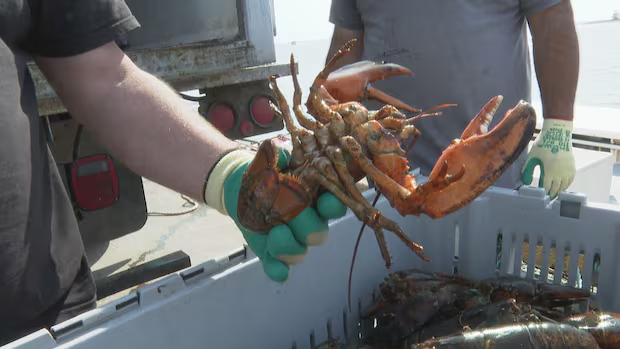
Pointe-du-Chêne is a hotspot for fishing this time of year, with lines dipping off the pier and commercial boats hauling lobster from the Northumberland Strait.
Peter Wallace has been fishing these waters for nearly 50 years, carrying on a family legacy that dates back to 1917, when his grandfather purchased a lobster licence for 25 cents.
These days, that piece of paper would cost someone new to fishing about $1 million, Wallace said.
“If they have to buy a licence, it’s very very expensive,” he said, and a “half-decent” boat will cost another $700,000 to $1.2 million.
 Peter Wallace says he plans to fish for a while yet, but after that his licence may go to a family member or be sold to a new captain. (Shane Fowler/CBC)
It’s a cost of entry that few can afford and banks won’t fully finance, say industry insiders.
Many worry that seafood buyers and processors are increasingly filling the gap, while getting the fisher to turn over rights and privileges of their licence in what is known as a controlling agreement.
WATCH | 3rd-party control leads some fishers to take greater risks, Maritime Fishermen’s Union says:
Fishers forced to give up control in exchange for financing, union says
Some seafood processors are helping finance the growing cost of a lobster licence. That’s prompting concerns that loan conditions are undermining the Atlantic inshore fishery.
“It’s a growing concern,” said Martin Mallet, executive director of the Maritime Fishermen’s Union. “With the rising value of our fishing operations … we’re seeing more and more prevalence of these controlling agreements.”
“The fisherman literally becomes a slave to that third-party corporation, and it creates all kinds of issues.”
 Martin Mallet, executive director of the Maritime Fishermen’s Union, was one of about 20 fishing industry stakeholders who attended a regulatory review session Aug. 27 in Moncton. (Jennifer Sweet/CBC)
One of the most serious consequences could be increasing the safety risks on the water, he suggested.
“That third party could force fishermen to make dangerous decisions when it comes down to going out fishing or not because of bad weather. If the fisherman has to go out because he has to make his payment because that third party is telling him to, he’s putting his life and his crew on the line.”
It can also eat into fishermen’s revenues.
According to Fisheries and Oceans Canada, in some agreements made between fishermen and their lenders, 60 per cent of a fisher’s revenue goes to repay a loan, or the principal owed continues to grow even when the fisher makes their payments.
 Rachelle Duval, the director of fisheries policy with Fisheries and Oceans Canada, said the department has seen money being used to exert control and wants to clarify the regulations so this doesn’t happen anymore. (Jennifer Sweet/CBC)
“In these instances, it’s hard to say the benefits are actually the licence-holder’s, and the fisher can be left with “a minimal amount of income,” a DFO staffer said at a meeting with fishers Aug. 27 in Moncton.
Clauses that were red-flagged by DFO as signalling a controlling agreement include:
- The fisher defaults if they don’t land their catch in a specific place or if fish aren’t available.
- The lender can set or influence daily fishing choices, such as crew selection.
- The lender can influence who gets the licence next.
- Repayment is to be made in fish instead of money.
When DFO sees things like this during licence-transfer requests, it rejects the transfers. But the department acknowledged that sometimes arrangements are made by handshake deals.
The department is in the process of consulting fishers and the rest of the public on how the regulations could be clarified and strengthened. Online submissions close Sept. 18.
 A DFO staffer leads a discussion about control of fishing rights and privileges during a consultation session in Moncton. (Jennifer Sweet/CBC)
The issue of controlling agreements is being considered at various levels, including Senate and House of Commons committees, but there’s still no hard evidence about just how prevalent they are.
The Lobster Processors Association did not respond to CBC’s requests for an interview.
Amanda Johnson, executive director of the Fundy North Fishermen’s Association, told the Senate fisheries committee this spring that she was “confident” at least 30 per cent of the fleet in her area was in “some form of a controlling agreement with a buyer.”
 Amanda Johnson, the executive director of the Fundy North Fishermen’s Association, was one of many fishing group representatives to tell the Senate fisheries committee they are concerned about controlling agreements. (Parliament of Canada)
Her association president, Brad Small, told CBC News that estimate is based on what fishermen see at the wharf and on the water. For instance, a young person may suddenly and inexplicably come into everything they need to start fishing, he said.
“Immediately he has the boat and the money and away he goes,” Small said. “He would sell to a certain buyer, which is known to have these agreements. He would buy bait from them and everything would be done through that one buyer.”
Gerry Byrne, a former MP and Newfoundland and Labrador fisheries minister, estimated during testimony before the Senate committee that if all of the financing now handled by seafood processors and other corporations in Atlantic Canada were suddenly unavailable there would be a $350 million to $450 million hole to fill.
 Gerry Byrne a former MP and fisheries minister in Newfoundland and Labrador, said part of the ‘big hook’ of processor financing is having things like bait and ice supplied as part of the deal. (Parliament of Canada)
The MFU and other fishing associations in Eastern Canada say if it keeps up, Atlantic fishers will soon be in the same dire straits as their counterparts in B.C.
“Most of the benefits of fisheries on the West Coast are going to big corporations,” said Mallet. “There are fishermen on the boats, but they’re being paid literally minimum wage for the work.”
On the East Coast, by contrast, where fishing is done by owner-operators, according to federal policy going back about 40 years, it’s come to be known as a lucrative business with significant economic spinoffs throughout the region.
 A fishing boat called at MacEachern’s Point Wharf, part of the municipality of Alnwick, northeast of Miramichi, where about 38 boats fish lobster and employ more than 100 people. (Shane Fowler/CBC)
“When a fisherman owns his enterprise, he re-invests in his vessel, in his fishing gear, usually locally,” Mallet said, adding that supports other local businesses such as boat yards and gear suppliers.
Preserving the independence of the fleet is something fishermen support, said Denis St-Pierre, a tax specialist and accountant in Bathurst who works with crab and lobster fishermen to structure their businesses.
“They do not want the control to be transferred to fish processors. That’s for sure,” St-Pierre said.
 Denis St-Pierre, a tax partner with MNP, said some licences, including boat and gear, are going for $2 million, but the bank would only value it at about $1 million and issue a loan for a maximum of about $750,000. (Jennifer Sweet/CBC)
But right now, banks will only finance about 75 per cent of what they assess the value of a fishing licence to be in bad times, he said, and a provincial government program offers maximum loans of $500,000.
“It makes a huge gap to be filled, and the only ones who are ready to fill that are the processors because they need the product,” St-Pierre said.
Back at the wharf in Pointe-du-Chêne, lobster boat captain Daniel Doiron sees things in a similar way.
”I know some plants, they help the fishermen, but they’ve got no choice. The bank’s not going to help them. The government’s not going to help them.”
Doiron and many others are supporting the idea of a national public financing program for fishermen, such as what farmers have through Farm Credit Canada, to help younger people get started in the fishing industry.
“They’re going to need it,” Wallace said. “There’s a lot of old fishermen. The majority of them are. … Within the next 10 years there will be a lot retiring.”