
Open this photo in gallery:
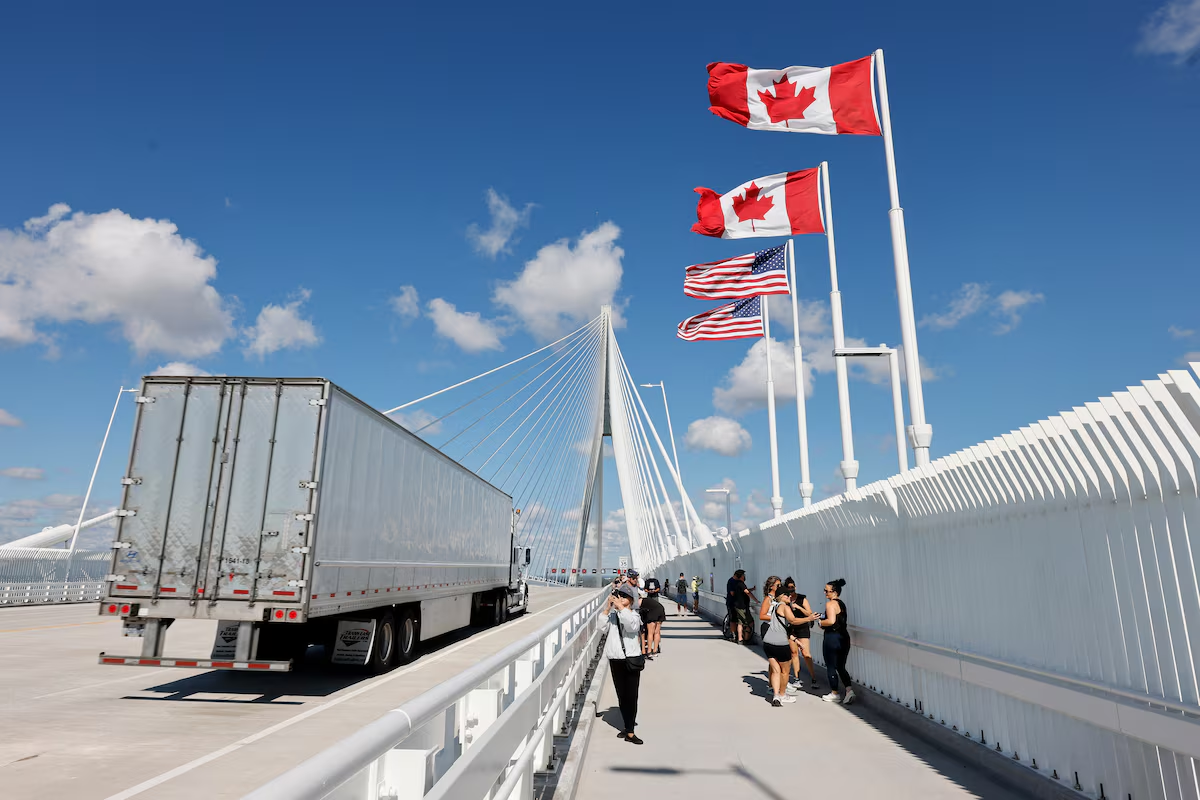
A truck crosses into the United States on the Gordie Howe International Bridge. Canada’s countertariffs are in response to 50-per-cent tariffs that President Donald Trump levelled against Canada on Aug. 22.JEFF KOWALSKY/AFP/Getty Images
09/08/26 10:53
Trump’s tariff policy could cost him in the midterms
– Adrian Morrow
U.S. President Donald Trump’s policy of imposing or raising tariffs on nearly every country in the world – and escalating his trade war against Canada – could cost him politically in November’s midterm elections.
That’s because U.S. voters are already anxious about the cost of living, and the opposition Democrats are doing everything they can to tie this to Trump’s signature policies, including the war in Iran, cuts to health care spending and tariffs.
In a campaign video released Tuesday morning, Abdul El-Sayed, the Democratic nominee for a Senate seat in swing state Michigan, invites voters to play “The Price is Wrong.” In the two-minute spot, his mock game show highlights price increases to a range of goods, from dishwashing detergent to Tim Hortons coffee.
“Everything’s gotten more expensive over the last year because of Trump’s tariffs and his war in Iran,” El-Sayed says. “Americans are paying way more for everyday goods that they have to buy at the grocery store – all because of this insane war that’s spiking the price of gas … and now, a trade war that’s just expanded with Canada.”
El-Sayed’s messaging is emblematic of the “affordability” theme that Democrats are hoping will win them back control of the House of Representatives, possibly the Senate and several state governorships.
It is particularly significant in border states such as Michigan, whose economies are heavily reliant on Canada. And Trump may have just handed them a potent new weapon.
09/08/26 10:45
Bombardier shares fall after Trump threatens U.S. market access
– Nicolas Van Praet
Open this photo in gallery:
Jet planes are assembled at Bombardier’s aircraft assembly centre in Mississauga, Ont., on May 8.Sammy Kogan/The Canadian Press
U.S. President Donald Trump’s latest attack on Bombardier Inc. is spooking some investors as the Quebec plane maker gets dragged into Canada’s trade war with the United States with no talks in sight.
Bombardier shares were down 7 per cent to $293.49 in heavy trading on the Toronto Stock Exchange Tuesday morning. It’s the first trading day since the President floated a ban on Bombardier jets sales in the U.S. over the long weekend.
Analysts say it’s not clear what legal mechanism the White House would use to stop the company from exporting into the U.S., and Trump hasn’t explained what he intends to do. But his threat is not a welcome development for the company.
Read the full story here.
09/08/26 10:08
Saskatchewan’s retaliatory tax on American alcohol to kick in for retailers
Open this photo in gallery:
Bottles of Jim Beam are displayed at Rossi’s Deli in San Francisco.Jeff Chiu/The Associated Press
Saskatchewan’s government is set to slap its retaliatory tax on American booze today amid the ongoing Canada-U.S. trade war.
Saskatchewan Premier Scott Moe announced last month his province would implement the 50-per-cent fee on American alcohol on the same day Canada’s reciprocal tariffs take effect.
Any U.S.-produced alcohol purchased through the Saskatchewan Liquor and Gaming Authority’s online ordering system, used by retailers across the province, is being hit by the levy.
Unlike other Canadian provinces, Saskatchewan and Alberta do not have a ban on American alcohol products.
Alberta Premier Danielle Smith hasn’t followed Saskatchewan’s lead by implementing a reciprocal tax. Following Moe’s announcement, she said her cabinet would consider it.
Moe has said U.S. liquor would remain on store shelves, because the province doesn’t want to limit the public’s ability to choose.
“That is a very important core value for this government,” he said in late August.
Read the full story here.
09/08/26 09:55
Carney warns of ‘cost to action’ in national address
– Bill Curry and Mark Rendell
Prime Minister Mark Carney released a video to Canadians Tuesday morning, outlining why Ottawa is moving ahead with retaliatory tariffs on a wide range of American goods.
In the 15-minute video, Carney summarized why his government walked away last month from trade negotiations.
“The most fundamental issue is that the cumulative U.S. demands revealed that they wanted us to become even more reliant on them, not less. In too many areas, they wanted dependency, not a true economic partnership. Last spring, I warned that America is trying to break us, so they can own us. And I promised, ‘that will never, ever happen,’” he said.
The video, the latest in a series that Carney has labelled “forward guidance,” does not announce any new measures. Instead, it outlines the government’s current economic plan and its rationale.
“First, we are matching the new U.S. measures dollar for dollar with new tariffs of our own. I don’t believe in escalating the conflict, that’s not constructive, but our tariffs are necessary to protect our workers, companies and communities. We can’t let American goods into Canada tariff free while they charge our companies to export to them,” he said.
“Second, we’re supporting Canadians, because, up here, we take care of each other,” he said.
Later in the video, Carney said adversity will make the country stronger.
“There’s always a cost to action. But it doesn’t come close to the cost of standing still,” he said.
Carney does not have any scheduled public appearances Tuesday.
09/08/26 09:55
Trump’s Truth Social posts take aim at Carney, Bombardier
– Marieke Walsh and Sophia Bertuzzi
Instead of negotiations over the weekend, President Trump made a steady stream of insulting social media posts about Canada and floated a ban on Canadian luxury-jet maker Bombardier.
In one post on Truth Social, the President shared an illustration of himself in Team USA hockey gear towering over a wincing Mr. Carney clad in Team Canada colours and telling him to “Get up, governor.”
In another, Mr. Trump posted a map that showed the U.S. flag superimposed over Canada, Mexico, Greenland, Iceland, the entire Caribbean and most of Central America. The Prime Minister’s Office declined to comment on Mr. Trump’s posts.
On Monday, the President’s most substantive attack was on a Canadian company.
“NO MORE SELLING BOMBARDIER IN THE UNITED STATES! Their products aren’t good enough!” he wrote on his social-media platform. “If they want our Market, they must build here, and stop treating America like a “piggy bank.”
The attack was made only on social media, with no formal policy announcement from the White House.
In a statement on Monday, Montreal-based Bombardier said that it was helping to drive trade surpluses in the U.S. – the single trade metric that most preoccupies Trump – by employing workers in the country and buying parts from American suppliers.
“The American aerospace industry is a clear winner on trade and exports. Bombardier is a strong contributor to the sector, creating tens of thousands of jobs across the United States. Aerospace is routinely one of the top export sectors for the United States and a continual trade surplus winner,” the company said.
Quebec Premier Christine Fréchette pledged to defend Bombardier in a statement on social media:
09/08/26 09:55
Explaining Canada’s countertariffs on U.S. goods
– Jason Kirby and Dexter McMillan
Canada’s countertariffs are designed to send a message that two can play the trade war game, and the federal government is hoping politicians in a number of states will be its messengers.
The Sept. 8 duties fall heaviest on swing states such as Ohio, Pennsylvania, Michigan and Wisconsin, while also targeting key industries in other Republican strongholds.
Meanwhile, Canada’s tit-for-tat approach to the countertariffs means many of the items on Canada’s list of $27.6-billion worth of imports from the U.S. were on Mr. Trump’s $27.6-billion worth of Section 338 tariffs.
Those include products like honey, hair care products, metal furniture and cardboard boxes.
Here are six charts to help you understand the impact of Ottawa’s countertariffs.
09/08/26 09:55
Canadian countertariffs take effect on $28-billion of U.S. imports
– Marieke Walsh and Sophia Bertuzzi
Canada’s retaliatory tariffs on $28-billion worth of U.S. imports came into force at 12:01 a.m. Tuesday. They apply to 629 items – everything from clothing and home appliances to metals and electronics.
Prime Minister Mark Carney’s office said Monday that there had been no eleventh-hour talks to prevent Canada from imposing the countertariffs.
The Canadian tariffs are in response to 50-per-cent tariffs that U.S. President Donald Trump levelled against Canada on Aug. 22. Ottawa’s levies are set mostly at 25 or 50 per cent, with a small number of goods subject to a lower 15-per-cent duty.
Canada walked away from negotiations late on Aug. 21, with Carney saying American negotiators had made unreasonable last-minute demands. No formal talks have taken place since.
Trump’s administration has promised to retaliate, meaning that Ottawa’s new countertariffs could widen the trade war, with ever-expanding economic pain for businesses and consumers on both sides of the border. And Trump has already said that he would double auto tariffs to 50 per cent from 25 per cent as of Jan. 1, 2027, and have them also apply to auto parts, which have so far been exempted.
Read the full story here.
Canada’s retaliatory tariffs on $28-billion in U.S. imports took effect Tuesday, as Ottawa responded to President Donald Trump’s escalating trade war. Here’s what’s affected.
The Associated Press