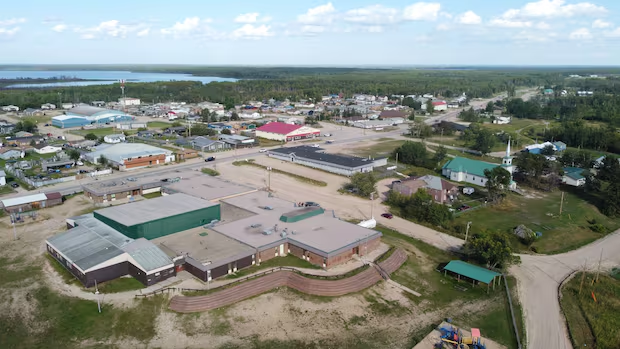
Ronald Lemaigre saw it happen while working in Fort McMurray, Alberta. He hopes it doesn’t happen in his hometown of La Loche, Sask.
Lemaigre co-owns MR Equipment & Services, which supplies equipment and maintenance to other companies working around La Loche and the province’s northwest region.
In Fort McMurray, he saw established companies partner with Indigenous-owned entrepreneurs just to bid on contracts, without much consideration for building a sustainable business, he says.
“I call them rent-a-feathers,” said Lemaigre, a member of Clearwater River Dene Nation, which is a short drive north of La Loche.
“It’s usually bigger companies looking at people like me to stamp their logo on and go, ‘Here’s a little percentage of what we’re making.'”
Construction is underway at NexGen Energy’s Rook 1 uranium mine and mill project north of La Loche, while Paladin Canada is applying for a licence to build its own uranium mine and mill, also north of La Loche in the southwestern Athabasca Basin.
NexGen expects to spend $2.2 billion over the four-year construction phase of its Rook 1 project, which could be one of the world’s largest new sources of uranium.
With other exploration work and construction projects in the region, some locals see a once-in-a-generation opportunity to grow into a regional economic powerhouse. But unlike in the past, people want to build a community — better infrastructure, a better quality of life — that outlasts the boom and bust cycles of a resource economy.
 Ronald Lemaigre co-owns MR Equipment and Services in La Loche. Aug. 26, 2026. (Jeremy Warren/CBC)
For Lemaigre, that starts with supporting and growing existing and new businesses created by local entrepreneurs.
“I would rather see communities from the north with established businesses that can keep people employed in the future even if these mines move on,” Lemaigre said.
“That’d be amazing if that’s what’s possible from all this, not just rent-a-feathers.”
That’s what Nicholas Herman set out to do when he started Stratton Group Development Corporation about three years ago.
The company provides safety consulting and training and recently signed an MOU with Northlands College to expand its offerings, but Herman also has his eye on bigger projects, like establishing an animal clinic and an addictions rehabilitation centre in La Loche.
“These are my neighbours, my family and my friends. I’ve always had a vision for the region,” said Herman, a member of Clearwater River Dene Nation.
In late August, Herman was busy organizing the Northern Horizons Summit, an economic conference happening Sept. 29 at the Robbie Fontaine Memorial Arena. He also sees a generational opportunity to build up the community and help a lot of people.
 Nicholas Herman owns Stratton Group Development Corp. in La Loche. Aug. 26, 2026. (CBC/Jeremy Warren)
“What I’m hoping for the region is to build brand new services that have never been here before, and that’s something we’re working towards every day,” Herman said.
“We can’t solely rely on one company, no matter how big of a project it is. There are multiple streams people can participate in.”
Herman said NexGen has done a good job investing in the region because regulations and expectations for mining companies are much different now compared to the days of Cluff Lake, the now-decommissioned uranium mine also north of La Loche.
How big is the opportunity?
Construction of the mine and mill started this year, including surface earthwork and an expansion of the site’s airstrip. Shaft development is slated to start next year, and commercial production could start in 2030.
The company estimates the mine could produce up to 30 million pounds (over 13,000 tonnes) of uranium annually, or around 20 per cent of the current global supply, and create 459 full-time jobs during its estimated 24-year life span.
 An aerial view of the NexGen Rook I uranium mine and mill currently being built north of La Loche, Sask., Aug. 27, 2026. (Don Somers/CBC)
There’s a lot of contracting work to be had, both for local businesses and across the province. There’s also spin-off projects, like the 59-bed hotel in La Loche that is being built under a partnership between NexGen, Clearwater River Dene Nation and Métis Nation—Saskatchewan Local 39.
Dale Petit started his business when Highway 956 opened in 1999. Sometimes called Garson Lake Road, the highway runs between La Loche and the provincial border, but remains unfinished on the Alberta side.
“That was my main road. I was grading for just about 19 years,” Petit said during an interview at his home in La Loche. “From there I’ve done other odd things, different contracting like some brush clearing.”
Last year, his company, Petit’s Grading and Contracting, started working with Clearwater Clearlake Métis Ventures, which is owned by the Métis Nation locals in the region. Petit was contracted to supply one grader and an operator to the NexGen mine site.
“There’s a fair amount of people who want to start a business and get involved, but some of them do shy away when they realize it’s more than just buying a piece of machinery or sending a labourer up there,” Petit said.
Companies and Indigenous organizations could help with organizing workshops to help local entrepreneurs navigate the strict regulations and bidding processes, Petit said.
“They have the opportunity but they don’t have the qualifications to bid on a lot of these jobs and understand what a bidding process is,” Petit said.
 Dale Petit owns Petit’s Grading and Contracting in La Loche. Aug. 26, 2026. (Jeremy Warren/CBC)
He knows people who have bought old machinery hoping to bid on contracts, only to find out the equipment doesn’t meet requirements.
“Times have changed from the past where you’d bid on a job to go cut five trees down, you’d just start up your chainsaw and away you went and cut those five trees down,” Petit said. “Now you have to have all your PPE [personal protective equipment], you gotta be certified and have your liability insurance.”
Which communities are affected?
NexGen secured endorsements from Indigenous communities that are close to or have traditional territory affected by the mine, signing benefit agreements with Clearwater River Dene Nation, Birch Narrows Dene Nation, Buffalo River Dene Nation and Métis Nation—Saskatchewan (MNS).
Details of the agreements are confidential but they typically include employment and training guarantees, environmental protections, royalty payments and contracts for locally-owned and Indigenous businesses.
In 2023, MNS called its deal with NexGen the “largest Métis impact and benefit agreement in Canadian history.”
WATCH | Drone footage progress of mine construction:
A bird’s eye view of construction underway at NexGen’s uranium mine
Construction is underway at NexGen Energy’s Rook 1 uranium mine and mill project north of La Loche.
Municipalities in the region also want to get a deal done with NexGen, but haven’t secured any agreements yet. The Village of Buffalo Narrows is hosting the Northwest Economic Summit in October and is looking to establish a regional economic development board to deal with all of the projects happening in the area.
Mayor Shaylee Gardiner said she’s hoping to secure more training for the Buffalo Narrows volunteer fire department, help with road maintenance and other infrastructure and environmental protections for local trappers and hunters.
“We should all be benefiting. I admire what they’ve done so far, but they need to sit down with municipalities,” Gardiner said.
“So many things can go wrong if we’re not prepared … We could have a uranium spill. They’re hauling chemicals. There’s no other way to get to the mine but through the Buffalo Narrows.”
 The future site of the shaft to the underground uranium mine NexGen is building north of La Loche, Sask., Aug. 27, 2026. (CBC/Don Somers)
The Village of La Loche, which also has not signed a benefit agreement with NexGen, did not respond to CBC’s interview requests.
In a statement, a NexGen spokesperson said the company has worked with Indigenous communities in the region since 2013 and cited its benefit agreements with the three First Nations and MN—S.
“Residents of the local municipalities are predominantly members and citizens of these Nations and are represented through their respective agreements,” the statement said.
It detailed some of the investments NexGen has made in La Loche, including student scholarships, a breakfast program in schools, playground upgrades and athletic sponsorships.
Clearwater River Dene Nation has established a checkstop on the road heading out of the reserve toward the mine, the only road access to the NexGen site. The First Nation said it wants to keep tabs on all of the vehicles and people coming through for exploration and construction.
That’s one way communities are dealing with unprecedented economic activity in the region.
Herman sees economic development as a way to improve the quality of life for everyone in La Loche, not just those working for the mine. An addictions recovery centre would help, he said.
“As somebody who’s lived here his entire life and had past experiences with addictions, it is something that is dear to me,” Herman said.
“Jobs are great. Jobs help stimulate the economy. But when people are hurting and suffering from addiction, it’s hard to retain a worker struggling with their own battles.”
Lemaigre agrees that more addictions and mental health resources are needed as the community is set to grow.
“Even if you have a good job and you’re making a lot of money, if your mental state at home is not up to par, then it’s not worth it,” Lemairgre said. “It’s gotta work hand in hand.”