
Open this photo in gallery:
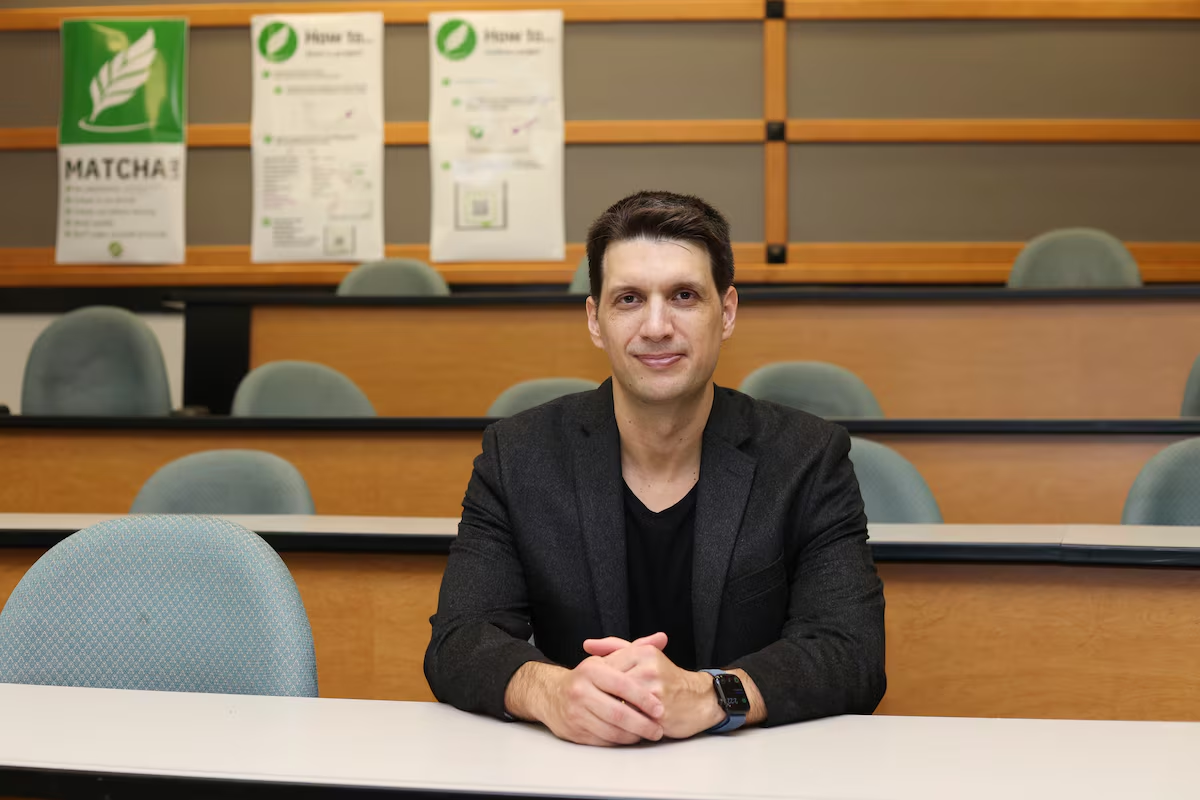
Associate professor David Bourget created a program called MATCHA, designed as a walled garden in which users can access word processors and online research materials but not AI tools, for students in a second-year course.Nicole Osborne/The Globe and Mail
As the fall semester begins at universities across Canada, professors are grappling with a fundamental challenge of the artificial-intelligence era: How do you assess students when cheating has never been simpler?
Research essays and other take-home written assignments can be conjured from thin air with a prompt to Claude or ChatGPT.
And ferreting out such subterfuge is hard because many Canadian universities forbid or discourage professors from using AI-detection software, said Mark Daley, the chief AI officer at Western University in London.
“We ban the use of AI detectors as unethical because they’re not 100 per cent accurate,” Prof. Daley explained, referring to Western’s policy.
Opinion: Universities should stop treating AI as a cheating problem
When cheating is easy and cheaters can’t easily be caught, instructors must get creative. Here is how four professors in different fields at one university are remaking their assignments for the new AI reality.
An AI-free computer lab
For the past few years, Western University philosophy professor David Bourget tried to assign essays that were AI-resistant. He asked narrow questions and picked obscure readings that, as far as he knows, stumped early versions of ChatGPT.
But as large language models (LLMs) improved, “all of these techniques stopped working,” Prof. Bourget said. “Then I had to turn around and, like everybody else, rethink how I do things.”
This year, he is running a pilot project where about 130 students enrolled in Introduction to the Philosophy of Mind, a second-year course, will research and write essays in an on-campus computer lab under the watchful eye of a teaching assistant.
Students will bring their own laptops. The supervisors, using QR codes on their phones, will sign the students in to external servers for MATCHA, a software program that Prof. Bourget designed as a walled garden in which users can access word processors and online research materials but not AI tools.
The program, which stands for Modern Authoring Tool for Certified Human Authorship, has other features that record the work that goes into producing an essay, including research notes, early drafts and edits. Prof. Bourget co-founded a company to license the program.
The supervised nature of the lab keeps students from using AI on a secondary device, such as a phone, and typing the results into MATCHA.
As a bonus, the lab will bring students and their teaching assistants together for what would otherwise be a virtual course. Prof. Bourget will be delivering his lectures online.
“My goal,” he said, “is to make cheating hard again.”
A return to pen and paper
Selma Purac, the undergraduate program chair at Western’s Faculty of Information and Media Studies, realized the traditional essay was in peril in the fall of 2023, less than a year after the launch of ChatGPT.
She was marking a batch of 40 papers for a mass communication class she had taught for years. Thirty of the essays were remarkably similar. They read nothing like the student writing she was used to grading. Twenty-eight employed a word that Prof. Purac had never seen in a student essay, one she now recognizes as a favourite of ChatGPT’s. (She declined to reveal the word, saying she’d rather not give away the AI tell.)
Prof. Purac didn’t want to abandon essays. Writing them taught her students to read critically, develop strong arguments and find their voices. “But those skills were being degraded by the way in which my students were using LLMs,” she said.
Instead, Prof. Purac decided to reimagine the essay. Two years ago, she started breaking down her assignments into worksheets. She gave her students time outside of class to conduct research and outline their arguments, including pulling direct quotes from source material. Then, she had them write their essays in class with pen, paper, their worksheets and supervision.
For example, in her third-year course, Children, Advertising and Consumer Culture, she had for years assigned a close reading of an advertisement.
Opinion: The cheating generation is asking us to help them stop
Before LLMs, students selected ads and composed their assignments at home. Now, Prof. Purac distributes a three-and-a-half page worksheet, which must be completed in point form, at least three weeks in advance of a two-hour, in-class writing period.
“I really like the way it demystifies the traditional essay,” she said.
A green light for AI, with some catches
Students studying at Western’s Ivey School of Business know they’ll be expected to use AI in the workplace. So Guneet Kaur Nagpal, who teaches marketing management and digital marketing analytics to undergraduates, had to find a way to teach students to master AI without losing the ability to think critically.
Prof. Kaur Nagpal developed a marketing strategy simulation tool called plAIbook that allowed her students to use generative AI as an assistant in solving business case studies. The program caps the number of prompts students can give AI and sets strict time limits.
The tool garnered positive feedback from faculty and students after it was piloted in 10 sections of a marketing class last spring. Prof. Kaur Nagpal built it as one of Western’s Generative AI teaching fellows. She and two other professors have been seconded to the university’s Centre for Teaching and Learning for two years to develop and assess new ways of teaching with AI.
On top of developing plAIbook, Prof. Kaur Nagpal and her colleagues overhauled some classic assignments. In the pre-ChatGPT era, she gave groups of students 48 hours to compare two legacy brands and develop a marketing plan for the weaker of the two. Now she asks groups to develop marketing plans in 24 hours, using AI, for newly minted brands from sources such as the crowdfunding platform Kickstarter or the start-up incubator Y Combinator.
She also traded a week-long take-home exam for a four-hour, in-class exam with the help of AI. Unfortunately, when she quizzed students orally on the material, she discovered that some who scored well on the written final with AI couldn’t even define simple terms.
“It’s telling and it’s troubling,” she said.
Prof. Kaur Nagpal plans to increase the weight of oral tests this fall.
A generative AI free-for-all
Western history professor William Turkel was on sabbatical in the 2024-2025 academic year when he realized that generative artificial intelligence was improving at a clip that would force him and his colleagues to teach differently.
He changed the name of his third-year Digital Research Methods class to Digital Research Methods with Artificial Intelligence. He told his students to use AI as much as they liked, including as a virtual teammate for group projects.
But he warned that the standard fare spit out by an LLM would net only an average grade.
If students wanted higher marks, they would have to do something more ambitious. One example: Dispatch an LLM or multiple LLMs to comb through thousands of digitized texts at U.S. presidential libraries, and compare what American leaders said in real time about the Vietnam War to facts that emerged later in the Pentagon papers.
Prof. Turkel is also one of Western’s generative AI teaching fellows. He thinks students are better off embracing the inescapable new technology.
“How many undergrad students become professional historians? One in 100? One in 200?” he said. “The rest of them are going to workplaces where they can’t pretend AI doesn’t exist.”