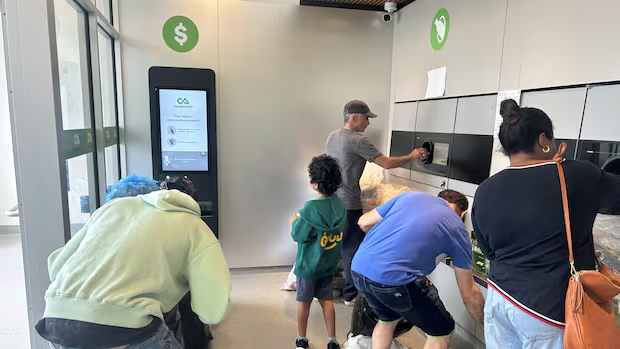
In less than three years, Consignaction changed how Quebecers return empty beverage containers and get paid for it.
With the help of the province, the company has centralized Quebec’s bottle deposit-refund system by removing thousands of return points from retailers.
Instead of using the bottle deposit machines usually found in grocery and convenience stores across the province, people can now go to two types of sorting centres: Consignaction, for single-unit returns, and Consignaction+ for bulk deposits.
Since the rollout of its first phase in 2023, Consignaction’s new system has received mixed reviews; some users love it, others, not so much.
CBC spoke with some users, waste management experts and the company behind the new system. Here’s a breakdown of what’s working and what needs improvements.
WATCH | New system receives mixed reviews:
Quebec tried to modernize its bottle recycling system. Did it work?
Two years after the creation of Consignaction sorting centres, users and experts agree that some aspects are working well, but that other issues still need to be resolved.
Long lines, limited access
Before Consignaction took over the network, empty containers could be returned to thousands of businesses participating in Quebec’s deposit-refund system.
Many of these return points, often located within walking distance to users, are now gone, and only 172 Consignaction sorting centres have opened in their place.
Karel Ménard, executive director of the Quebec Common Front for Ecological Waste Management, says that’s not nearly enough to meet the needs of Quebecers.
“We used to have around seven to eight thousand depot centres: confectionery, retail stores and so on. It wasn’t perfect, but we had a lot,” he said. “We have billions more containers but thousands less deposit centres.”
Ménard says this creates two outcomes: long lineups at centrally located return points or “access deserts” for people living in areas where a Consignaction isn’t easily accessible.
The waste management expert believes Quebec needs at least 2,000 deposit-refund centres for the system to run smoothly.
Some users like Marie Claude agree. She frequents the Consignaction location on Beaubien Street in Montreal’s Rosemont–La Petite-Patrie borough.
“The wait times are very long, some days it can take two to three hours. Only having two machines to collect containers for the entire neighbourhood is not nearly enough,” she said.
Long lines are usually caused by one of the two machines being out of service or not handing out cash. Users say both occurrences are common.Some also say it can take days or weeks to receive electronic refunds for a return.
Hiccups to be expected, Consignaction says
Consignaction says it’s listening to feedback from retailers and users, attributing most issues to hiccups with any new launch.
“This network did not exist just a bit over two years ago,” argues Jean-François Lefort, the company’s vice-president of strategy.
“Whatever happens, we address it quickly, but we just have to be aware this is a transition phase.”
Lefort points out that employees work at Consignaction + locations to facilitate the deposit process or help with broken machines.
He adds opening more locations will reduce long lines.
 Waste management expert Karel Ménard says Quebec needs at least 2,000 bottle deposit points for the system to run smoothly. There are currently 172 Consignaction sorting centres across the province. (Djeneba Dosso/CBC)
‘It’s out of money’
It might not be that simple for “binners” — people who collect cans and bottles from waste bins to earn money.
Les Valoristes Co-op, an organization supporting unhoused people who rely on the system for extra income, have noticed the new model creates barriers.
“The biggest one that always comes about is that the machine that gives money is not working, it’s out of money,” explains co-founder Marica Vazquez Tagliero, who argues supermarkets were more efficient.
“Yes, there were machines that would break here and there but they always had money. This is very important for those who collect every day and need that cash every day.”
 Consignaction created dedicated bottle drop-off centres to replace standalone machines inside businesses like grocery stores. (Djeneba Dosso/CBC)
When asked about this, Consignaction said users can either be reimbursed through their app or by receiving a redeemable coupon.
If the machine is down at one location, that coupon is still valid at other points to ensure users get their money, even if they don’t have a bank account or phone.
But Tagliero argues this extra step can be discouraging for binners who spent their night collecting cans and bottles.
“We need more machines and we need a diversity of collection systems,” she said.
Her organization created their own bottle depot made for and by binners. They’ve noticed more turnout since some return points were removed from retailers.
Out with the old, in with the new
Meanwhile, others don’t just like the new system — they prefer it.
Joseph Gonzalez and his partner made the move from returning cans at their local grocer to making deposits at the nearest Consignaction + location.
So far, the transition has been smooth.
“It’s great, it’s a lot easier than it is at the stores,” he said. “Usually at the shops, the machines would break down and there would be no staff, so it’s much nicer to have dedicated service versus rolling your luck.”
Gonzalez’s Consignaction + centre in Saint-Laurent is the latest to open, joining 171 other sites across the province.
Quebec has given Consignaction until March 2027 to open at least 400 dedicated bottle deposit facilities and 800 modernized return points inside retailers.
March 2027 is also the deadline for the final phase of the system. Consignaction will extend bottle deposits to all glass containers, including wine and spirit bottles, as well as milk and juice cartons.