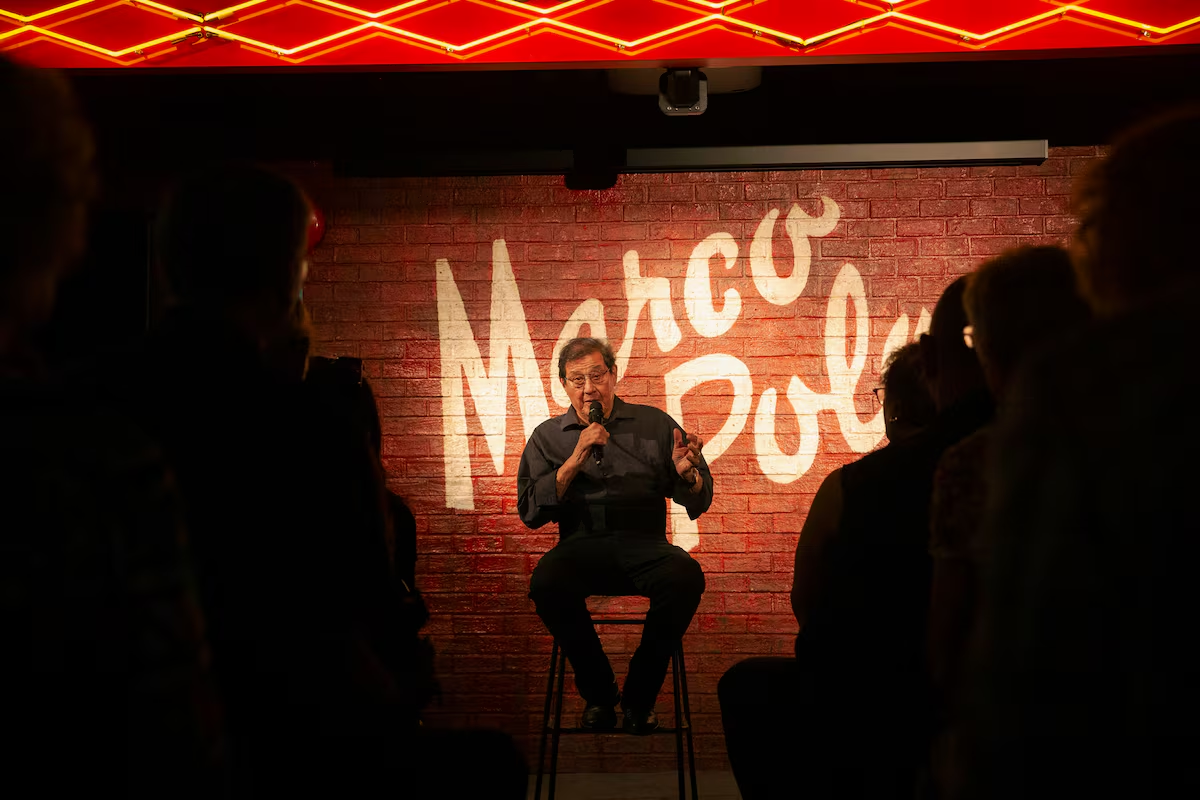

Open this photo in gallery:
Henry Young, a jazz guitarist who performed at the Marco Polo nightclub, speaks to visitors on the opening night of the Learning Lab at Vancouver’s Chinatown Storytelling Centre on June 19.Isabella Falsetti/The Globe and Mail
As Henry Young remembers it, Nina Simone was in a bad mood when she arrived at the Marco Polo theatre restaurant in Vancouver’s Chinatown that spring evening in 1968.
Ms. Simone was then nearly a decade into commercial success as a singer, composer and pianist and had just received her first Grammy nomination weeks earlier. But a series of civil-rights flashpoints in the U.S. was transforming the musician both personally and politically, turning her live performances into platforms for protest, her songs into rallying cries for justice. It sometimes made for unpredictable appearances; Ms. Simone was as likely to banter with an audience as she was to scold it.
But Mr. Young, then 25 and the house guitarist for the popular supper club, didn’t know enough about Ms. Simone to feel intimidated by her presence. Recognizing only her arresting cover of Screamin’ Jay Hawkins’s I Put a Spell On You, he asked to play a song with her.
“You don’t know my music,” Ms. Simone said tersely.
“Well, I’ve always had good pitch,” Mr. Young responded.
The young guitarist ended up sitting in for Ms. Simone’s whole set. Before sunrise, she would invite him to join her on tour.
Mr. Young, now 84, recounted the story at Marco Polo Memories, which sold out both of its June performances at the Learning Lab, which opened in May at Vancouver’s Chinatown Storytelling Centre.
Open this photo in gallery:
Visitors enjoy the opening night of the Learning Lab, the immersive exhibit that celebrates an important chapter in the history of Vancouver’s Chinatown.Isabella Falsetti/The Globe and Mail
To mark the cultural hub’s fifth anniversary, organizers transformed a 4,000-square-foot basement space into a journey to Chinatown’s heyday through recreated façades of restaurants and curio shops, and colourful neon signs that evoke the vibrancy of the neighbourhood from the 1950s through the 1980s.
Carol Lee, chair of the Vancouver Chinatown Foundation, which operates the centre, said her team had from the outset avoided calling the storytelling centre a museum so as not to focus solely on the past. While the main floor exhibits confront difficult chapters of Chinese-Canadian history – including the treacherous working conditions faced by those building the Canadian Pacific Railway and the escalating head tax and Chinese Exclusion Act – Ms. Lee also wanted to spotlight the community that emerged in the decades that followed.
“Upstairs is kind of the challenge of what we faced when we got here, but, despite that, they created a very vibrant community,” she said in an interview. “And that’s what we wanted to show with the Learning Lab: This is what we created, despite all the hardship and obstacles.”
Guests enter the space by descending a flight of stairs, under neon lights in a plum blossom motif and past walls of chipped green paint that are ubiquitous in the neighbourhood. They continue through a hallway adorned with historic Hong Kong movie posters, flyers for “authentic Chinese cuisine” and covers of the English-language Chinatown News magazine from the 1950s. Inside, digital walls and carefully curated artifacts further tell the story of what once was.
Open this photo in gallery:
The Learning Lab uses recreated storefronts and digital displays to tell stories of Vancouver’s Chinatown from the 1950s to 1980s.Isabella Falsetti/The Globe and Mail
On this June evening, Mr. Young is perched on a stool on a small stage in front of a brick wall façade bearing the Marco Polo’s retro wordmark, his audience on folding chairs. A faint smell of spring rolls wafts through the space – a snack offered to guests along with Dragon Tail Slings, the signature cocktail of the defunct nightclub. It’s an intimate setting, not unlike an old friend telling stories over dinner.
After Ms. Simone’s set, Mr. Young continued, he drove across town to his second job, starting at 2 a.m., playing guitar at an after-hours club owned by his friend and fellow musician, Tommy Chong.
“All of a sudden, the room hushed. Nina was in the crowd,” he told a rapt audience. “We played, she listened for an hour and a half and said, ‘Send him a plane ticket and a contract. I want him in New York.’”
Mr. Young ended up touring internationally with Ms. Simone for two years, on and off, including a date at Carnegie Hall.
Alex, Victor and Harry Louie – brothers from one of the region’s most successful Chinese-Canadian families – opened the Marco Polo in 1964 and operated it in Vancouver until 1982. The nightclub quickly set itself apart from the city’s other live entertainment venues with its smorgasbord buffet, yo-yo champion emcee and capacity for 500 guests.
Open this photo in gallery:
The event featured stories from members of the Louie family, known for growing one general store, opened in 1903, into a business dynasty that includes the London Drugs retail chain.Isabella Falsetti/The Globe and Mail
Despite being known as “Canada’s only Oriental nightclub,” the Marco Polo drew a diverse mix of both audiences and performers, the name itself a nod to exploration. Racial tensions at the time also kept the two other big Vancouver nightclubs from bringing in Black artists, Mr. Young recalled.
“The idea was when they brought in minority acts, like Redd Foxx and Sly and the Family Stone, they would not draw the rich Shaughnessy people they wanted,” he said, referencing a tony Vancouver neighbourhood. “So they would shoot down to the Marco Polo. Thank god, we had some good music.”
Comedian Richard Pryor and musicians the Platters and the 5th Dimension were among other acts who performed at the Marco Polo.
Karen, Jari and Mark Louie, Alex Louie’s adult children, joined Mr. Young on stage that evening and regaled the audience with childhood memories of the nightclub. Karen Louie spoke of its famous lemon chicken and whole barbecued pig, and the elaborate dragon art on the walls. She described the frantic activity in the kitchen downstairs, the clanging of utensils, hot oil sizzling at the wok stations and the line of cooks wielding meat cleavers over huge wooden blocks.
“It was marginally controlled chaos at best, and it was very noisy, but whenever we would venture down to the kitchen, the cooks would stop what they were doing and greet us like family,” Ms. Louie said, flipping through slides of photos and old menus on a projector. “And then dad would tell them to get back to work.”
Open this photo in gallery:
To mark the cultural hub’s fifth anniversary, organizers transformed a 4,000-square-foot basement space into a journey to Chinatown’s heyday.Isabella Falsetti/The Globe and Mail
Jari Louie told the crowd that preparing for the exhibit was an unexpected gift for the siblings, who, in preparation, pored through old photographs and memorabilia and swapped memories of growing up at the nightclub, “trying to approximate some kind of truth out of all of this crazy.”
“We passed these stories around like a basket of bread between us, and it was really joyful at times,” she said. “It was really hilarious at times, and at times, it was really emotional.”
The Learning Lab, accessible through a guided tour, includes a media studio and workshop space that can be used for hands-on activities. The venue can also be rented for private functions.
Beginning this month, Family Saturdays, with arts and crafts activities, will be held on the second Saturday of each month. A fifth anniversary celebration is also planned for November.
Open this photo in gallery:
Digital walls and carefully curated artifacts help tell the story of what once was.Isabella Falsetti/The Globe and Mail
Agatha Sit, archivist at the Chinatown Storytelling Centre, said the design of the space is semi-permanent, and that displays and artifacts can be periodically updated.
“We believe that archives are not to be stored, but to be seen,” she said in an interview. “And from seeing, people know.”
Ms. Lee told the crowd at the Marco Polo event that she was heartened by the response the space had received in its first few weeks of opening.
“I think that many people had forgotten about the vibrancy of Chinatown,” she said. “What we’re trying to do is show them what once was – and what we hope can be again.”