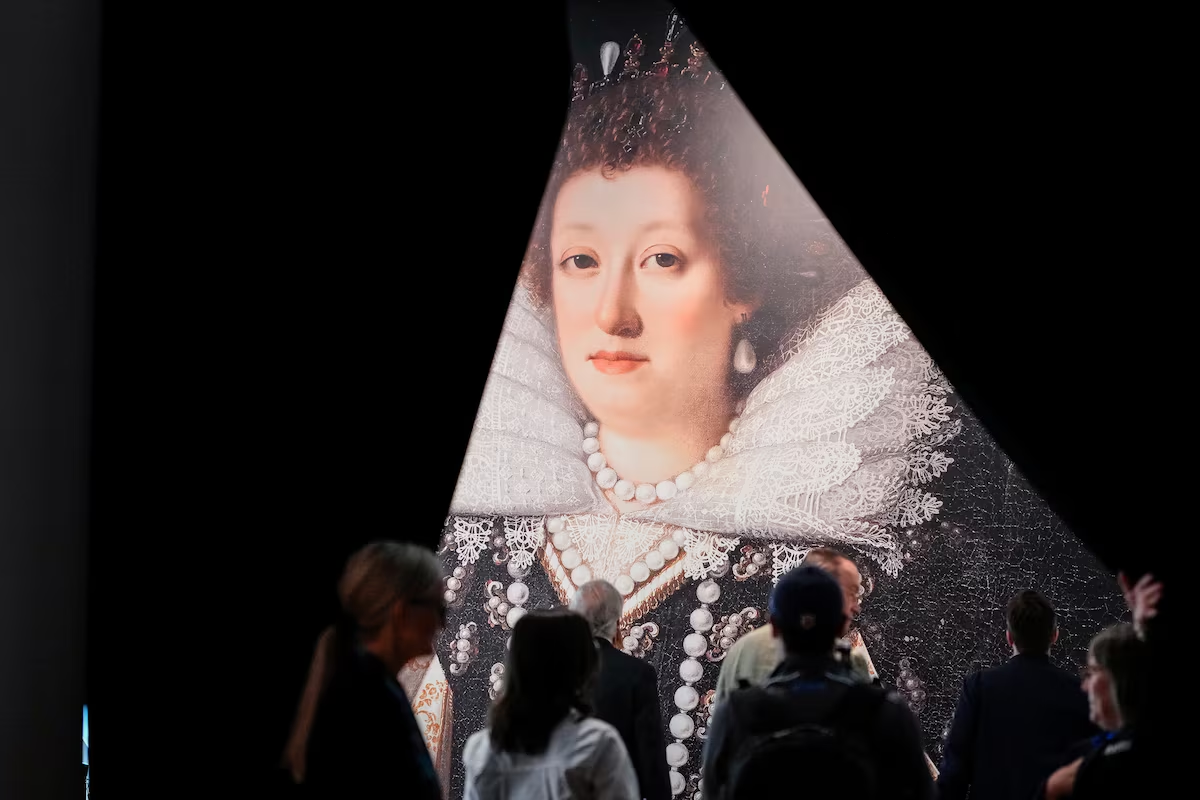

A pale yellow diamond as large as a quail’s egg. A glittering watch worn by Marie Antoinette. Rubies and emeralds fit for a coronation.
A trove of storied imperial gemstones is emerging from a cloak of secrecy and legal fog this week to go on display in Canada, the improbable country where they lay hidden for more than 80 years.
Open this photo in gallery:
A watch pictured during a presentation of the exhibition.MATHIEU BELANGER/The Globe and Mail
The Habsburg family jewels were smuggled out of Europe at the outset of the Second World War by Zita of Bourbon-Parma, Empress of Austria and Queen of Hungary, and presumed lost for decades. Only last year did her grandchildren reveal that, all along, they had been stashed in a vault in Quebec – the same province where Zita and her children sheltered during the war.
It has been a long journey for an array of jewellery that adorned Medicis and included the 137-carat Florentine Diamond, through the chaotic dissolution of the Austro-Hungarian Empire, to the Musée national des beaux-arts du Québec, where they will star in a public exhibition opening Friday.
The family wanted to display the treasures in Quebec City, the quiet Catholic government town where the former imperial family found a fitting refuge from their Nazi persecutors.
“Showing these jewels at the Musée is an expression of profound gratitude to Québec and Canada for welcoming and sheltering my grandmother and her eight children during World War II,” Karl von Habsburg, Zita’s grandson, said in a statement.
Open this photo in gallery:
Zita of Bourbon-Parma, the last Empress of Austria and Queen of Hungary.Supplied
The museum show also comes at a time when the Austrian government is awaiting the results of a commission on the legal ownership of the jewels, which it says will determine whether the modern state has a claim to the heirlooms of a family that once ruled its territory.
Last November, the remaining Habsburg grandchildren announced that the precious collection would be held in a Canadian trust with Andrew Molson, scion of the Canadian brewing dynasty, as trustee.
The family hired eminent British historian Richard Bassett to study the provenance of the jewels and he found the Florentine Diamond, among others, had always remained the personal property of the Habsburgs.
Once thought ‘lost forever,’ the Florentine Diamond was secretly tucked away in a Quebec vault for decades
Meanwhile, as the grandchildren were preparing to reveal the whereabouts of the gems, the Louvre heist in Paris last October massively heightened security concerns. Anxiety about the safety of the treasures prompted the museum to forgo publicity of its landmark exhibition until the day before its grand opening.
For all the hype around the jewels, one of the most striking exhibits on display is the flimsy suitcase Empress Zita used to carry her priceless cargo across the Atlantic – not made of cardboard, as family lore had it, but the somewhat flashier material of crocodile leather.
Open this photo in gallery:
Due to the Louvre heist in Paris last October, the museum decided to forgo publicity of its landmark exhibition until the day before its grand opening.MATHIEU BELANGER/The Globe and Mail
The great escape began in 1918 with the collapse of the Austro-Hungarian Empire after its defeat in the First World War. The newly created Austrian Republic expropriated all Habsburg property in 1919, but the family had already transported their private jewellery to the safety of Switzerland.
Empress Zita and Emperor Charles were effectively on the run, until he died of pneumonia on the Portuguese island of Madeira in 1922.
Open this photo in gallery:
The Habsburg family jewels were smuggled out of Europe at the outset of the Second World War by Zita of Bourbon-Parma.MATHIEU BELANGER/The Globe and Mail
Zita and her children wandered Europe through the interwar period, notably emerging as staunch opponents of the Nazis. In retaliation, the Luftwaffe descended on the Belgian castle where Zita had been living at the outbreak of the Second World War.
Again, the Habsburgs had already fled with their jewels, as a confluence of factors drew them to Quebec. It was Catholic, like them, and the children were already being educated in French. Canada’s government welcomed them and arranged for accommodation in the Quebec City area.
Despite their secret bounty, the Habsburgs were cash poor and lived modestly. Zita wore a widow’s black habit and made soup from dandelion leaves. The family hunted moose and went cross-country skiing. After two decades on the run, the Empress was happy.
“She felt she had some of the best times of her life in Quebec,” Karl von Habsburg said in an interview on Thursday.
Open this photo in gallery:
Presentation of the new exhibition at the Musee des Beaux-Arts in Quebec City, on Thursday.MATHIEU BELANGER/The Globe and Mail
The family eventually left Canada after the war, but the jewels remained in a Quebec vault whose location her children were sworn to keep secret until 100 years after her husband’s death.
The Florentine Diamond, especially, developed an extensive lore. After its disappearance in the 1920s, rumours spread that it had been stolen by a servant and spirited to South America. Truth was stranger than fiction: The stone was wrapped in yellowing paper inside a crocodile-skin suitcase, burrowed deep within a Canadian bank.
There are other remarkable treasures in the exhibition, including a diamond and yellow sapphire brooch that the 18th-century Habsburg ruler Maria Theresa wore on “festive sleigh rides, attached to the ribbon of her muff,” and a jewel-studded pocket watch that belonged to her daughter, the doomed Queen of France Marie Antoinette.
The Austrian culture ministry did not respond to a request for comment about the jewellery, but Karl von Habsburg dismissed any rival claims as “political chit-chat.”
Open this photo in gallery:
Last November, the remaining Habsburg grandchildren announced that the precious collection would be held in a Canadian trust with Andrew Molson, scion of the Canadian brewing dynasty, as trustee.MATHIEU BELANGER/The Globe and Mail
Jean-Luc Murray, director general of the museum, is treading more carefully. He is “conscious of questions around” ownership and has been in contact with the government of Quebec about them.
Diplomatic concerns are hardly his only stressor. The specter of the Louvre heist has prompted the museum to take extraordinary security measures whose details he would not discuss.
“It hasn’t been easy!” he acknowledged.
Then again, nothing about the saga of the Habsburg jewels ever has been.