
Open this photo in gallery:
Jim Fowler’s love for Canada is unabashed, but he was unsurprised at the tight results about separation in his riding of Rimbey—Rocky Mountain House—Sundre.Megan Albu/The Globe and Mail
Standing on his acreage near the eastern foothills of the Canadian Rockies, Jim Fowler is breathing a long sigh of relief. The 68-year-old, whose homestead is adorned with pro-unity flags, simply refused to believe that a majority of his province would ever feel the need to separate from his country.
His love for Canada is unabashed, he said, and his patriotism goes way back: His mother was one of more than 800,000 women dubbed bomb girls, who worked out of secret plants on the Allied front during the Second World War to manufacture munitions.
The Alberta referendum by the numbers
Mr. Fowler, however, lives in the west-central town of Rocky Mountain House. He knows how his neighbours and friends think; conversations with some of them have been incredibly difficult in the past few months. “We try not to talk about it too much,” he said, “but it’s been hard to escape our political differences.”
And so, despite his own convictions, he’s not surprised that his neck of the woods is one of the only two ridings in the province where a slim majority of voters supported the beginning of a legal process toward a binding secession referendum.
Open this photo in gallery:
Main Street in Rocky Mountain House, Alta. The separation question in the town’s riding saw nearly 49 per cent of votes for Alberta to remain in Canada and about 51 per cent agreeing to a second secession ballot.Megan Albu/The Globe and Mail
Provincially, 75 per cent of Albertans voted to stick with Canada. But people in the electoral district of Rimbey–Rocky Mountain House–Sundre were so split that, by final count, the difference was just 615 votes. The separation question saw 48.8 per cent of votes for Alberta to remain in Canada and 51.2 per cent agreeing to a second secession ballot.
The battle over the province’s future has led to divisiveness at dinner tables, coffee shops, schools, grocery stores, playgrounds and community centres, residents in the small municipalities that comprise the riding told The Globe and Mail. They worry, they said, that these ruptures will be lasting.
Mixed results on Alberta referendum questions highlight urban-rural divide
“Let me give you an example,” Mr. Fowler said on a sunny afternoon, just days after the referendum. “One of my friends here drove by a little while ago, pulled in, and saw my place. And he says to me, ‘I see you got those stupid Canadian flags there, eh?’ ”
He understands the impulse. “Ottawa has not been the easiest to work with or kindest to Alberta. It’s true that they don’t seem to understand our way of life,” Mr. Fowler said. “But come on, we can’t be serious about separatism being the solution to that frustration.”
Some Alberta referendum questions flip to ‘no’ as count continues
Across this rural district of around 34,000 registered electors, the idea of Alberta sovereignty is certainly not new.
With its rich farming and fur trade history, growth over the past century here has been largely propelled by oil, gas, coal and lumber. For many who supported separatism, their vote wasn’t necessarily a desire to dissolve Canadian unity altogether, they said. Instead, it served as a vehicle to voice long-standing angst over federal energy policies, equalization payments and a perceived lack of autonomy for Alberta.
“I think it’s high time we changed the status quo,” said Nichole Stewart, who runs the Lighthouse, a holistic healing centre on Rocky Mountain House’s downtown strip.
She describes her town of about 8,000 as being proud of its quietude, “especially compared to those big, louder-than-necessary cities like Edmonton.” Cozy cafés, gift shops and western-wear clothing stores line its main street. Cats roam freely in neighbourhoods. And just under 20 churches of various denominations are part of the predominantly blue-collar area.
The referendum, though, has caused deep fissures. “There’s just so much judginess now that you can’t even have an Alberta flag flying without someone needing to say something about it to you,” the 40-year-old Ms. Stewart said.
Open this photo in gallery:
Nichole Stewart decorates her business for Halloween on Main Street in Rocky Mountain House.Megan Albu/The Globe and Mail
Case in point: Shane Boniface, the mayor of Rocky Mountain House, declined an interview because he said any more commentary on the matter would create further hurdles for his community to move on from the referendum.
But for Ms. Stewart, separatism is a serious affair. Her fury toward Ottawa reached its peak amid COVID-19 lockdowns, during which she felt vaccine mandates stripped away her privacy and freedom of choice.
“I’m just so sick of just complacency all the time,” she said. “We keep sending all this money elsewhere to Ukraine and wherever, and we’re adding so much more to this country than getting back from it. I just feel like Alberta – we’re so strong on our own, we don’t really need the rest of Canada to have our own strong economy and people.”
Open this photo in gallery:
A large sign promoting Alberta independence sits on a rural property just outside of Rimbey on Oct. 21.Megan Albu/The Globe and Mail
A short drive away, past multiple anti-abortion billboards on the highway, the strife is especially palpable in the town of Rimbey – population 2,500.
Ghosts, goblins and ghouls of the inflatable and kitschy variety have quickly replaced much of the outdoor decor of many homes for Halloween after the largest electoral event in Alberta’s history. But pro-separation signs are still aplenty. They can be spotted in cul-de-sacs of single-family units, outside large ranches and even scattered haphazardly on several streets.
Opinion: Separatism’s crushing referendum loss is all upside for the Canadian economy
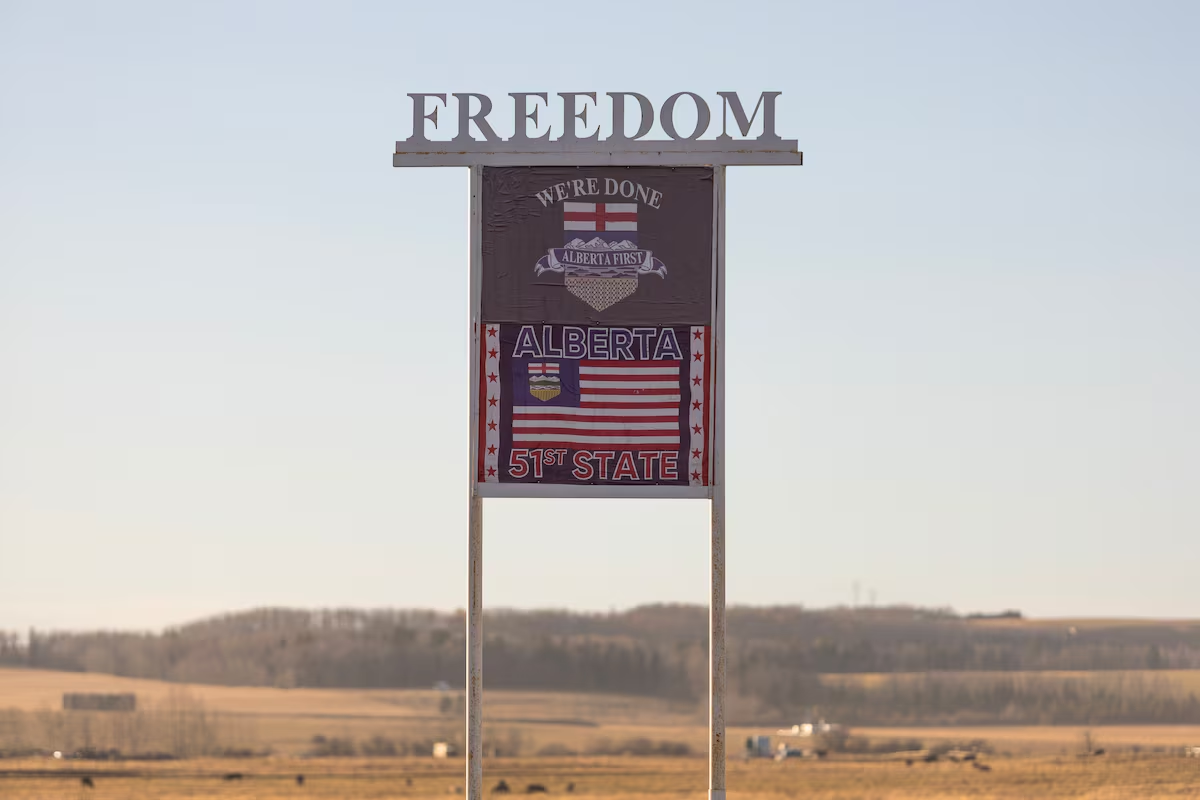
One sign in Nugent, just outside Rimbey, declares Alberta as the 51st State: “WE’RE DONE,” it boldly asserts with American insignia. In town, another hollers: “QUEBEC GOT TO VOTE, WHY CAN’T WE?”
“You have to understand, we’ve been just done by this woke agenda of the radical left and Carney’s Liberals, with all this money for left-wing causes like LGBTQ initiatives or the BLM movement,” said Ron Lapka, 56, as his wife, Sue Ceasar, also 56, nodded along.
“There’s a saying that’s attributed to Al Capone that goes: You can get more done with a kind word and a gun than you can get with a kind word alone. And when it comes to Alberta’s independence, kind words just aren’t cutting it for us any more,” he said.
Ms. Ceasar, who works as a community nurse while her husband has retired, believes most of Rimbey voted for separation. “There’s maybe just one guy there that has those unity signs,” she chuckled, pointing at a house nearby. “The rest of us are on the same page. We’re mostly home-schoolers, churchgoers and, you know, just very grassroots-oriented.”
Open this photo in gallery:
Ron Lapka and wife Sue Ceasar. Ms. Ceasar believes most of Rimbey voted for separation.Megan Albu/The Globe and Mail
In fact, there are many pro-unity signs exhibited across Rimbey. But while people in those homes were willing to explain their thinking, they said they were afraid to provide their names to The Globe out of fear of backlash from their neighbours.
John Willow was the only exception. “Everyone should have a right to express their opinion. That’s the point of democracy,” said the 59-year-old, whose Forever Canadian sign stands out in a corner filled with Independent Alberta flags.
“I just want people now to accept this result and move on with their lives. We all need to learn how to respect each other again and learn to move forward, as hard as that may be for some more than others.”